Best Infrared Camera for Electrical Inspections That Professionals Trust
Infrared cameras for electrical inspections help identify overheats, loose connections, and electrical faults before they become failures. This guide features five capable models suited for professional electricians, building inspectors, and DIY technicians seeking reliable heat imaging for electrical panels, wiring, and related systems. Each pick emphasizes clarity, accuracy, and practicality in real-world electrical inspection scenarios. Below, you’ll find concise why-to’s, best-use scenarios, and a buyer-friendly comparison to help you choose the right tool.
Product Overview: Quick Reference
| Product | Best For | Key Strength |
|---|---|---|
| AccuMEMS GT14S Thermal Imaging Camera | Electrical panels, HVAC, moving equipment | Thermometer mode plus center/hot/cold spot modes |
| HF96 Thermal Camera with AI Scene Detection | Electrical/building inspections | AI scene recognition with IntellFault |
| FOXWELL RT280 Thermal Imaging Camera | Electrical checks, mechanical diagnostics | TISR upscaling for detail |
| Tadeto Infrared Thermal Camera | Electrical/AC/HVAC inspections | Laser pointer and lighting assist |
| FLIR C3-X Compact Thermal Imaging Camera | Electrical/mechanical/building inspections | MSX visual details and WiFi |
AccuMEMS GT14S Thermal Imaging Camera

Best for professionals who want a compact tool with multiple measurement modes. The GT14S blends conventional thermal imaging with Thermometer Mode to deliver exact temperature readings on demand, useful for electrical panels, HVAC diagnostics, and mechanical inspections. Its light 240 g weight and non-slip grip support long inspection sessions, while seven color palettes offer flexible visualization. Emissivity and distance settings help improve accuracy across materials often encountered in electrical installations. Choose this if you need a dual-capability device that can both visualize heat patterns and provide spot temperature data quickly.
Limitations to consider: While versatile, some users may prefer more advanced PC analysis features found in larger systems. The device’s best advantage is real-time, on-device analysis rather than post-processing power.
HF96 Thermal Camera with AI Scene Detection

Best for inspections where quick scene awareness matters. HF96 integrates AI-driven IntellFault to automatically identify potential problem areas—such as water leaks or insulation gaps—streamlining field assessments. It combines thermometer, thermal camera, and laser pointer in one tool for efficient inspections. The live 25 Hz feed and sub-50 mK sensitivity help detect subtle thermal differences in electrical panels and HVAC systems. This model is ideal for professionals who value rapid scene-detection and real-time heat mapping. Note that moisture readings are not included, so use this device primarily for heat-based fault detection rather than humidity assessment.
Caution: While AI-assisted scene interpretation saves time, it should complement, not replace, professional judgment and on-site verification.
FOXWELL RT280 Thermal Imaging Camera

Best for electricians who need strong image clarity and PC-based analysis. The RT280 offers a 320 × 240 sensor with TISR upscaling to 240 × 180 on a 2.8″ LCD, enabling sharper visuals of electrical hotspots. Its 50° x 38° field of view and 25 Hz frame rate ensure smooth, detailed images for electrical inspections, mechanical diagnostics, and automotive checks. The device supports PC-based analysis with 2D/3D views and temperature insights, making it suitable for professionals who compile formal reports. Best choice for those who expect robust post-processing and documentation capabilities.
Limitation: Mac users may encounter compatibility restrictions with certain PC software, so plan for Windows-based workflow if that is a concern.
Tadeto Infrared Thermal Camera

Best for thorough inspections where high detail and visualization aids are needed. Tadeto uses super-resolution to elevate 120 × 90 native resolution to 320 × 240, delivering clear temperature maps and enhanced detail. It includes a laser pointer and LED fill light to help you locate and verify hotspots in challenging environments. With nine standard palettes plus software-based palettes for offline analysis, this camera suits professionals who want flexible analysis and reporting workflows. Choose Tadeto when you need precise localization of heat sources and the option to perform offline analysis for documentation.
Limitation: Not all software features are Mac-compatible, so verify your operating system compatibility before purchase if you rely on Mac-based analysis tools.
FLIR C3-X Compact Thermal Imaging Camera
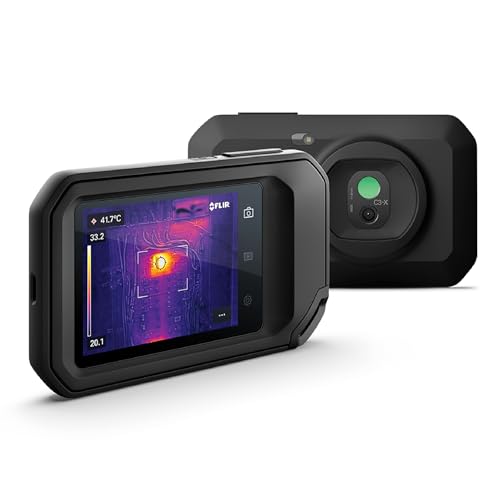
Best for versatile building and electrical inspections with easy WiFi connectivity. The C3-X delivers temperatures from -20 to 300°C (-4 to 572°F) and uses MSX technology to emboss contextual details on the thermal image, producing sharper visuals that are easier to interpret during electrical troubleshooting. Its compact design and integrated WiFi facilitate quick transfers and on-site sharing of findings. This model suits inspectors who require a portable, all-around camera with clear thermal-plus-visual fusion for faster problem localization.
Limitation: While MSX adds clarity, it hinges on the visible-spectrum image; complex electrical faults may still require targeted measurement or follow-up testing for absolute confirmation.
Buying Guide: What To Consider When Purchasing
What is your primary use case? Electrical inspections often benefit from a mix of heat visualization and precise temperature readings. If you need spot temps on-the-fly, look for Thermometer Mode or integrated temperature readouts. For broad electrical panels, ensure the device supports high-contrast visuals, good thermal sensitivity (low NETD), and adjustable emissivity for common construction materials.
Resolution and imaging performance matter. A higher effective resolution improves hotspot localization in electrical panels. Look for mid-to-high range sensors (320 × 240 or better) and frame rates around 25 Hz for stable live imaging. If you plan to document findings, consider cameras with PC analysis software or easy data export formats for reporting.
Ease of use and portability. A lightweight, balanced grip reduces fatigue during long surveys. Multiple color palettes help adapt visualization to different environments and lighting conditions. A laser pointer or spotlight can dramatically improve target identification on complex electrical assemblies.
Software and data workflow. Some models offer offline analysis software or Windows-based PC tools for advanced interpretation and report generation. Check compatibility with your operating system (Windows vs. Mac) and whether you’ll need USB or WiFi transfer for sharing images and data with clients or team members.
Durability and range. For field use, a rugged build with reliable temperature range broadens applicability—especially when inspecting electrical gear near heat sources or in unconditioned spaces. Consider emissivity settings, distance-to-target accuracy, and how well the device handles reflective surfaces common in electrical panels.
Frequently Asked Questions
- What is NETD and why does it matter for electrical inspections? NETD (noise-equivalent temperature difference) indicates thermal sensitivity. A lower NETD lets you detect smaller temperature differences, which is crucial for spotting early-stage electrical faults.
- Do I need AI scene detection for electrical work? AI scene detection helps quicken hotspot localization and anomaly spotting, but it should complement manual verification rather than replace it.
- Is MSX or Super Resolution important for electrical inspections? MSX adds contextual visual details to thermal images, aiding interpretation near electrical components. Super Resolution improves apparent detail in the image itself, helpful when inspecting small or distant targets.
- Can I use these cameras on Mac computers? Some models offer PC software that works on Windows; others provide offline analysis tools for Mac or cross-platform use. Check software compatibility before purchasing if you rely on a Mac workflow.
- What features matter most for electrical inspections? Key features include: precise temperature reading capabilities, adequate thermal sensitivity, good on-device image quality, a clear visual interface, and reliable data export for reporting.
- Should I prioritize a compact camera or a device with stronger PC analysis? If you value field portability and quick scans, a compact unit with solid on-device visuals is ideal. If you regularly generate formal reports, a device with robust PC-based analysis and data export features may be worth prioritizing.