Best Hybrid Thermal Night Vision Scopes for Real-World Stealth and Precision
Answering the demand for clear, all-weather visibility, the hybrid thermal night vision category blends thermal imaging with digital night vision to improve target detection and identification in low-light or obscured conditions. These picks are ideal for professional operators, hunters, and outdoor enthusiasts who need reliable vision across day and night. The following five products emphasize multispectral sensing, user-friendly interfaces, and practical applications such as rangefinding, ballistic correction, and helmet or weapon mounting. The table below compares core capabilities at a glance to help inform a purchase decision.
| Product | Key Benefit | Best For |
|---|---|---|
| DNT Optics TNC225R | Multispectral ThermNight with high-sensitivity 12um detector, PiP display | Compact, versatile field use; hunters and patrols |
| AGM Global Vision F14-3APW Fusion | Gen 3 White Phosphor NV combined with thermal overlay; dual-channel fusion | Low-visibility operations; tactical professionals |
| DNT Optics TNC335R | 384×288 thermal with Sony Starvis 2 sensor; ballistic rangefinding | Precision shooting; field commanders |
| DNT Optics TNC635R | 640×512 thermal with AI imaging and ballistic calculator; wide FOV | Long-range engagement; adaptable platforms |
| Fusion Thermal Vision & Digital Night Vision Goggles | 60FPS display; lightweight head/helmet mounting | Budget-conscious users; CQB and training |
DNT Optics TNC225R ThermNight Multispectral Scope

The TNC225R combines thermal and night-vision capabilities in a compact riflescope. It uses a high-sensitivity 12µm detector with 256×196 resolution and NETD under 25 mK, enabling extended detection ranges and precise identification. Sony Starvis 2 sensor support enhances low-light performance, delivering clearer imagery in mixed environments. Multispectral mode and Picture-in-Picture (PIP) allow quick switching between thermal and digital night vision to aid target recognition. Best for operators who need a portable, all-around solution for daytime and nighttime engagements.
Who it’s best for: frontline scouts, patrol officers, and hunters who require a compact multispectral scope with reliable thermal and night vision in a single device. Limitations include the reliance on electronic displays in bright daylight when thermal contrast is reduced, and the compact form factor may limit long-range stabilization on heavy rifles.
AGM Global Vision F14-3APW Fusion Tactical Monocular

The F14-3APW merges Gen 3 White Phosphor night vision with a 640×512 thermal overlay, delivering robust visibility in complete darkness, smoke, foliage, or low-contrast scenes. This dual-channel fusion supports detection, recognition, and engagement across challenging environments. Helmet-mountable and compact, it suits tactical teams and individuals who need flexibility for weapon-mounted or standalone use. Best for those prioritizing high-contrast night vision with an accompanying thermal context; better for low-light duty than for daylight-only applications.
Best for: users who require elite imaging clarity with thermal context in total darkness. Caution: the unit’s dual-channel design may add weight and require careful mounting for extended wear, and the cost is typically higher than single-channel units.
DNT Optics TNC335R ThermNight Multispectral Scope
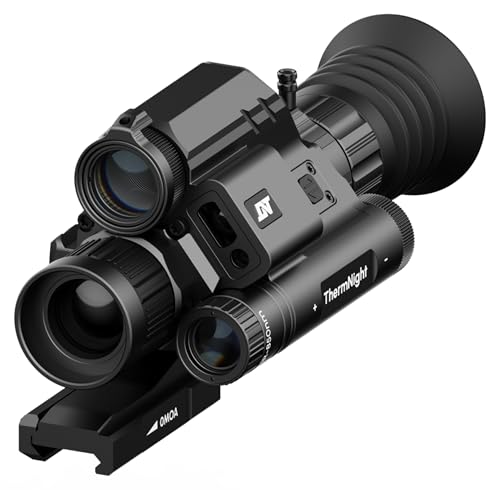
The 335R offers an excellent blend of thermal and digital night vision with a 384×288 thermal sensor and Sony Starvis 2 sensor. Its 60Hz 1920×1080 Micro-OLED display ensures crisp visuals in daylight and darkness. A built-in laser rangefinder covers 5–1200 yards and works with an onboard ballistic calculator to provide real-time corrections. AI-enhanced imaging improves clarity in tough conditions. Best for precision shooters who need quick distance data and instant ballistic adjustments, with a broader field of view for fast target acquisition.
Who should avoid: if you require ultra-lightweight gear, this model’s added electronics may add bulk, and users seeking basic functionality without ballistic features may prefer simpler options.
DNT Optics TNC635R ThermNight Multispectral Scope
The TNC635R uses a 640×512 thermal sensor paired with Sony Starvis 2 digital sensor, producing high-definition thermal and digital night images. It features a 60Hz, 1920×1080 Micro-OLED display for clear daytime and nighttime viewing. The built-in laser rangefinder ranges 5–1200 yards and couples with a ballistic calculator for immediate corrections, enabling quick dial-in or holdover. AI-enhanced imaging helps maintain sharpness in adverse conditions, while a wide FOV supports rapid target acquisition. Best for long-range operations and adaptable mounting on rifles or helmets.
Limitation: the broader feature set may require more training to utilize effectively, and higher performance comes with additional setup complexity and cost.
Night Operators Fusion Thermal Vision Goggles

These goggles provide near delay-free 60FPS display with 100m vision in night mode and 150m in thermal mode, offering a cost-effective option for entry-level users. They are designed for comfort with an adjustable rubberized head strap and support head or helmet mounting. The unit blends thermal and night vision for quick situational awareness, making it suitable for CQB training, entry scenarios, or general outdoor use. Best for budget-conscious buyers seeking a dual-mode headset without high-end ballistic features.
Limitations include a shorter detection range and a focus on everyday use rather than long-range tactical engagements, which may not satisfy high-demand operations.
Buying Guide: Hybrid Thermal Night Vision Essentials
What to prioritize: image quality vs. weight
Look for detectors with high pixel density, like 640×512 or better, and sensors with low NETD for clearer images at far distances. Weight and balance matter for long wear, especially when helmet-mounted. Consider a compact, rugged design if you intend to move quickly or mount to a weapon.
How to choose between multispectral and fusion options
Multispectral devices rely on a dedicated thermal channel plus digital night vision for identification. Fusion devices blend channels, enabling smoother transitions in challenging conditions. Choose fusion for quick recognition in total darkness; select multispectral if you favor separate control over each channel and extended battery life.
Rangefinding and ballistic support: is it worth it?
Built-in laser rangefinders and ballistic calculators are valuable for shooters who engage at variable distances. They reduce holdover errors and speed up target acquisition. If your use case involves precise shot placement, prioritize models offering reliable range performance and AI-assisted corrections.
Mounting options and platform compatibility
Helmet-mountable or weapon-mountable designs broaden use cases. Ensure compatibility with your platform and consider whether you prefer standalone operation or integrated mounting. Review included adapters, battery life, and heat management for extended sessions.
Maintenance and durability considerations
Rugged construction, weather sealing, and IP ratings contribute to reliability in harsh environments. Check user serviceability, battery replacement ease, and whether software updates are available to improve performance over time.
Short FAQ
- What is hybrid thermal night vision? It combines thermal imaging with digital night vision for better detection and identification in low light.
- Do these devices require specialized training? Basic operation is straightforward, but advanced features like ballistic calculation benefit from practice.
- Is fusion better than multispectral for hunting? Fusion provides seamless channel switching; multispectral can offer more targeted control depending on the environment.
- Can I mount these on a helmet? Many models offer helmet or weapon mounting; verify mounting hardware with each product.
- What about power and battery life? Battery life varies by model and usage; consider field-replacement options for extended sessions.
- Are these suitable for day use? Yes, most provide clear visuals in daylight, but performance is optimized for low-light and thermal conditions.