Best High Resolution Film Scanners for Preserving Old Photos and Negatives in 2026
Answering the question “which high resolution film scanner should I buy?” this guide highlights five reliable options that produce sharp digital copies from 35mm, slides, and various film formats. These scanners are best for archiving personal memories, preserving family slides, or digitizing vintage collections. Each selection targets a different priority: ease of use, screen size for on-device viewing, advanced software, or standalone operation. The table below summarizes the top picks to help you compare at a glance.
| Product | Best For | Key Benefit |
|---|---|---|
| KODAK Slide N SCAN | All-in-one ease | 5” LCD, quick feed, 22MP JPEGs |
| Magnasonic All-in-One 24MP | Versatility | HDMI output, 24MP, built-in memory |
| DIGITNOW! 135 Film Scanner | Budget standalone | SD card save, simple USB connectivity |
| Plustek OpticFilm 8300i Ai | Professional archiving | SilverFast included, high calibration tools |
| BEONEGLOBAL P5 | High detail | 24MP, large LCD, user-friendly |
KODAK Slide N SCAN Film & Slide Scanner

The KODAK Slide N SCAN is a compact, all-in-one film-and-slide digitizer designed for quick conversion of 135, 110, and 126 film formats into high-quality JPEGs. It features a 5″ LCD display for on-device viewing and editing, making it ideal for family historians who want immediate results without a computer. This model shines for users who want to preview and share images in real time with minimal setup.
Best for: casual collectors, families digitizing a large slide collection, and beginners who prioritize a built-in screen and simple workflow. The 5″ LCD display and continuous-loading tray enable fast scanning of multiple frames with minimal handling. A potential limitation is that the device relies on SD storage (not included) and may require a separate card for larger libraries.
Magnasonic All-in-One 24MP Film Scanner

The Magnasonic 24MP scanner supports 35mm, 110, 126, and Super 8 film, plus 135/126/110 slides. It offers built-in memory and an SD card slot up to 128GB, plus a 5″ LCD for immediate review and an HDMI output for larger displays. This model is strong for small to medium archives where a single device handles multiple film types and direct viewing on a TV is useful.
Best for: users who need broad format compatibility and a simple, standalone device with easy sharing to a TV or monitor. It’s a solid pick if you want a single scanner to cover mixed media. Limitation: performance can vary on more demanding color-correction needs, and higher-end software features are not included.
DIGITNOW! 135 Film Negative Scanner

The DIGITNOW! 135 Film Negative Scanner provides a budget-friendly, stand-alone option that converts 35mm film and slides to JPEG on an SD card (up to 32GB) or a computer via USB. It uses 1800 DPI for high-resolution scans and includes a rapid slide feeder for faster throughput. It’s suitable for those digitizing smaller collections or starting a digitization project on a tight budget.
Best for: hobbyists with smaller archives who want a simple, affordable device with a quick feeder. Choose this if you prefer no computer dependence and straightforward file transfer. Limitation: resolution at 1800 DPI may be lower than premium models, impacting very fine detail in tiny slides.
Plustek OpticFilm 8300i Ai
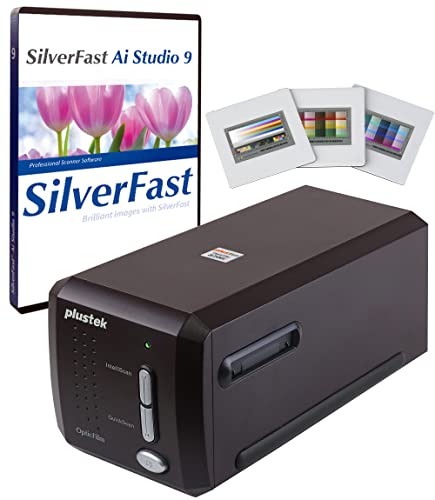
The Plustek OpticFilm 8300i Ai is a professional-grade film scanner designed for serious archiving. It supports 35mm film and slides and is bundled with SilverFast Ai Studio software and QuickScan Plus. It emphasizes color accuracy and advanced calibration, including IT8 targets. This model suits readers who want precise color control and robust workflow integration for archiving large collections.
Best for: archivists and photographers who need reliable calibration, high-quality scans, and strong software support. Limitation: higher price and a steeper learning curve compared with entry-level scanners.
BEONEGLOBAL ClearScan P5

The BEONEGLOBAL ClearScan P5 offers a 24MP CMOS-based scan with a 5″ LCD for immediate preview and editing. It emphasizes high-resolution capture of 35mm/135/126/110/Super 8 film and slides with a user-friendly interface and quick JPEG conversion. The on-device display supports quick verification before saving.
Best for: users who want high-detail scans on a dedicated device with a straightforward, ergonomic interface. Limitation: while feature-rich, it may not include the advanced calibration tools found in higher-end models.
Buying Guide: Choosing the Right High-Resolution Film Scanner
What formats do you plan to scan? Some scanners handle 35mm and slides only, while others support multiple film formats including Super 8 and 8mm. Decide based on your existing collection and future needs.
Do you prefer a built-in screen or computer-based workflow? Cameras and displays differ in how you review images. Built-in LCDs are convenient for quick checks, while computer-connected scanners often offer more advanced editing and color management.
Is standalone operation important? If you want a single device with memory and card slots, consider models with internal storage or SD compatibility. For multi-device work, ensure USB or HDMI outputs for external displays.
How important is color accuracy? Professional archiving benefits from calibrated software and IT8 targets. If precise color rendering matters, look for bundled software or calibration tools.
What’s your tolerance for cost and complexity? Entry-level scanners are affordable and simple but may sacrifice some fine detail. Higher-end models offer better calibration, workflow options, and image quality at a higher price.
Storage and expansion: Check SD card compatibility and whether the scanner can handle large libraries. Longer-term archiving benefits from reliable file formats and clear naming conventions.
FAQ
- What resolution should I expect from these scanners? Most models reach between 18 MP and 24 MP-equivalent outputs, with some claiming higher theoretical resolutions. Actual results depend on film quality and scanning settings.
- Do these scanners require a computer? Some are standalone with built-in displays and memory, while others connect to a computer via USB for processing and saving files.
- Can I scan Super 8 film with these devices? A subset of models supports Super 8 or 8mm formats; verify format compatibility before purchase.
- Is software included for color calibration? Higher-end options often bundle advanced software or calibration targets, which help achieve accurate color reproduction.
- What should I consider for large archives? Look for models with fast feeders, reliable storage options, and strong software support to streamline bulk digitization.
- Are these devices easy for beginners? Entry-level devices emphasize simplicity and straightforward operation, while professional models require more setup and knowledge.