Best Global Shutter Video Cameras for High-Speed Capture
When you need crisp, motion-free footage of fast-moving subjects, a global shutter camera is essential. This guide highlights five top picks that balance high frame rates, adjustable lenses, and USB or PC integration. These options suit analysts, hobbyists, and professionals who need reliable, distortion-free imaging for golf swing analysis, machine vision, or slow-motion review. Below, find quick-fit profiles and a buyer’s table to compare core specs at a glance.
| Product | Key Strength | Best For |
|---|---|---|
| IFWATER Global Shutter 90fps USB Camera | 90fps, 5-50mm varifocal lens | Golf swing analysis and rapid-motion capture |
| ELP Global Shutter USB Webcam 1080P 90fps | High-speed 90fps, 5-50mm varifocal | Creative projects and laptop use with adjustable zoom |
| QILOVE Global Shutter USB Camera (Monochrome) | 120-640fps modes, 2.8-12mm CS lens | Extreme slow-motion and high-speed analytics |
| Arducam 100fps Mono Global Shutter USB Camera | Monochrome, 1MP, external trigger support | Precise timing and machine-vision tasks |
| QILOVE Global Shutter USB Camera (Monochrome) | 120-640fps modes, 5-50mm CS lens | Flexible observation at distance and detailed motion |
Note: all products are USB-based, designed for laptops, PCs, Raspberry Pi, and Linux/Windows/Mac environments. Each option emphasizes minimizing rolling shutter artifacts and maximizing frame-rate options to suit fast-motion analysis and industrial vision tasks.
IFWATER Global Shutter 90fps USB Camera
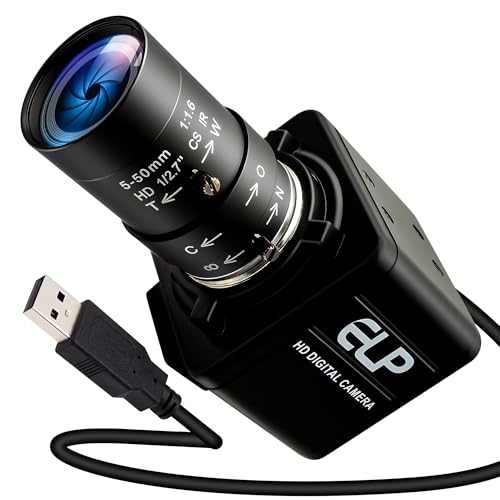
Global Shutter 90fps High Speed Camera with a 5-50mm varifocal lens offers 10x optical zoom. It uses a standard UVC protocol, requiring no extra drivers for quick plug-and-play setup on laptops, Android devices, and Raspberry Pi. Best for: golf swing analysis and high-speed equipment monitoring where quick frame updates matter most. Limitation: while versatile, the 90fps ceiling may be outpaced for ultra-fast industrial processes requiring higher frame rates.
ELP Global Shutter USB Webcam – 1080P 90fps

Global shutter with 2MP HD resolution supports 90fps at 1080p, and features a 5-50mm varifocal lens for distance adjustments. Best for: laptop-based workflows and high-speed scenes where precise focus is needed across varying distances. Caution: ensure software can support the higher frame-rate mode and confirm compatibility with your OS before purchase.
QILOVE Global Shutter USB Camera – Monochrome, 800P

This monochrome USB camera offers ultra-high speed recording up to 640fps in 120/210/420/640fps modes with a 2.8-12mm CS-mount lens providing 4x optical zoom. Best for: high-speed mechanics, fluid dynamics, and ballistic tracking where contrast matters in low light. Limitation: monochrome sensor may not suit all color-based analysis projects.
Arducam 100fps Mono Global Shutter USB Camera

Based on the OV9281 monochrome global shutter sensor, this camera delivers up to 100fps (MJPG) at 1280×800 and includes external trigger ports for precise timing. Best for: industrial PC camera applications, QR/barcode scanning setups, and situations requiring triggering. Caution: software may require adjustment to achieve higher frame-rate expectations; confirm trigger compatibility with your system.
QILOVE Global Shutter USB Camera – Monochrome, 800P

Monochrome camera with 5-50mm CS lens provides 120-640fps in multiple modes and 10x optical zoom. Best for: flexible, distance-variant observation and fast process analysis. Choose this if you need longer focal reach and adjustable focal length in a monochrome format. Limitation: color imaging is not available in this monochrome model.
Buying Guide
- Global shutter vs. rolling shutter: Global shutter eliminates motion artifacts in fast scenes, making it essential for sports analysis and mechanical motion capture.
- Frame rate requirements: For golf swing or high-speed machinery, prioritize models offering 90fps or higher. Consider 640fps options for extreme motion but verify practical usability and software support.
- Lens flexibility: Varifocal and CS-mount lenses provide adjustable focal length and better framing without swapping lenses. Match lens range to your typical working distance.
- Interface and compatibility: USB-based cameras with UVC support offer quick plug-and-play setup across Windows, Mac, Linux, and Raspberry Pi. Ensure your software accepts MJPEG or YUY2 streams as needed.
- Monochrome vs. color: Monochrome sensors enhance contrast in some lighting and improve low-light sensitivity, at the cost of color data. Choose based on your analysis needs.
- Triggering and automation: External trigger support is valuable for synchronized measurements in machines and robotics. Check for trigger ports if timing precision is critical.
- Practical use case: For field or lab environments, weigh portability, power needs, and ease of integration with existing analysis workflows.
FAQ
- What is a global shutter camera best used for?
Global shutter cameras excel at capturing fast-moving subjects without motion blur or distortions, ideal for sports analysis, high-speed manufacturing, and precise motion tracking.
- Do these cameras require special software?
Most listed models use standard USB video protocols (UVC) for plug-and-play compatibility, but some features (like high frame-rate modes) may require compatible software settings.
- Is monochrome always better for high-speed capture?
Monochrome can offer higher contrast and sensitivity in certain lighting, which helps in edge detection and motion analysis. Color may be preferable when color data matters for identification.
- Can I use these cameras with Raspberry Pi?
Yes. All listed options indicate compatibility with Raspberry Pi, Windows, Mac, and Linux environments, often via UVC drivers.
- What limit should I expect with very high frame rates?
Very high frame rates often come with reduced resolution or increased data bandwidth. Verify the practical resolution at your desired frame rate and ensure your processing pipeline can handle the data rate.
- Should I choose a vari-focal lens or fixed lens?
Vari-focal lenses provide flexible framing without swapping lenses, which is beneficial for dynamic shooting distances. Fixed lenses can offer lighter setups and predictable sharpness for specific tasks.