Best Full Frame Zoom Lenses for Sony, Tamron, and Nikon in 2026
Finding the right full-frame zoom lens depends on balance between reach, speed, and weight. This guide highlights five top-rated options across popular brands, helping you pick the right glass for landscapes, portraits, events, and wildlife. Each lens offers distinct advantages in sharpness, stabilization, and color rendition, ensuring you can cover a wide range of shooting scenarios without swapping lenses. Below is a quick overview of the featured products to compare at a glance.
| Product | Brand | Key Feature | Why It Stands Out |
|---|---|---|---|
| Sony SEL2470GM E-Mount | Sony | 24-70mm, F2.8, DDSSM, G Master | Exceptional image quality and resolution across the zoom range |
| Tamron 70-300mm F/4.5-6.3 Di III RXD | Tamron | Telephoto zoom, lightweight, RXD autofocus | Portable reach for travel and wildlife with good image quality |
| Sony FE 24-105mm F4 G OSS | Sony | 24-105mm, F4, OSS stabilization | Versatile all-in-one zoom with solid stabilization |
| Tamron 70-180mm F/2.8 Di III VC VXD G2 | Tamron | 70-180mm, F2.8, VC, VXD AF | Fast, bright tele-zoom with excellent AF and stabilization |
| Sony FE 70-200mm F2.8 GM OSS II | Sony | 70-200mm, F2.8, OSS | Top-tier performance for sports and portraits |
Across systems, these lenses balance speed, aperture, and sharpness. The following sections break down each option, highlighting who benefits most from its design, and how it fits into a broader kit for full-frame photography.
Sony SEL2470GM E-Mount Lens: FE 24-70mm F2.8 G Master

The Sony SEL2470GM is a standard zoom designed for full-frame E-mount cameras. It uses Direct Drive Super Sonic wave Motor (DDSSM) for fast, quiet AF with a reliable focus hold button and smooth manual focus transition. The lens features ED and Super ED glass to deliver high texture and detail, with two aspherical elements and a precise XA element to minimize aberration and preserve resolution across the 24-70mm range. Note: It does not support image stabilization, so it pairs best with bodies that include stabilization or careful camera handling for low-light work.
Tamron 70-300mm F/4.5-6.3 Di III RXD for Sony

This Tamron telephoto zoom emphasizes portability and versatility. With 70-300mm reach and lightweight construction, it’s well suited for travel, sports, and wildlife where mobility matters. The design incorporates 15 elements in 10 groups to maintain image quality across the zoom range, enabling sharp performance and detailed rendering from mid to telephoto distances. It’s a practical option when a compact setup is a priority without sacrificing focal length flexibility.
Sony FE 24-105mm F4 G OSS Standard Zoom

The Sony FE 24-105mm F4 G OSS offers a versatile all-in-one zoom with a constant F4 opening and Optical SteadyShot stabilization. The lens uses a G-lens design with multiple aspherical and ED elements to maintain corner-to-corner sharpness. A 9-blade circular aperture helps produce pleasing bokeh for portraits, while the broad focal range makes it a reliable walkaround lens for events, travel, and everyday shooting on full-frame bodies.
Tamron 70-180mm F/2.8 Di III VC VXD G2

This Tamron G2 lens pairs a fast F/2.8 aperture with image stabilization (VC) and the new VXD focusing system for high-speed, high-precision AF suitable for stills and video. Its compact design reduces overall weight, and the optimized optical configuration minimizes aberrations while delivering strong center-to-edge sharpness. The shorter minimum focus distance at the wide end expands composition possibilities for portraits and close-up telephoto work.
Sony FE 70-200mm F2.8 GM OSS II
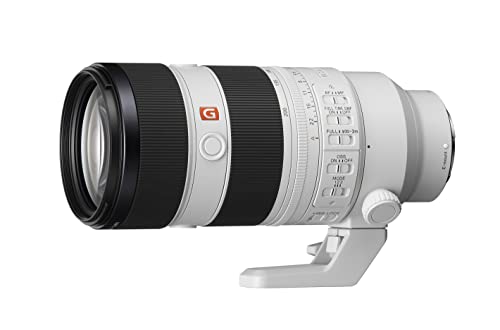
The FE 70-200mm F2.8 GM OSS II is a flagship telephoto zoom for professionals, offering superb image quality across the zoom range and distances. It combines two aspherical elements and multiple ED components to control chromatic aberration, while Sony’s Nano AR coating minimizes flare. The XD Linear Motors enable fast, precise AF, even in challenging lighting or fast-action scenarios. This lens is well-suited for sports, events, and wildlife where reach and speed are critical.
Buying Guide
Key considerations when choosing a full-frame zoom lens include aperture stability, weight, autofocus performance, stabilization, and overall sharpness across the zoom range. Here are several angles to compare:
- Constant aperture vs. variable: Lenses with a constant F2.8 or F4 provide consistent exposure and depth of field, especially in low light, but may be heavier and pricier.
- Image stabilization: OSS, VC, or built-in stabilization helps when shooting handheld, particularly in low light or at longer focal lengths.
- Autofocus speed and accuracy: Lenses with advanced AF motors (DDSSM, VXD, XD Linear Motors) deliver reliable tracking for moving subjects and video work.
- Optical design: Elements like ED, aspherical, and XA elements reduce chromatic aberration and improve edge-to-edge sharpness across the frame.
- Weight and handling: Lighter designs are ideal for travel, while professional workloads may justify heavier, rugged builds with faster autofocus.
Brand ecosystems matter too. Native lenses for Sony E-mount often provide seamless autofocus and stabilization integration with Sony bodies. Tamron’s RXD and VXD technology offers strong performance at a lighter weight, while Nikon and other brands provide built-in stabilization and different flange distances to consider when pairing with bodies.
When assembling a full-frame zoom kit, consider starting with a versatile standard zoom, then add a fast telephoto zoom for events or wildlife, and a longer-range option for portraits or distant subjects. Always verify compatibility with your camera body, especially when mixing third-party lenses with camera features like focus magnification, tracking, and aperture control.