Choosing the right full-frame wide-angle lens expands creative options for landscape, architecture, and night-sky photography. This guide focuses on five strong options for Sony E-mount and compatible full-frame setups, highlighting primes and zooms that balance sharpness, weight, and handling. Each lens below serves a distinct use case—whether you need a bright prime for low light, a versatile zoom for video, or a compact option for travel. Use the summary table to compare basics at a glance, then dive into detailed sections for practical considerations, usage notes, and capabilities.
| Product | Brand | Focal Length | Aperture | Mount |
|---|---|---|---|---|
| Sony FE 20mm F1.8 G Ultra-Wide Prime | Sony | 20mm | F1.8 | FE |
| Sony FE PZ 16-35mm F4 G Wide-Angle Power Zoom | Sony | 16-35mm | F4 | FE |
| Sony E-mount FE 24mm F1.4 GM | Sony | 24mm | F1.4 | FE |
| VILTROX 16mm F1.8 FE | VILTROX | 16mm | F1.8 | FE |
| 7artisans MF14mm F2.8 For Sony E Mount | 7artisans | 14mm | F2.8 | E Mount |
Sony FE 20mm F1.8 G Ultra-Wide Prime
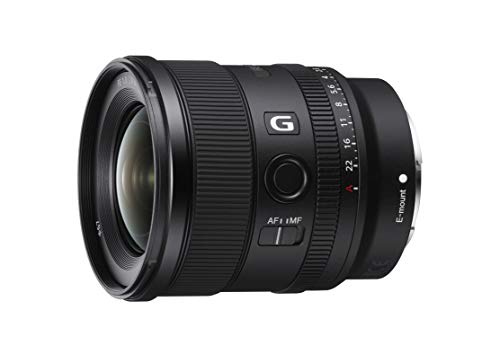
As a compact ultra-wide prime, the Sony FE 20mm F1.8 G delivers sharp, high-contrast images with a bright F1.8 aperture. The wide field of view is well suited to landscapes, architecture, and astrophotography, while the G lens design minimizes distortion and aberrations across most of the frame. Its compact, lightweight construction makes it comfortable for extended shoots on full-frame Sony bodies, and it can be used on some APS-C bodies with a 30mm equivalent field of view. This combination supports versatile image-making in tight spaces or open landscapes.
Autofocus performance is precise for stills and video, and manual focus is straightforward for critical focus pulls. The lens handles close focusing well for environmental portraits or detailing foreground textures. In low light, the F1.8 aperture helps maintain shutter speeds that reduce motion blur. Chromatic aberration is typically well controlled, contributing to clean edge definition from corner to corner. For photographers seeking a fast, compact wide-angle option, this lens offers a balanced mix of resolution, weight, and handling.
Sony FE PZ 16-35mm F4 G Wide-Angle Power Zoom
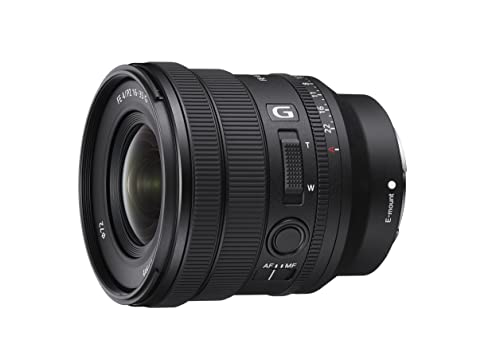
Designed as a compact, lightweight zoom, the Sony FE PZ 16-35mm F4 G combines a wide 16-35mm range with a dedicated power zoom system. The lens uses four XD Linear Motors for fast, quiet AF and smooth zoom, with minimized angle-of-view shifts during focusing or zooming, aiding stable footage. The constant F4 aperture supports video across the zoom range and helps keep exposure consistent when panning or moving. The construction emphasizes portability for run-and-gun shooting, gimbal work, and solo production teams while preserving the signature G lens rendering.
For stills, the lens provides sharpness and contrast at wide angles; for video, the focus and zoom operation is quiet. It’s especially beneficial for travelers and documentary shooters who need flexible focal lengths with a compact form.
Sony 24mm F1.4 GM: Master Wide Prime
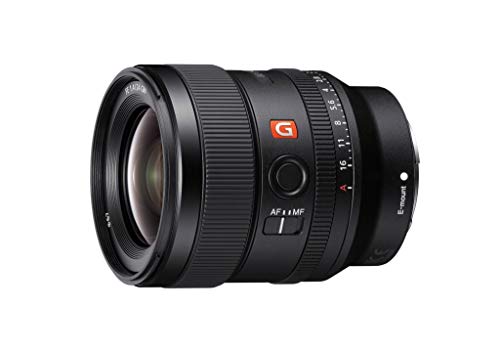
As a compact Master wide prime, the SEL24F14GM delivers exceptional sharpness, contrast, and controlled bokeh across the frame. The F1.4 maximum aperture provides dramatic subject isolation and improved low-light performance, while the G Master lineage ensures high resolution from edge to edge and smooth, natural rendering of highlights. The focal length offers a natural perspective for landscapes and street work, making it a versatile choice for general-purpose wide-angle imaging on full-frame bodies.
Autofocus performance is fast and reliable in varied lighting, and the lens handles flare well due to advanced coatings. The build is robust and designed for professional use, with weather-sealing suitable for demanding outdoor shoots. This lens suits photographers who prioritize image quality and consistent rendering across the frame.
VILTROX 16mm F1.8 FE

With a fast F1.8 aperture and a 16mm angle of view, this lens broadens the creative range for Sony E-mount users. The 16mm focal length provides expansive landscapes and interior spaces, while the built-in autofocus system, EXIF information transmission, and compact design help maintain sharpness and tracking across scenes. The lens employs a precise autofocus mechanism to support reliable subject detection and tracking in varied lighting conditions, making it suitable for documentary work, street photography, and interior shoots.
Key strengths include precise autofocus and broad coverage that suits run-and-gun filming and landscape work. The lens supports travel and urban shoots where a fast aperture aids low light and foreground separation, while the 16mm field of view captures impressive sky and architecture. Overall, optics and handling align well with portable rigs and gimbal setups.
7artisans MF14mm F2.8 For Sony E Mount
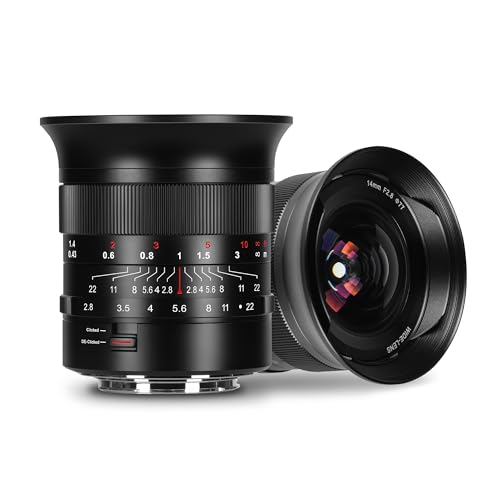
The 14mm focal length provides an expansive ultra-wide perspective for landscapes, interiors, and architecture. The lens offers manual focus for deliberate composing and a bright F2.8 aperture that helps in low-light conditions and starry-sky photography. It supports front-filter attachment, enabling ND and CPL filters for creative control on wide scenes. Designed for Sony E-mount, this lens prioritizes portability and value in an ultra-wide configuration, with a focus on creative flexibility through wide coverage and filter compatibility.
Designed for Sony E-mount, this lens prioritizes portability and value in an ultra-wide configuration. It emphasizes creative flexibility through its wide coverage and filter compatibility, while manual operation invites controlled focus decisions in architecture, interiors, and landscape shots.
Buying Guide
When selecting a full-frame wide-angle lens, balance field of view, light gathering, autofocus, and handling. Prime lenses tend to offer brighter apertures and edge-to-edge sharpness, while zooms provide framing flexibility across a range. The right choice depends on your shooting style, whether you prioritize low-light performance, video stability, or portable kits for travel.
Choosing a focal length for scenarios
The 14mm and 16mm options excel in architecture, interiors, and astrophotography, where distortion control matters and you want to frame expansive scenes. The 20mm and 24mm primes provide a more natural perspective with strong low-light capability, ideal for landscapes and environmental portraits. Zooms like the 16-35mm cover a broad range for run-and-gun shooting, delivering consistent exposure and framing without changing lenses mid-shoot.
Prime vs zoom: Trade-offs
Prime lenses deliver maximum brightness and often superior sharpness across the frame, which is valuable for night skies and low-light landscapes. They are generally lighter and more compact, aiding portability. Zooms offer flexibility to adjust composition on the fly, which is advantageous for video work or documentary shooting. However, they may have a smaller maximum aperture (such as F4 with a constant range) and can be heavier depending on design.
Video and autofocus considerations
For video work, features like quiet focus, smooth zoom, and minimal focus breathing are important. Power-zoom lenses or those with advanced AF motors (such as XD Linear Motors or STM-based systems) enable steadier gimbal work and less distracting autofocus. If your priority is still photography with occasional video, a fast prime like F1.4 or F1.8 can provide superior subject separation and shallower depth of field in low light.
Practical tips and compatibility
- Consider your camera body’s weight balance. Some wide-angle lenses can shift the center of gravity, affecting handheld stability and gimbal performance.
- Be mindful of distortion at the wide end. Some lenses show barrel distortion; RAW processing and in-camera corrections can mitigate this.
- Filter compatibility matters for wide angles. Some ultra-wide primes offer front-filter options, while others require specialized circular filters or no filters at all.
- Weather sealing and build quality vary. Professional-grade lenses often include more robust sealing, beneficial for outdoor shooting and varying climates.
- Evaluate long-term value. While third-party options tend to be cost-effective, service, warranty, and future compatibility should factor into your decision.
In short, the best full-frame wide-angle lens for you depends on your priority—fast, bright primes for low light and pristine edge-to-edge sharpness, or versatile zooms that keep you shooting without changing lenses. The five lenses covered here provide a spectrum of options across focal lengths, apertures, and price points, helping you tailor a setup to your shooting style and environment.