Best Full-Frame Telephoto Lenses for Sony and Other Full-Frame Cameras
Answer: If you’re shopping for a full-frame telephoto lens, these five options offer strong reach, solid image quality, and practical features for different shooting needs. Best for wildlife and sports, these lenses help you stay distant while capturing sharp detail. This guide compares top picks by weight, focal range, stabilization, and autofocus speed to help you choose the right lens for your camera system.
| Product | Focal Range | Best For | Key Benefit |
|---|---|---|---|
| Tamron 70-300mm F/4.5-6.3 Di III RXD for Sony | 70-300mm | Entry-level full-frame Sony shooters | Lightweight portability with solid image quality |
| Tamron 50-400mm f/4.5-6.3 Di III VC VXD | 50-400mm | Versatile all-in-one for Sony | Broad zoom range and fast AF |
| Tamron 150-500mm f/5-6.7 Di III VC VXD | 150-500mm | Long-range wildlife and sports | VC stabilization for handheld telephotos |
| Tamron 70-180mm F/2.8 Di III VC VXD G2 | 70-180mm | Portraits and events with full-frame Sony | Bright f/2.8 with advanced tracking |
| Panasonic LUMIX 70-300mm F4.5-5.6 | 70-300mm | L-Mount full-frame users | Macro capability and strong stabilization |
Tamron 70-300mm F/4.5-6.3 Di III RXD for Sony Full-Frame

Best for: Budget-conscious Sony mirrorless shooters who want a compact telephoto option without sacrificing range. This lens offers light weight for day-long shoots and easy handling for travel or fieldwork.
- Lightweight portability aids travel and handheld use.
- Image quality remains solid across its range, enabling creative framing.
- Up-close performance includes capable minimum focus distance for closer subjects.
Caution: The maximum aperture of f/4.5-6.3 can limit low-light performance compared to brighter pro zooms. Choose this if you prioritize portability over the largest possible opening.
Tamron 50-400mm f/4.5-6.3 Di III VC VXD for Sony
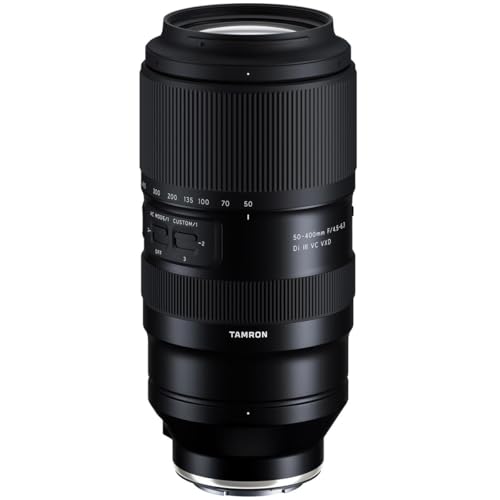
Best for: Players who want a single versatile Sony full-frame lens that covers wide to super-telephoto ranges, ideal for travel and wildlife photography in one package.
- 8x zoom ratio with a wide 50mm starting point and 400mm reach.
- Advanced elements (XLD, LD, GM, and Hybrid Aspherical) minimize chromatic and geometric aberrations.
- VXD focus mechanism delivers fast, quiet autofocus for moving subjects.
Caution: The longer end at 400mm may require stabilizing technique in handheld shots to avoid subtle shake in brighter scenes or fast action.
Tamron 150-500mm f/5-6.7 Di III VC VXD for Sony

Best for: Wildlife and distant action where reach is critical and light handling matters. Suits photographers who want long reach without a heavy setup.
- VC image stabilization supports handheld shooting at extreme telephoto lengths.
- Long reach helps capture distant subjects with clarity and minimal interference.
- Variable AF speed suits moving subjects while keeping noise and wind impact manageable.
Caution: At the maximum 500mm, subtle focus hunting can occur in low-contrast scenes; consider bracketing or bracing for steadiness.
Tamron 70-180mm F/2.8 Di III VC VXD G2 for Sony

Best for: Portraits and events where a bright constant f/2.8 is beneficial, paired with Sony full-frame bodies for sharp subject isolation and smooth bokeh.
- Constant f/2.8 aperture maintains exposure across zoom range.
- Advanced VC stabilization complements fast AF for action and handheld shooting.
- Close minimum focus distance enables working close to subjects for studio-like results outdoors.
Caution: Heavier than consumer-grade telephotos; plan for a stable setup or monopod if extended shoots are expected.
Panasonic LUMIX 70-300mm F4.5-5.6 Macro O.I.S. (L Mount)

Best for: L-Mount full-frame shooters seeking a versatile telephoto with macro-friendly capability for close-up subjects and landscapes.
- Macro capability adds close-range shooting versatility up to 0.5x max magnification at 300mm.
- Powerful stabilization helps reduce shake during long focal lengths.
- Cross-system compatibility makes it a solid choice for L-Mount cameras beyond Panasonic.
Caution: Macro performance at 300mm is subject to working distance requirements; not a substitute for dedicated macro lenses in tight close-ups.
Buying Guide: Key Considerations for Full-Frame Telephoto Lenses
- Focal range and coverage: Choose a lens that fits your typical subjects—shorter telephotos (70-300mm) for travel and portraits; longer reach (150-500mm) for wildlife.
- Aperture and low-light performance: Lenses with larger maximum apertures (e.g., f/2.8) provide better subject isolation and faster shutter speeds in dim light, but often weigh more and cost more.
- Stabilization: VC/VXD/OSS stabilization helps when shooting handheld, especially at longer focal lengths. Check the presence and effectiveness for your camera body and typical shooting distance.
- Autofocus speed and tracking: For moving subjects, fast and precise AF is essential. Look for lenses with dedicated linear motors or advanced AF systems for better tracking.
- Weight and balance: Heavier lenses require sturdy support and may affect handling on longer shoots. Consider a monopod or accessories for stability.
- Compatibility: Confirm mount compatibility with your camera system (Sony E-mount, L-Mount, etc.).
- Close-focus performance: If you shoot macro or close-ups, lenses offering macro capability or minimal focusing distance can be advantageous.
FAQ
- What is a good all-in-one telephoto zoom for travel? A versatile 50-400mm lens can cover wide and telephoto ranges in one lightweight package, reducing the need to switch lenses.
- Do telephoto lenses with stabilization help in low light? Yes, stabilization helps maintain sharpness at longer focal lengths, enabling slower shutter speeds without blur.
- Is a brighter aperture essential for wildlife? A brighter aperture (e.g., f/2.8) can improve subject separation and shutter speed, but long focal lengths with stabilization can also work well.
- When should I choose a dedicated long telephoto like 150-500mm? Choose when you need extended reach to capture distant subjects, such as wildlife or sports.
- Are macro-capable telephotos useful? If you frequently shoot close-ups, macro capability provides flexibility beyond standard telephoto use.
- What is the benefit of a fast autofocus motor? Fast AF improves accuracy for moving subjects and reduces miss-distance in action photography.