Best Full Frame Cine Lenses for Professional-Quality Video
Answering the question: which full-frame cine lenses are best for filmmakers seeking versatility, image quality, and mount flexibility? This guide highlights five strong options, including a true zoom lens and several premium primes, to cover a range of shooting scenarios from indie dramas to professional productions. Best for: videographers needing flexible focal ranges, multi-mount compatibility, and high-contrast, sharp imagery. A quick buyer’s table is provided below to compare core specs at a glance.
| Product | Mounts | Key Strength | Best For |
|---|---|---|---|
| CHIOPT Xtreme 75-250mm T3.2 | PL | Parfocal, minimal breathing, wide zoom range | Long focal-length storytelling, 8K-ready shoots |
| SIRUI VP-1 Vision Prime 1 24mm | E / RF / Z / L (interchangeable) | Fast T1.4, edge-to-edge sharpness | Guerilla-style or run-and-gun production |
| SIRUI VP-1 Vision Prime 1 50mm | E / RF / Z / L (interchangeable) | Balanced perspective, smooth bokeh | Portraits, dialogue scenes |
| DULENS Triassic Prime 25/35/50/90/120 | PL | Full set for varied coverage | Matched prime set for full-frame narratives |
| Rokinon Cine DS 85mm T1.5 | Canon EF | Color-matched DS line, fast aperture | Close-ups, shallow depth-of-field |
CHIOPT Xtreme 75-250mm T3.2 Parfocal Cine Zoom Lens

The CHIOPT Xtreme 75-250mm T3.2 is a full-frame cinema zoom designed for PL-mount cameras, delivering a versatile 3.5x zoom range from mid-telephoto to long-telephoto. It features minimal focus breathing and a 46mm image circle, ensuring sharp, distortion-free results across the entire zoom range. The 11-blade iris creates smooth, natural bokeh for cinematic depth of field control. This lens is best for narrative scenes requiring dynamic focal-length shifts and precise rack focusing. It’s a strong choice for directors who want to cover a broad range of shots without changing lenses. A potential limitation is the size and weight of a long zoom when shooting handheld or on smaller rigs.
Best for: shooters needing extensive zoom versatility in a single lens and smooth focus behavior.
Choose this if: your production demands rapid focal-length changes with minimal breathing and you shoot with full-frame PL cameras.
Caution: Heavy enough to require sturdy support and proper balancing on gimbals or cranes.
SIRUI VP-1 Vision Prime 1: 24mm

The SIRUI VP-1 Vision Prime 1 24mm full-frame cine lens emphasizes a fast T1.4 aperture, multi-mount versatility, and advanced optical elements (aspherical, ED, and HRI). It ships with a pre-installed E-mount and supports interchangeable RF/Z/L mounts for compatibility across multiple camera brands. This lens is best for wide establishing shots, interiors, and low-light scenes where a bright image with shallow depth of field is desirable. A potential limitation is that, as a prime, you’ll need to change lenses for different focal lengths.
Best for: filmmakers who need a fast, wide prime with flexible mount options.
Better for: low-light environments and shots where minimal distortion is essential.
Caution: Prime-only lens means more coverage planning for varied focal lengths.
SIRUI VP-1 Vision Prime 1: 50mm

The 50mm variant of the VP-1 Vision Prime 1 provides a balanced normal-length perspective with a similar multi-mount system and fast T1.4 aperture. Its edge-to-edge sharpness and controlled aberrations support natural skin tones and clean bokeh in mid-shots and portraits. This lens is best for narrative scenes and dialogue-heavy sequences where a natural perspective is desired. Limitation: focal length may feel restrictive in tight spaces or for establishing wide shots.
Best for: medium-shot compositions and character-driven scenes.
Better for: projects requiring consistent color and contrast across multiple cameras.
Caution: Not ideal for wide-angle interiors without stepping back or switching lenses.
DULENS Triassic Prime 5-Lens Cine Set
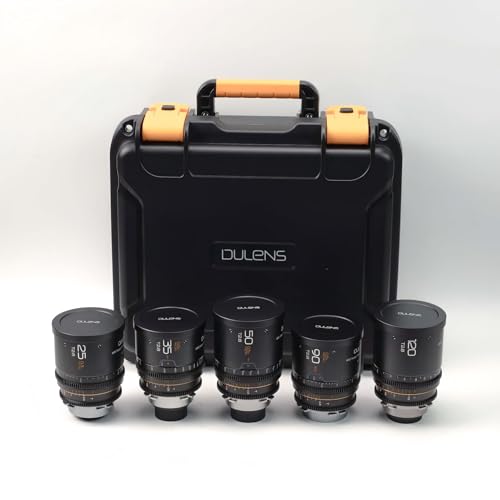
The DULENS Triassic Prime set includes five PL-mount full-frame primes: 25mm, 35mm, 50mm, 90mm, and 120mm. This complete set provides broad focal coverage for narrative cinema, enabling consistent image quality across multiple focal lengths. It is best for productions that prefer matching prime lenses to maintain color and contrast across scenes. A limitation is that the set lacks an included zoom option, so changing focal lengths requires lens swaps.
Best for: indie features or short-form productions needing a matched prime set for full-frame sensors.
Why selected: comprehensive focal coverage with PL mount supports flexible storytelling without sacrificing consistency.
Caution: Requires careful lens management and rig configuration for quick changes on set.
SIRUI VP-1 Vision Prime 1: 50mm (Metal Gray)

This variant mirrors the 50mm focal length with a rugged metal-gray finish and the same multi-mount system and optical design as the other VP-1 primes. The integration with E, RF, Z, and L mounts makes it adaptable to many camera bodies, ideal for multi-camera shoots or rental houses. Best for: productions requiring a durable prime that preserves color and contrast across cameras. Limitation: the color finish is a cosmetic variant; optical performance remains the same as the standard 50mm.
Best for: camera crews that value durability and cross-brand compatibility.
Better for: high-contrast scenes where stabilization and sharp edges are essential.
Caution: Fit and balance should be checked on lighter rigs due to added weight from the optic block.
Rokinon Cine DS DS85M-C 85mm T1.5
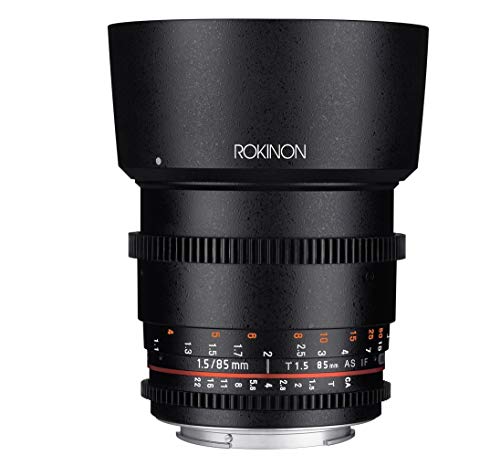
The Rokinon Cine DS 85mm T1.5 is designed for Canon EF but features the DS color-matching series and unified aperture positions across the Cine DS line. It offers full-frame coverage with a bright T1.5 aperture and a 28.3-degree field of view on full-frame cameras, making it ideal for intimate close-ups, portraits, and dramatic lighting. A limitation is that a dedicated EF mount may require adapters on newer camera bodies, which could slightly affect balance.
Best for: close-ups and character-driven scenes with strong subject isolation.
Better for: productions using Canon EF bodies or those with compatible adapters.
Caution: Verify compatibility with your camera body and accessories to avoid vignetting or balance issues.
Buying Guide: Full-Frame Cine Lenses For Your Workflow
What matters most when choosing full-frame cine lenses?
Key factors include mount compatibility, optical quality, exposure control, and ease of use on set. Multi-mount lenses save time when you switch between cameras, while fast T-stop values help in low-light conditions without excessive ISO. Consider whether you need a zoom for dynamic scenes or a matched set of primes for consistent look across shots.
Should you choose a zoom or separate primes?
A zoom like the CHIOPT Xtreme 75-250mm T3.2 provides flexibility across focal lengths without swapping lenses, making it ideal for run-and-gun production and long takes. Primes offer superior image sharpness, controlled distortions, and often better bokeh. For high-end features, combine a zoom for coverage with a few primes for specific looks.
How important is mount flexibility?
Interchangeable mounts (E, RF, Z, L) expand compatibility with a wide range of cameras. This can future-proof a lens line and simplify gear rental or multi-camera shoots. If you already own multiple camera bodies, prioritize multi-mount options.
What about image quality and color matching?
Look for edges-to-edges sharpness, minimal distortion, and chromatic aberration control. Lenses built with aspherical elements, ED glass, and high-refractive-index glass can deliver cleaner images at wide apertures. When building a multi-lens kit, prioritize color consistency across lenses to minimize grading work in post.
Size, weight, and setup time
Heavier, longer lenses require sturdy support and careful rigging. Lighter primes are easier for handheld or gimbal work, while heavier zooms may demand additional stabilization. Factor in the production style, venue, and crew experience when building your lens kit.
Practical checklist
- Confirm camera compatibility and mount options for each lens.
- Verify lens availability of required focal lengths for your project.
- Assess weight, balance, and support rig needs for each lens on your setup.
- Plan for color matching across lenses in the kit.
- Ensure protective storage and transport for sensitive optics.
Frequently asked questions
- What is a full-frame cine lens?
- Is a paro-lens necessary for professional cinema?
- Are interchangeable mounts worth it?
- How important is aperture speed?
- Should I buy a set of primes or a single zoom lens?
- What maintenance does a cine lens need?
It is a cinema lens designed to cover full-frame sensor sizes, delivering high-resolution imagery, consistent color, and precise control of focus and exposure across a wide format.
Parfocal lenses maintain focus when zooming, which benefits multi-shot sequences. Not all cine zooms are parfocal, so check the spec if you plan to zoom during takes.
Yes, if you work with multiple camera brands or rent equipment often. It saves time and reduces the need for additional lens purchases.
A wide maximum aperture (low T-stop) improves low-light performance and subject isolation. Consider T1.4–T2.0 for most narrative work.
A prime set provides uniform color and sharpness across focal lengths, while a zoom offers flexibility on set. A hybrid approach often works best for varied projects.
Regular cleaning of front elements, careful storage, and proper calibration of focus and iris rings help maintain performance over time.