Best Full Frame 35mm Lenses for Sony E-Mount: Sharp, Fast, and Travel Ready
If you’re shopping for a full-frame 35mm lens for Sony E-mount, this guide highlights the best options for different shooting styles—portraits, street, travel, and video. These lenses are ideal for photographers seeking bright apertures, compact designs, and reliable autofocus. The list below covers five strong choices, explaining who each lens suits best and why. Use the included buying guide to compare key factors like aperture, weight, weather sealing, and close-focus capability.
| Product | Best For | Key Specs |
|---|---|---|
| Sony FE 35mm f/1.8 | All-around performance, travel light | Aperture f/1.8, compact, sharp |
| Tamron 35mm f/2.8 Di III OSD | Ultra-compact travel, budget-friendly | Lightweight, good macro support |
| Samyang 35mm f/1.8 | Video and low-light versatility | Quiet AF, weather-sealed options, sharp |
| Rokinon AF 35mm f/1.8 | Travel and portraits | Fast AF, lightweight, edge-to-edge clarity |
| VILTROX 35mm F1.8 II EVO APO | High-contrast colors, APO performance | APO design, bright, close focus |
Sony FE 35mm F1.8 Lens For Sony E
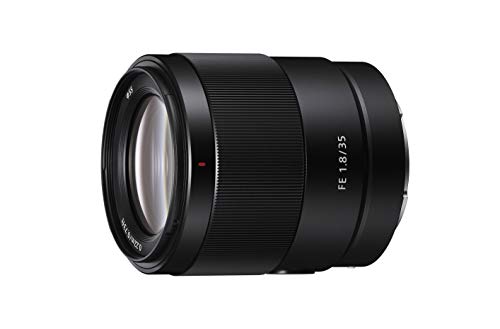
The Sony FE 35mm f/1.8 is a compact, lightweight option built for all-day shooting. Its bright f/1.8 aperture supports low-light work and smooth bokeh, while an aspherical element helps reduce aberrations for sharp corners. Best for street photographers and travelers who need an unobtrusive lens with solid image quality.
Who it’s best for: Everyday shooters who want a portable, high-quality prime for portraits and landscapes.
Why selected: Combines portability with reliable sharpness and color, a strong baseline for Sony E-mount systems.
Caution: Edge performance can soften slightly wide open; stopping down improves sharpness in busy scenes.
Tamron 35mm f/2.8 Di III OSD M1:2

The Tamron 35mm f/2.8 Di III OSD M1:2 is praised for its ultra-compact design. It offers a near 1:2 macro reproduction, enabling close focusing and creative compositions without adding bulk. This lens suits travelers and vloggers who want a lightweight prime with decent macro capability.
Who it’s best for: Travel photographers and street shooters who prioritize size and macro options.
Why selected: Notable for its balance of size, weight, and macro performance in a full-frame prime.
Caution: Autofocus can be less aggressive in dim light; consider brighter scenes or gentle focus pulls for video work.
Samyang 35mm F1.8 Auto Focus For Sony E

The Samyang 35mm F1.8 uses a silent STM motor and internal focusing for smooth AF performance. Its 10-element design aims to deliver edge-to-edge clarity with a bright F1.8 aperture for cinematic low-light capture. Ideal for video and street photography where quiet operation matters.
Who it’s best for: Videographers and street shooters who need quiet AF with reliable depth and color.
Why selected: Combines quiet AF with a robust optical design to minimize focus breathing and maintain image quality.
Caution: Some users may notice slight field curvature in high-contrast scenes; stopping down can help overall sharpness.
VILTROX 35mm F1.8 II EVO APO

The VILTROX 35mm F1.8 II EVO APO emphasizes an APO design with 13/10 elements, including 2ED, 3HR, and 1UA, to deliver sharp details and accurate color. The bright F/1.8 aperture is advantageous in low light, and a 0.34m minimum focusing distance helps capture fine close-up details. Best for photographers who want strong color accuracy and macro-like close focus in a compact form.
Who it’s best for: Imaging enthusiasts who value chromatic aberration control and close-focus usefulness.
Why selected: APO design and bright aperture provide distinctive color fidelity and subject separation.
Caution: Heavier than some ultra-compact primes; may be less ideal for long-day travel without a bag.
Buying Guide: How To Choose Your 35mm Full-Frame Lens
- Aperture needs: Choose f/1.8 for low light and shallow depth of field; f/2.8 or smaller is acceptable for daylight and sharp landscape work.
- Autofocus performance: Video users benefit from quiet, fast AF (STM or linear AF). For stills, reliable AF helps in street photography and events.
- Weight and size: Ultra-compact lenses are ideal for travel and street shooting, while slightly larger lenses may offer better optical performance.
- Close-focus distance: If macro-like capability matters, check minimum focusing distance to frame small subjects up close.
- Weather sealing: For outdoor use, weather sealing adds resilience against dust and moisture; consider if you shoot in varied conditions.
- Optical design: APO or extra-low dispersion elements reduce chromatic aberration and color fringing, improving color accuracy across the frame.
Frequently Asked Questions
- Is a faster lens always better for low light? A faster aperture (lower f-number) lets in more light, improving low-light performance, but consider size, weight, and AF performance as well.
- Do I need weather sealing on a 35mm prime? Weather sealing is beneficial if you shoot outdoors in varied conditions; it’s not mandatory for most indoor photography scenarios.
- Which 35mm lens is best for portraits on Sony E-mount? Lenses with wide apertures (f/1.8 or faster) provide better subject isolation and pleasing bokeh, ideal for portrait work.
- Should I choose a compact lens over a heavier APO design? If portability is priority and you don’t mind slightly less edge-to-edge sharpness, choose compact; otherwise APO designs offer improved color accuracy.
- Is 35mm a good all-around focal length for Sony full-frame? Yes, it offers a natural perspective close to human vision, suitable for landscapes, street, and general photography.
- Do these lenses work on Sony’s newer camera models? All listed lenses are designed for Sony E-mount full-frame bodies and should function across current and newer models with standard AF behavior.