Best Focal Reducer Options for Refractors and SCT Telescopes for Astrophotography
The right focal reducer can expand your refractor’s field of view, speed up exposures, and improve edge-to-edge sharpness. This guide highlights five highly compatible focal reducers and field flatteners that work with refractors and Schmidt-Cassegrain telescopes. Explore each product’s strengths, compatibility, and what to consider when choosing one for deep-sky imaging and visual observing.
Summary table of selected products
| Product | Brand | Key Benefit | Thread Compatibility |
|---|---|---|---|
| Celestron Focal Reducer & Field Corrector | Celestron | Reduces focal length and f/ratio by 37% for deep-sky imaging | Rear cell SCT threads |
| SVBONY 0.5X Focal Reducer | SVBONY | 1.25″ reducer for wider field of view and easier imaging | 1.25″ format |
| Astromania Focal Reducer f/6.3 | Astromania | 37% reduction, SCT-compatible, robust aluminum body | SCT thread |
| Astromania 0.5X Focal Reducer | Astromania | Halves focal length for wider field and shorter exposures | 1.25″ format |
| SVBONY SV209 Field Flattener | SVBONY | 0.8X reducer and field flattener for edge-to-edge crispness | For SV550 refractor system |
Celestron Focal Reducer & Field Corrector

This reducer attaches to the rear cell of a Schmidt-Cassegrain, converting an f/10 SCT into an f/6.3 for deep-sky observing and astroimaging. It reduces focal length and focal ratio by 37%, enabling a wider field of view without sacrificing optical performance. The device remains compatible with common accessories like T-adapters, visual backs, star diagonals, and off-axis guiders after installation. It’s especially useful for lunar and planetary work when you want to switch quickly to wide-field imaging.
Key features include a simple thread-on design and broad compatibility with SCT-based setups. The reducer makes it possible to image larger nebulae and galaxies without moving to a separate, dedicated wide-field guide scope. Its build supports standard SCT accessories, ensuring a straightforward integration into existing rigs. For those who want more than a single optical mode from a single telescope, this option offers a practical, two-in-one approach.
SVBONY 0.5X Focal Reducer

The SVBONY 0.5X focal reducer is designed for refractor tubes and accepts 1.25″ accessories. It halves the effective focal length to deliver a wider field of view and can significantly improve the signal-to-noise ratio by enabling shorter exposure times. The optic stack is multi-coated to reduce reflections and maintain contrast across the field, minimizing distortions at the image edges. This reducer is especially suitable for astrophoto work with small to mid-size refractors and compatible imaging sensors.
Users should expect a wider sky coverage with less magnification, making it ideal for wide-field Milky Way studies, nebulae, and galaxies. The 1.25″ format keeps compatibility with standard eyepieces and cameras, simplifying integration into many existing rigs. Due to its straightforward design, it’s a practical upgrade for enthusiasts expanding from visual-only sessions to imaging attempts with refractors.
Astromania Focal Reducer F/6.3 for SCT
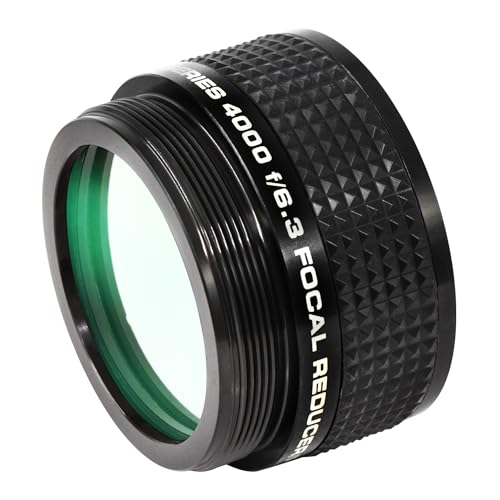
Astromania’s focal reducer for SCTs offers a 37% reduction in focal length, converting an f/10 system to approximately f/6.3. The unit features premium aerospace-grade aluminum with a shock-absorbing rubber housing and includes dust caps and a storage case. Its 4-element, fully multi-coated optical system delivers clear views with minimized chromatic aberration. The SCT-thread compatibility extends to a wide range of Celestron models, including popular NexStar variants, making it a reliable upgrade for SCT owners seeking faster imaging performance and wider fields of view.
The device’s rugged construction supports transport and field use, while maintaining alignment and optical quality. It pairs well with T-adapters and camera sensors used in astrophotography, enabling more expansive framing of star fields and extended galaxies. Overall, it presents a balanced option for SCT users prioritizing durability, compatibility, and optical performance.
Astromania 0.5X Focal Reducer for Telescope

Astromania’s 0.5X focal reducer is designed for 1.25″ eyepiece systems, offering a 0.5x reduction to halve the focal length. The result is a broader field of view and reduced exposure times for astrophotography. Its fully multi-coated 4-element optics provide improved brightness and contrast with minimized edge distortions. The accessory uses standard 1.25″ filter threads, allowing easy stacking with other 1.25″ adapters and cameras, and is compatible with SCT-based or refractor setups that use 1.25″ accessories.
Made with a black anodized aluminum housing, it is built for both visual use and photography. Its compact form enables quick swaps between higher magnification and wide-field imaging without significant reconfiguration of the mounting systems. This option is well-suited for hobbyists who want an affordable, practical step into wider-field imaging along with existing 1.25″ gear.
Astromania 0.5X Focal Reducer For 1.25″ Systems
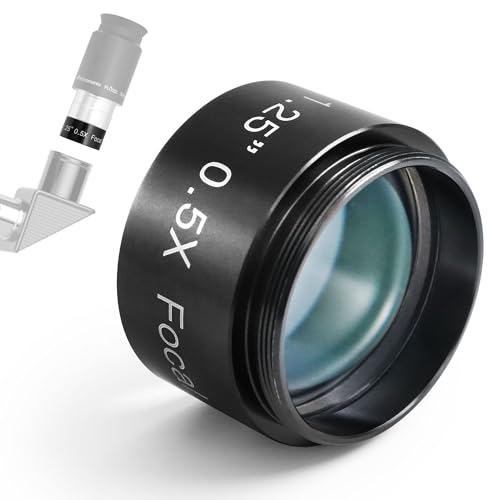
This version also halves the focal length by approximately 0.5x and is intended for 1.25″ filter-threaded setups. The focal reduction enables a wider field of view and shorter exposure times for astrophotography. It uses a two-lens system with cemented, coated optics housed in a black anodized aluminum shell. The device threads into standard 1.25″ accessories on both sides, and it can be stacked with other 1.25″ components to tailor back focus for particular imaging configurations.
Buying Guide: Key Considerations For Choosing A Focal Reducer Or Field Flattener
- Compatibility: Check thread size (1.25″ vs SCT) and telescope type (refractor vs SCT). Some reducers are designed for specific mounts and may require adapters.
- Focal Length and Speed: Most reducers claim a 37% reduction, moving from f/10 to around f/6.3 or f/7. Ensure your camera sensor and field of view align with your imaging goals.
- Optical Quality: Look for multi-coated optics and four-element designs to minimize chromatic aberration and field curvature, especially toward the edges of the frame.
- Mechanical Build: Aluminum housings with protective caps help during transport. Consider whether the unit includes dust protection and storage cases.
- Field Flattening: If edge-to-edge sharpness is critical, consider a dedicated field flattener or a reducer that includes flattening characteristics for your sensor size.
- Weight and Back Focus: Some reducers slightly alter the optical length of the train. Verify that your total back focus remains within safe limits for your imaging setup.
- Budget vs. Value: While premium options offer robust coatings and durability, entry-level reducers provide significant benefits at a lower cost. Balance features with your needs.
- Ease of Use: Simpler, screw-on designs reduce setup time and potential misalignment. Ensure compatibility with your existing accessories like T-Adapters and diagonals.
For imaging performance, consider how a reducer or field flattener will affect your exposure strategy, star shapes across the frame, and the need for calibration frames. If you image wide fields or large targets, a reducer that preserves edge sharpness and minimizes vignetting will deliver the best results across the sensor. Always verify compatibility with your specific telescope model and camera system before purchasing.