Best EF Cinema Zoom Lenses for Filmmaking: Versatile Parfocal Options
For filmmakers using Canon EF bodies, dedicated cine zoom lenses with parfocal design, minimal focus breathing, and smooth iris control can simplify on-set workflows. The following selections focus on full-frame capable EF-mount options that deliver sharp imagery, reliable color rendition, and consistent performance across zoom ranges. Each lens is evaluated for focus stability, breathing behavior, and ease of operation in dynamic shooting scenarios—from documentary run-and-gun to controlled narrative setups.
| Product | Brand | Mount | Notable Strengths |
|---|---|---|---|
| SIRUI 28-85mm T3.2 Full-Frame Parfocal Zoom Cine Lens | Sirui | EF | Practical zoom range; parfocal focus; strong optical clarity |
| DZOFILM Pictor 20-55mm & 50-125mm T2.8 Bundle | DZOFILM | PL / Canon EF | Parfocal across two focal ranges; minimal breathing |
| DZOFILM Pictor 20-55mm T2.8 Cine Lens | DZOFILM | PL / Canon EF | Maintains focus, 16-slat iris |
| DZOFILM Pictor 50-125mm T2.8 Cine Lens | DZOFILM | PL / Canon EF | Full-range parfocal; smooth iris; compact |
| DZOFILM Catta Ace 35-80mm & 70-135mm T2.9 Bundle | DZOFILM | PL / Canon EF | Wide-to-tele coverage; cinematic bokeh |
SIRUI 28-85mm T3.2 Full-Frame Parfocal Zoom Cine Lens (EF Mount)

The SIRUI 28-85mm T3.2 is a compact, full-frame cine zoom with a practical range suited to run-and-gun and controlled shoots. Its key feature is parfocal performance, ensuring that subject focus remains stable when adjusting the zoom, which is crucial for dynamic shots with moving subjects or steady camera movement. The 8K-class emphasis in its optics translates to crisp, high-contrast images with pleasing micro-contrast and color. The step-less aperture ring (T3.2 to T22) allows precise exposure control, while the long 259° focus throw supports smooth focus pulls. Minimal focus breathing helps maintain continuity on dolly and handheld moves. The dual-scale focus/readout in feet and meters assists operators who switch between on-set shorthand and metric planning. This lens is well-suited for documentary work, corporate shoots, and narrative scenes where a single glass must cover a broad range. The lens’ design minimizes warping in the frame during zoom transitions, aiding consistent composition across takes.
DZOFILM Pictor 20-55mm & 50-125mm T2.8 Bundle

This DZOFILM bundle combines two focal ranges into a cohesive kit with parfocal confidence across both the wide-to-standard and standard-to-tele ranges. Focus remains stable as you zoom, which reduces re-framing needs during tracking shots. The 16-blade iris delivers round, cinematic highlights, contributing to pleasing bokeh when shooting at wider apertures. Minimal breathing is emphasized across the zoom, ideal for sequences where the subject remains in frame during zoom adjustments. While the bundle supports multiple mount configurations, its Canon EF compatibility makes it a practical choice for indie productions and rental houses seeking a versatile kit without swapping glass mid-shoot.
DZOFILM Pictor 20-55mm T2.8 Cine Lens

This Pictor 20-55mm T2.8 is a mainstay for EF-mount productions needing consistent focus across a broad zoom range. The lens emphasizes minimal breathing, which is beneficial for on-location shoots where subjects move toward or away from the camera or the operator repositions the frame. The 16-slat iris contributes to a controlled, cinematic depth of field, creating smooth transitions between foreground and background elements. The full-frame image circle ensures compatibility with modern cinema cameras, while the parfocal design reduces the need for re-focusing during zoom pulls, essential for run-and-gun workflows or interviews where timing matters.
DZOFILM Pictor 50-125mm T2.8 Cine Lens

The 50-125mm Pictor provides longer reach with consistent parfocal performance across the zoom head. A 16-slat iris yields smooth bokeh, while the T2.8 aperture enables shallow depth of field for character-driven scenes. Minimal breathing again supports smooth subject isolation during zooms and doles of movement across a shot. This lens pair is well-suited to mid-to-long focal work on full-frame cameras, such as dialogue scenes, tight close-ups, and establishing shots that require sustained image quality across a zoom range.
DZOFILM Catta Ace 35-80mm & 70-135mm T2.9 Cine Lens Bundle
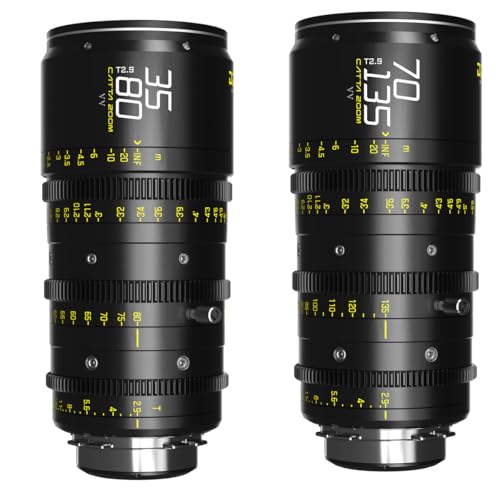
The Catta Ace bundle covers a broad range from wide to tele with two distinct zooms designed for full-frame sensors. The 35-80mm and 70-135mm ranges provide flexible on-set coverage for interviews, b-roll, and narrative scenes. The 16-blade iris contributes to cinematic depth of field with smooth out-of-focus highlights, while parfocal design ensures minimal refocusing during zoom operations. The lenses are described as delivering superior image quality with strong contrast and clear image circles, making them a practical option for productions that require durable glass with reliable performance in diverse lighting conditions.
Buying Guide: Key Purchase Considerations
When selecting EF cinema zoom lenses, filmmakers should weigh several factors beyond focal length. Parfocal design remains central for maintaining focus during zooms, especially on dynamic shoots. Minimal breathing helps preserve composition when the camera moves or is operated with a dolly and tripod. Look for a wide aperture that remains useful across focal lengths and a robust, repeatable iris for consistent exposure. Consider image circle coverage for your camera sensor (full-frame vs. Super 35) and ensure compatibility with your EF-mount bodies or EF-to-E-mount adapters if needed. Build quality, weather sealing, and weight also influence on-set practicality. Finally, evaluate vendor support, service options, and the availability of spare parts given the specialized nature of cine lenses. For rental houses, scripted bundles that cover multiple focal ranges reduce on-set glass swaps and improve continuity across takes. For indie productions, a versatile bundle with strong parfocal performance can deliver professional results without frequent lens changes.
Performance perspective: Parfocal lenses excel in controlled scenes and run-and-gun contexts, while minimal breathing maintains consistent framing across zoom changes. Optical sharpness and color rendition across the image circle influence post-production workflow, including LUT application and color grading. If you frequently shoot in tight, interview-heavy setups, prioritize shorter end focal lengths with strong close-focusing ability. If your projects demand long-reach framing, ensure the tele-end performs equally well in resolution and contrast. Finally, assess budget and lifecycle costs; cine lenses can be an investment, but the right mix of focal lengths and consistent performance often yields superior continuity and efficiency on set.