Best DSLR Wide Angle Lenses for Expansive Shots
DSLR wide angle lenses unlock dramatic perspectives, spacious landscapes, and immersive architectural imagery. This guide highlights five top options, covering prime and zoom choices across popular Canon, Nikon, and APS-C systems. Each lens emphasizes wide field of view, sharpness, and practical handling for everyday photography or creative projects.
The table below summarizes the featured lenses, including key attributes to compare at a glance.
| Product | Brand | Focal Length / Type | Approx. Angle Of View | Key Benefit |
|---|---|---|---|---|
| Rokinon 14mm F2.8 IF ED | Rokinon | 14mm, Prime | Approximately 90° (APS-C) | Ultra wide with close-focus capability |
| Canon EF-S 10-18mm f/4.5-5.6 IS STM | Canon | 10-18mm, Zoom | Ultra wide, versatile | Stable image stabilization on APS-C bodies |
| Sigma 10-20mm f/3.5 EX DC HSM | Sigma | 10-20mm, Zoom | Wide range with constant f/3.5 | High-contrast images with low flare |
| Rokinon 10mm F2.8 ED AS NCS CS | Rokinon | 10mm, Prime | Ultra wide with 106° coverage | High image quality on Canon APS-C |
| Altura Photo 8mm f/3.0 Fisheye | Altura Photo | 8mm, Fisheye | 180° (circular on APS-C) | Extreme perspective for creative shots |
Each lens below is reviewed with its standout use cases, optical traits, and practical notes to help you choose the right wide angle for your DSLR setup.
Rokinon 14mm F2.8 IF ED for Canon EF

The ultra-wide 14mm prime provides an approximate 90° angle of view on APS-C bodies, enabling dramatic architectural and landscape compositions. It offers a minimum focusing distance of about 0.9 feet (28 cm) for close-up wide-angle shots. The lens includes a built-in petal-type hood and a maximum diameter of 3.4 inches (87 mm). Aperture ranges from f/2.8 to f/22, supporting low-light performance and deep depth of field for expansive scenes.
Altura Photo 58MM 0.43x Wide Angle Lens with Macro

This lens attachment expands the field of view by screwing onto the 58mm filter thread of compatible lenses, with a detachable macro for high-resolution close-ups. It lists compatibility with a broad set of Canon EF-S and other camera models when using a 58mm thread, making it a versatile option for budget-conscious shooters seeking dramatic wide-angle effects without changing lenses.
Canon EF-S 10-18mm f/4.5-5.6 is STM

Canon’s EF-S 10-18mm is a compact ultra-wide zoom designed for APS-C bodies. It features a stepping motor-driven focus mechanism and a focal length range of 10-18mm with an aperture range of f/4.5-5.6. The closest focusing distance is about 0.72 feet (0.22 meters), delivering broad perspective control for interiors, landscapes, and architectural photography on compatible Canon DSLRs.
Sigma 10-20mm f/3.5 EX DC HSM

The Sigma 10-20mm f/3.5 EX DC HSM delivers a constant f/3.5 aperture across the zoom range, enabling strong performance in low light and consistent exposure control. Its ultra-wide angle supports dramatic perspective with sharp image quality, high contrast, and reduced flare thanks to multi-layer coatings. This makes it a solid choice for Nikon DSLRs seeking wide landscape and architectural capabilities.
Rokinon 10mm F2.8 ED AS NCS CS

The 10mm prime provides true ultra-wide coverage with edge-to-edge sharpness and a wide 106° angle on Canon APS-C sensors. It uses a Nano Crystal Coating to improve light transmission and minimize internal reflections, with a maximum aperture of f/2.8. Its compact design suits landscape and astrophotography where broad scenes and bright stars are desirable.
Altura Photo 8mm Fisheye
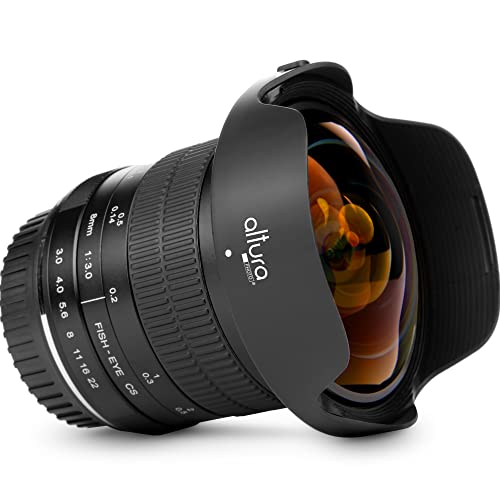
Altura Photo’s 8mm fisheye lens provides a specialty wide-angle option with a dramatic circular 360° image on many full-frame sensors, or a more traditional 180° hemispherical view on certain APS-C configurations. It is built for robust field use, offering manual focus and a removable hood for immersive, creative shots with pronounced distortion for artistic effects.
Buying Guide: Wide Angle Lens Considerations
- Sensor compatibility: Confirm whether your camera uses full-frame or APS-C, as this affects field of view and the need for crop factors. Prime ultra-wide lenses often deliver better edge-to-edge sharpness on APS-C than zooms.
- Aperture and light performance: Wider apertures (lower f-numbers) help in low-light scenes and astrophotography, but many budget ultra-wide zooms settle around f/4-5.6. Consider your typical lighting conditions when choosing.
- Distortion and coatings: Fisheye and ultra-wide designs naturally exhibit distortion; coatings like Nano Crystal reduce flare in bright scenes. A lens with good image stabilization can assist in handheld shots at slower shutter speeds.
- Depth of field control: Ultra-wide lenses provide deep depth of field, but the exact focusing distance matters for close-ups. Check minimum focusing distance if you plan close-range photos.
- Accessory compatibility: Some wide-angle lenses accept front filters or macro attachments. Ensure threads match your existing accessories if you plan to expand your kit.
- Creative use cases: Choose a lens based on your preferred subjects—landscapes often benefit from wide zoom ranges, while architectural or astrophotography fans may favor fixed focal lengths for maximum sharpness and control.
When selecting a DSLR wide angle lens, weigh focal length, maximum aperture, distortion behavior, and the camera system you own. The lenses listed here balance image clarity, optical coatings, and practical handling for American photographers pursuing expansive, dramatic perspectives across landscapes, interiors, and cityscapes.