Best Digital Eyepieces for Microscopes: Top Picks for 2026
The right digital eyepiece can transform a traditional microscope into a versatile observation and recording tool. This guide highlights five top-rated digital eyepieces compatible with standard 25–50 mm eyepieces, offering live view, high-resolution video, and easy app or PC connectivity. Explore the features, imaging capabilities, and usability to help you choose the best option for education, research, or hobbyist viewing.
| Product | Brand | Key Benefit |
|---|---|---|
| 64GB Digital Eyepiece Telescope Camera | Unalace | 2K Ultra HD video with built-in WiFi hotspot |
| AOMEKIE Digital Eyepiece | AOMEKIE | 3 adapter rings and wireless real-time view |
| FTVOGUE Electronic Eyepiece | FTVOGUE | 960 TV line imaging with dual modes |
| AmScope MD300A | AmScope | 3MP USB capture with broad software support |
| AmScope MD1200A | AmScope | 12MP capture with multi-platform software |
Below are five carefully chosen options, summarized with their standout capabilities. Each entry includes a direct link to the product page, a visual reference, and core features to help you compare quickly.
Unalace 2K Eyepiece With Built-In WiFi

This digital eyepiece from Unalace provides a universal fit for 25–50 mm eyepieces, enabling simple installation with no tools. It features a built-in WiFi hotspot for direct smartphone connection, allowing streaming of live HD video and remote control via the accompanying app. It records in 2K Ultra HD and supports 16MP still captures, with time-lapse options for hands-free sessions. The combination of high video quality and wireless control makes it suitable for classroom demonstrations and field observations.
AOMEKIE Digital Eyepiece with 1080P Video
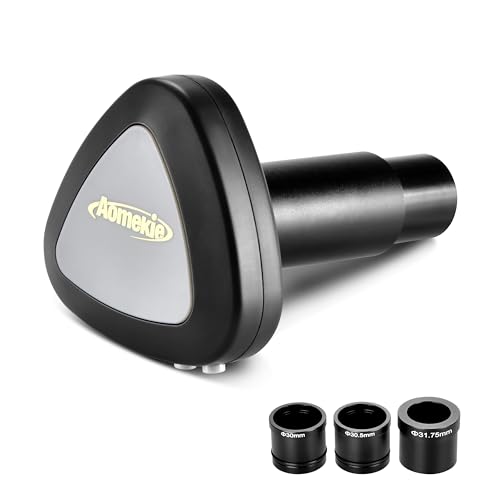
The AOMEKIE eyepiece delivers 1080p HD video and 2MP photo output. It includes three adapter rings to fit a variety of astronomical telescopes and microscopes, plus WiFi for real-time viewing on mobile devices, laptops, or PCs. A built-in 800 mAh battery offers 60–90 minutes of operation after full charge, making it convenient for sessions away from power outlets. This makes it a practical option for both side-by-side specimen viewing and educational demonstrations.
FTVOGUE Electronic Eyepiece 2MP

FTVOGUE’s electronic eyepiece features a 1/3 inch sensor with progressive scanning, designed for low-light conditions and high sensitivity. It offers two operating modes for manual or automatic white balance and exposure, with a sturdy stainless steel body and LED illumination for clear imaging. While the default region is PAL, the device emphasizes consistent color reproduction and reliable performance for detailed specimens and microstructures in dim environments.
AmScope MD300A 3MP USB Eyepiece

The AmScope MD300A provides a 3MP USB digital camera with live video and photo capture, compatible with Windows, macOS, and Linux. Its accompanying software suite offers editing, stitching, exposure, and color controls, along with DirectShow and Twain support for diverse imaging workflows. This makes it a robust option for classrooms and researchers needing versatile software integration across platforms.
AmScope MD1200A 12MP USB Eyepiece

The MD1200A delivers a higher-resolution 12MP capture with USB connectivity, enabling advanced image and video capture across Windows, Linux, and Mac environments. Its software supports stitching, EDF, measurement tools, and color controls, while the platform compatibility ensures broad usability for professional documentation and teaching labs. This option suits users prioritizing high-resolution stills and precise measurements.
Buying Guide: Key Purchase Considerations
- Compatibility and Fit: Ensure the eyepiece supports your current microscope or telescope’s eyepiece diameter (commonly 25–50 mm). Check for included adapters or rings to minimize extra purchases.
- Image Resolution and Recording: Consider your imaging needs. For classroom demos or field work, 1080p or 2K video with 16–20 MP stills may suffice. For research-grade documentation, higher resolution (12 MP or more) and advanced software features are beneficial.
- Connectivity: Decide between built-in WiFi for smartphone control, USB connectivity for PC integration, or HDMI output for direct monitoring. Wireless options offer mobility; wired options tend to be more stable during long sessions.
- Power and Run Time: Battery-powered units provide portability but check runtime (often 60–90 minutes). If you’ll record long observations, ensure easy recharging or USB-powered operation.
- Software and Platform Support: Look for compatible software across Windows, macOS, and Linux. Features like stitching, measurement tools, and color correction can save time in analysis and reporting.
- Durability and Build: A sturdy enclosure, LED illumination options, and anti-reflective coatings on lenses improve image clarity, especially in educational settings or field observations.
- Ease of Use: Quick installation, tool-free mounting, and intuitive apps help students and hobbyists get started quickly without a steep learning curve.
- Recording Modes and Features: Time-lapse, automated exposure, white balance settings, and manual versus automatic modes can expand how you capture dynamic samples or celestial events.
These considerations help compare practical use cases—from classroom demonstrations and hobbyist experiments to professional documentation and astro-imaging. When evaluating options, align the device’s strengths with your typical observing conditions, preferred software ecosystem, and required image quality.