Best Digital Cameras for Telescopes for Astrophotography
Finding the right digital camera setup for telescope use can unlock clear moonshots, planets, and deep-sky images. The following picks blend integrated imaging capability with portability, ease of use, and compatibility with popular mounts. Each item below is chosen for telescope enthusiasts—from beginners to seasoned stargazers—seeking sharper astrophotography results without bulky gear.
| Product | Brand | Key Benefit |
|---|---|---|
| Smart Telescope, Professional Refractor Auto-focus | FASHIONARI | 4K imaging and dual screens for real-time viewing |
| 64GB Digital Eyepiece Telescope Camera | Unalace | WiFi live view and 2K video with universal fit |
| Seestar S50 Smart Digital Telescope | ZWO | All-in-one portability with GoTo and auto-tracking |
| Seestar S30 All-in-One Smart Digital Telescope | ZWO | Ultra-portable with automatic shooting modes |
| SV105 Telescope Camera | SVBONY | Entry-level, USB plug-and-play for lunar/planetary imaging |
Best All‑In‑One Smart Telescope For Beginners
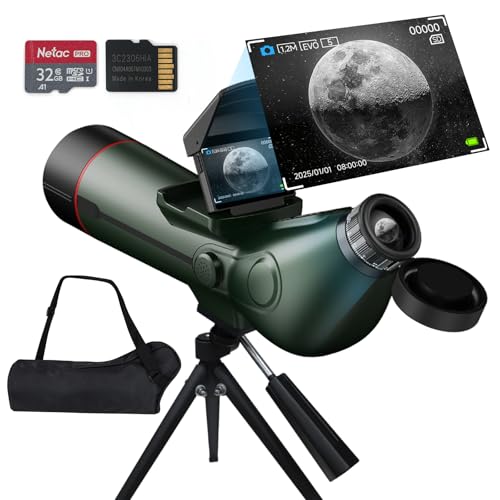
The Fashionari Smart Telescope combines an 80mm aperture with a 300mm focal length, delivering bright, detailed views suitable for beginners and seasoned observers. Its starlight-grade sensor supports up to 350X magnification and captures high-resolution 4K images, even in dim conditions. A notable feature is the dual-screen display, including a foldable external monitor for real-time viewing. Diopter adjustment (+/-4) helps users fine‑tune focus for individual vision, while the built-in sunshade enhances daylight usability. One‑touch photo and video switching streamlines workflows for spontaneous celestial moments.
In practice, this unit emphasizes accessibility alongside performance. The 4K imaging is a welcome upgrade for social sharing and detailed study, and the expandable storage (up to 512GB) ensures longer sessions without swapping cards. The internal and external displays reduce the need for separate devices, making it a strong candidate for hobbyists who want immediate visuals without a steep learning curve.
64GB Digital Eyepiece Telescope Camera

Unalace’s 64GB digital eyepiece camera emphasizes convenience and versatility. It installs on 25–50mm eyepieces with no tools, making it easy to switch between terrestrial and celestial observations. Built-in WiFi creates a direct link to smartphones for live HD streaming and remote control—no internet required in the field. The camera records 2K video and 16MP stills, offering time-lapse and timed recording options for hands-free sessions. While primarily a telescope accessory, its compact footprint and app-based control make it a practical upgrade for users who want quick, shareable captures without extra gear.
Performance is strong in daytime and bright lunar captures, with a straightforward workflow that appeals to novices. The lack of high-end astrophotography features means it’s best for those seeking immediate results and simple post-processing, rather than deep-sky work. Nevertheless, the WiFi and app control provide a modern, flexible approach to visual astronomy.
Seestar S50 Smart Digital Telescope

The ZWO Seestar S50 represents a highly integrated observing system. It weighs about 2.5 kg and combines a telescope, electrical focuser, astronomical camera, ASIAIR, altazimuth mount, and a dew heater in a compact package. The optics are designed to deliver crisp, low-noise imagery, with coatings that minimize light loss. Full-automatic Find & Track capabilities connect with a phone to access tonight’s target database and imaging progress via auto voice updates. This model is suited for both beginners and more experienced users who want a streamlined, go-to setup for quick, automated sessions without elaborate assembly.
What sets the S50 apart is its emphasis on automation and integration. The ability to navigate to targets and track them automatically reduces manual adjustments, enabling more time for composition and capture. The trade-off is a slightly larger footprint and a reliance on the accompanying app ecosystem for advanced control and planning. For users prioritizing ease of use and reliable capture, the S50 is a compelling option.
Seestar S30 All‑In‑One Smart Telescope

The Seestar S30 emphasizes portability without sacrificing imaging capability. Weighing roughly 1.65 kg, it is designed for travel and easy setup. The integrated Seestar App handles automatic star-finding, precise tracking, and one‑tap shooting. The dual-lens system adds versatility: a telephoto lens for distant objects and a wide-angle option for landscapes or guiding aims. Shooting modes span Stargazing, Scenery, and Solar System, enabling both astrophotography and terrestrial photography in a single compact unit. This combination makes the S30 a solid choice for hobbyists who expect flexibility and convenience in one package.
Users should note that while the S30 offers major ease-of-use benefits, exceptionally deep-sky imaging may require longer exposure times and potential post-processing. For on-the-go observers or those new to astrophotography, the all-in-one design reduces setup complexity while delivering competent results across multiple modes.
SVBONY SV105 Telescope Camera
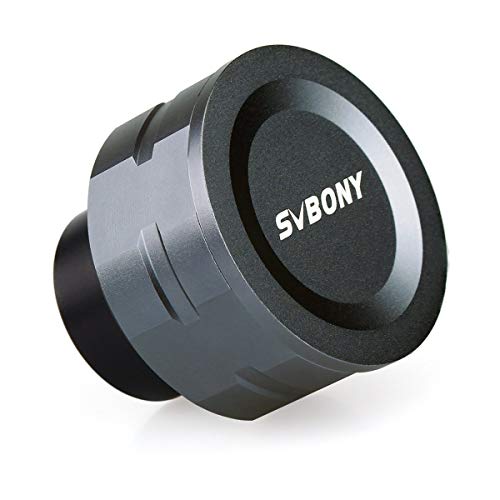
The SV105 is a beginner-friendly telescope camera that emphasizes simplicity and real-time observation. It uses a 1.25-inch CMOS sensor (IMX307) for color imaging and provides a straightforward plug-and-play experience with Windows, Linux, and Android compatibility. The camera is well-suited for lunar and planetary photography, offering quick video capture and easy transfer to a computer for analysis. For newcomers to astrophotography, the SV105 provides a gentle entry point into digital capture with minimal setup and broad software compatibility, making it a practical stepping stone into more advanced equipment.
Buying Guide: Key Purchase Considerations And Comparisons
- Imaging quality versus portability: All-in-one units (Seestar S50/S30) prioritize portability and ease of use, trading some degree of customization for convenience. Standalone cameras or eyepiece cameras (Unalace, SVBONY SV105) can offer higher image fidelity with flexible mounting but may require more setup.
- Ease of use and learning curve: If you’re new to astrophotography, models with automatic find/track, built-in apps, and simple controls reduce the learning curve. For experienced users, devices that allow manual exposure control and post-processing options may be preferable.
- Connectivity and software ecosystem: WiFi-enabled cameras and devices with companion apps enable live viewing and remote operation, beneficial for field sessions. Check compatibility with your existing devices and preferred editing workflows.
- Mount compatibility and weight: Ensure the device weight aligns with your tripod or mount’s capacity. Some all-in-one units are heavier but still portable, while ultra-light options excel for travel but may have fewer advanced features.
- Sensor size and resolution: Higher resolution helps with detail in planetary and deep-sky targets, but sensor size affects performance in low light. A balance between resolution and light sensitivity is important for astrophotography quality.
- Storage and expandability: Look for devices that support external storage or straightforward data transfer. Longer sessions require reliable storage options and efficient file management.
- Durability and weather resistance: Field use means exposure to dew, cold, and wind. Cameras with protective housings, dew prevention, and robust construction offer longer-term reliability.
- Budget and future-proofing: Consider a system that scales with your growing skill set. An all-in-one solution may be ideal now, while modular setups can be upgraded over time as your imaging goals evolve.