Best Ways to Convert a Camera Lens to a Telescope for Astrophotography
Converting a camera lens or camera body into a telescope setup lets you explore the night sky with existing gear. This guide reviews practical adapters and extensions that connect SLR, DSLR, and mirrorless cameras to telescopes for prime-focus and eyepiece-projection photography. You’ll learn what to look for, how these adapters differ, and which models suit different camera brands and styles.
| Product | Brand | Key Benefit |
|---|---|---|
| Starboosa Telescope Camera Adapter | starboosa | Fits Nikon SLR/DSLR bodies; extendable for prime focus or eyepiece projection |
| Celticbird 1.25″ T-Adapter (Canon EOS) | CELTICBIRD | 1.25″ T-mount for Canon EOS; durable all-metal construction |
| Starboosa Variable Extension Telescope Camera Adapter | starboosa | Canon compatibility; adjustable extension for better framing |
| Lightdow T2-RF T Mount Adapter (Canon RF) | lightdow | Solid alloy construction; works with Canon RF mount and telescope setups |
| Fotasy Adjustable T2 /T Mount to MFT Adapter | Fotasy | Converts T2 to Micro Four Thirds; broad camera compatibility |
Starboosa Telescope Camera Adapter

The Starboosa adapter uses a variable extendable design with a T2 ring to connect Nikon SLR or DSLR bodies to a telescope. It supports prime-focus photography and eyepiece projection by letting you place eyepieces inside the extension tube to boost detail. The fit covers many Nikon DSLR bodies, making it a versatile option for fixed-axis observing and imaging. Note that mirrorless cameras are not suitable for this model.
Celticbird 1.25″ T-Adapter for Canon EOS

This 1.25-inch T-mount adapter is designed to pair Canon EOS cameras with standard 1.25″ telescope focusers. It’s all-metal and anodized aluminum for durability, enabling reliable attachment for long-exposure astro imaging. Compatible Canon bodies cover a wide range—from older Rebels to 5D models—providing a dependable pathway for astrophotography projects that require stable mounting and alignment.
Starboosa Variable Extension Telescope Camera Adapter

This adapter provides variable extension for Canon SLR and DSLR bodies. It’s designed to connect to a telescope and supports both prime-focus photography and eyepiece projection. The extension tube can host eyepieces, which allows photographers to fine-tune magnification and field of view for night-sky targets, star clusters, and planetary shots. Mirrorless compatibility is not indicated for this model.
Lightdow T2-RF T Mount Adapter for Canon RF

The Lightdow T2-RF adapter converts to a T-mount with RF-compatible bodies. It emphasizes a robust alloy build and a matte black interior to minimize reflections, helping to deliver sharper, higher-contrast astrophotography results. It is suitable for Canon RF camera users seeking a stable bridge to telescopes and other optical accessories.
Fotasy Adjustable T2 to MFT Adapter

Fotasy offers a solid T2-to-MFT adapter that enables a wide range of Micro Four Thirds mirrorless cameras to mount lenses and telescopes via T2 threads. It emphasizes durability and ease of use, providing a reliable path for prime-focus imaging or eyepiece projection with MFT bodies. The adapter supports infinity focus and is designed for straightforward installation.
Astromania T2 T-Ring and M42 Adapter
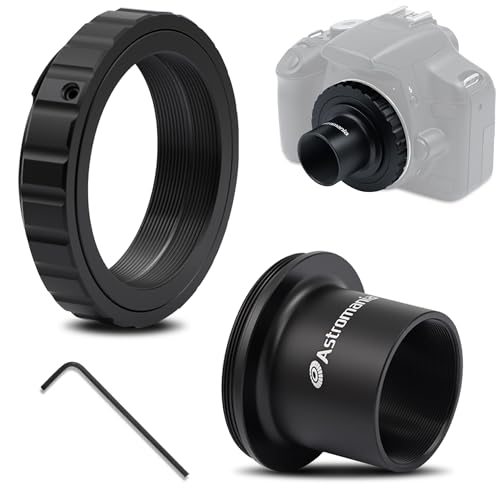
Astromania provides a T-ring for Nikon F-mount cameras along with a universal 1.25″ T-adapter. This kit links Nikon SLR/DSLR bodies to telescopes and supports standard telescope accessories like filters, diagonals, and barlows. It’s a versatile entry point for astrophotographers seeking reliable, widely compatible mounting options.
Starboosa Smartphone Telescope Adapter

While not a traditional camera-lens adapter, this model lets smartphones attach to telescopes, spotting scopes, or microscopes. It’s useful for quick field observations, capturing lunar details, birds, or distant scenes through a telescope-like setup. Compatible phone widths and a broad range of devices make it a flexible companion to a camera-based system when mobile imaging is needed.
Astromania Upgraded Telescope Camera Adapter

Astromania’s upgrade features a 1.25-inch extension tube kit designed for both prime focus and eyepiece projection. The anodized aluminum construction offers durable support for ongoing astrophotography sessions, with a 34mm scale for precise focal adjustments. This helps users dial in magnification to capture moon phases, planets, and deep-sky targets with greater consistency.
Buying Guide: Key Purchase Considerations
- Camera compatibility: Check whether the adapter supports Nikon, Canon, Canon RF, Sony, Micro Four Thirds, or other systems. Mirrorless compatibility is often more limited with older adapters.
- Mount type and diameter: Most telescope adapters use T2/M42 or 1.25″ focuses. Ensure your telescope’s focuser accepts the adapter and that the diameter matches your eyepiece or camera interface.
- Extension and focal length: Variable extension tubes let you tune magnification. However, longer extensions can lead to vignetting or field rotation if not balanced properly.
- Build quality and coatings: All-metal construction and matte black interiors reduce reflections and improve sharpness, particularly for long-exposure shots.
- Support for eyepiece projection: If you plan to project eyepieces into the optical path, verify that the adapter accommodates your preferred eyepieces and maintains focus.
- Stability and alignment: A robust, well-aligned setup minimizes shake and ensures precise framing during exposures.
- Mobility and use-case: Smartphone adapters offer quick field results, while dedicated camera adapters suit deep-space imaging or long-exposure work.
This selection addresses common use cases: attaching Nikon or Canon bodies to refractors or reflectors, extending working distance for better framing, and enabling eyepiece projection. The right choice depends on your camera system, telescope type, and whether you prioritize quick field shots, precise long-exposure imaging, or flexible multi-accessory compatibility.