Best 8mm Reel to Digital Converters for Seamless Preservation
The top choice for converting 8mm and Super 8 reels to digital is a stand-alone film digitizer that does not rely on a computer. These devices scan film frames and save high-definition MP4 videos directly to an SD card. They’re ideal for homeowners with vintage film collections who want an easy, cable-free solution or those who want a quick, stand-alone workflow. This guide highlights five reliable options and explains who each device is best for, with practical notes to help you pick the right model for your reels.
| Product | Best For | |
|---|---|---|
| KODAK REELS 8mm & Super 8 Films Digitizer | People with mixed reel sizes (3″–9″) and a large screen | 5” onboard LCD, frame-by-frame, 1080p output |
| 8mm & Super 8 Film to Digital Converter (eyesen) | Simple stand-alone use on up to 9″ reels | 2.4″ screen, 32GB SD included |
| Magnasonic FS81 (2.3″ screen) | Budget-friendly with easy playback | Built-in screen, RCA out for TV |
| USHNIH 8mm & Super 8 Film to Digital Converter | Frame-by-frame HD conversion without a PC | 5-megapixel sensor, 32GB SD included |
| eyesen 8mm & Super 8 Reels to Digital MovieMaker Pro | Compact option with 2.4″ screen | Standalone, 1080p, 32GB included |
KODAK REELS 8mm & Super 8 Films Digitizer

Best for: Home collectors with a mix of 3″, 5″, 7″, 8″, and 9″ reels who want a single device to digitize frame-by-frame and view on a large built-in display. This model uses an 8.08-megapixel sensor and offers a large 5” onboard LCD with touch controls for easy navigation and on-device editing options. It saves to SD card, and transfers can be done via micro USB for viewing on bigger screens. A potential limitation is that the unit records without sound, which may matter for some silent or sound-on footage.
8mm & Super 8 Film to Digital Converter (eyesen)

Best for: Users who want a straightforward, stand-alone digitizer that supports up to 9″ reels and includes a 32GB SD card. It features an automatic digitizing workflow, a built-in 2.4″ LCD, and direct SD card saving. No PC or software is required. A limitation to note: playback is silent, and the interface is tactile rather than highly automated for advanced editing features.
Magnasonic Super 8/8mm Film Scanner FS81
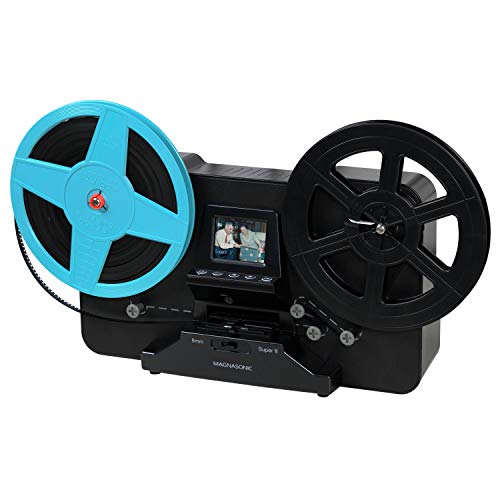
Best for: Those who want an inexpensive option with an easy display-to-TV viewing path. The FS81 automatically converts 3″, 5″, and 7″ reels, saving videos to an SD card and offering RCA output for TV viewing. It records video without sound, and its smaller LCD keeps the device compact. Choose this if you prioritize a budget-friendly, simple-to-use device above all.
8mm & Super 8 Film to Digital Converter (USHNIH)

Best for: Viewers who want a dedicated stand-alone film-to-digital workflow with 5-megapixel capture for frame-by-frame HD conversion. It supports reels up to 9″, includes a 32GB SD card, and provides a built-in display for quick checks. It’s a fit for collectors who want a straightforward, no-computer setup and who may value precise frame-by-frame control. A possible limitation is that audio is not captured with these conversions, as with several other models here.
eyesen 8mm & Super 8 Reels to Digital MovieMaker Pro

Best for: Individuals who want a compact, standalone digitizer with a built-in 2.4″ screen for quick frame-by-frame viewing. It supports 3″, 5″, 7″, and 9″ reels and saves directly to SD/SDHC cards (32GB included). It uses a 5MP sensor for HD 1080p output, with a tactile interface that favors straightforward, on-device editing and playback. A caution: some users may prefer higher-end color accuracy or audio support which this model does not provide.
Buying Guide: How to Choose the Right 8mm/ Super 8 Digitizer
What should you look for when selecting an 8mm reel-to-digital converter? Start with stand-alone operation if you want a PC-free workflow. Look for a larger onboard display if you prefer on-device playback and adjustments. Check the film size compatibility to ensure it covers 3″, 5″, 7″, and 9″ reels, and confirm SD card capacity is sufficient for your library. Consider the sensor resolution (5MP–8MP) for frame clarity, as well as whether sound recording is supported, since most devices digitize silent footage.
Consider the practical workflow: ease of loading, the quality of frame-by-frame captures, color and exposure controls, and how you’ll transfer final footage to your preferred viewing method (TV, computer, or mobile). For larger collections, a model with a bigger screen and reliable automatic digitizing will save time. If you value minimal setup, choose a device with included SD cards and straightforward saving to the card. Finally, budget considerations should balance feature set with the number of reels you need to convert.
Frequently Asked Questions
- Do these devices require a computer? Most listed options are stand-alone and save directly to SD cards without a PC, but some models offer PC transfer options via USB for additional workflows.
- Can I get audio with these conversions? Many devices digitize video without sound. If audio is important, verify this feature for your chosen model before purchasing.
- What reel sizes are supported? The common range is 3″ to 9″ reels. Verify specific model support in the product description to avoid compatibility issues.
- Is 1080p the best quality available on these devices? Yes, most units capture at 1080p for HD playback, though actual color and sharpness depend on sensor quality and exposure settings.
- Which device is easiest for beginners? Models with large onboard displays and simple, guided prompts tend to be friendlier for first-time users.
- What about color accuracy and exposure controls? Higher-end models offer more granular exposure and tint adjustments, which can improve color fidelity on older footage.