Astrophotography often demands wide angles and bright apertures without breaking the bank. This guide highlights five budget-friendly lenses and related accessories that help capture starry skies, auroras, and celestial objects without hefty price tags. Each option below is chosen for its depth of field, light-gathering ability, and practical performance on a range of DSLR and mirrorless cameras.
From ultra-wide panoramas to specialized fisheye views and accessible telephoto options, these picks cover both APS-C and full-frame systems. They are paired with concise buying advice to help you match a lens to your camera, sky conditions, and target subjects. A quick comparison table is provided to help you scan the essentials at a glance.
| Product | Brand | Mount | Key Benefit |
|---|---|---|---|
| Rokinon 14mm F2.8 For Nikon F | Rokinon | Nikon F | Ultra-wide field for expansive sky shots |
| Altura Photo 8mm F/3.0 Fisheye For Canon | Altura Photo | Canon EF | Full-sky panorama with dramatic 180° view |
| Canon RF16mm F2.8 STM | Canon | Canon RF | Compact ultra-wide for RF mirrorless bodies |
| YONGNUO YN35mm F2 For Canon EF | YONGNUO | Canon EF | Budget wide prime with good performance |
| High-Power 500mm/1000mm F/8 Telephoto Lens | Big Mike’s | Canon EF | Distant celestial and lunar subjects on a budget |
Rokinon 14mm F2.8 For Nikon F

The Rokinon 14mm F2.8 is a fixed focal-length wide-angle designed for Nikon F mounts, making it a classic choice for star fields and Milky Way imaging on budget setups. Its non-zoom design helps you maintain consistent framing while shooting long exposures. The lens delivers a broad 14mm perspective, enabling photographers to capture expansive skies with relatively simple setup. A short minimum focusing distance of about 10.8 inches adds flexibility for foreground elements in astro-landscapes.
As a manual-focus lens, this model invites deliberate focusing work—ideal for nighttime work where precise infinity might shift slightly from camera to camera. The combination of bright f/2.8 and a robust, reliable optical design helps keep noise down and stars sharp, provided you employ good technique: use live-view magnification to nail focus, shoot at low ISO, and allow for careful exposure control to balance dynamic skies with foreground details. The result is sharp, wide, and budget-friendly star photography performance.
Altura Photo 8mm F/3.0 Fisheye For Canon
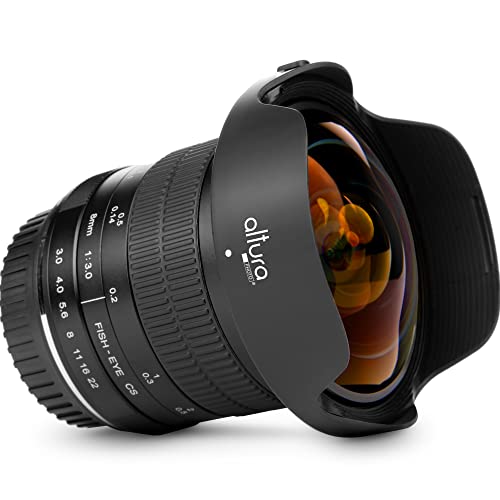
The Altura Photo 8mm fisheye is a fixed-focal-length ultra-wide lens tailored for Canon EF-mount bodies. This fisheye design delivers an exceptional 180-degree field of view, producing dramatic sky panoramas and immersive celestial vistas. Its manual focus means you’ll carefully frame starry skies while adjusting for foreground compositions. The included detachable hood helps reduce stray light and maintain contrast in night scenes, making it a compelling creative tool for bold, circular-sky images and star-trail experiments.
Although fisheyes can introduce significant distortion, this lens excels at creating unique, bold night-sky compositions. It suits photographers who want to emphasize the grandeur of the heavens, from Milky Way cores to aurora curtains, with a minimal gear footprint. For best results, shoot with a sturdy tripod, use long exposure settings appropriate to your sensor, and plan your foreground elements to maximize the striking circular perspective this lens offers.
Canon RF16mm F2.8 STM

The Canon RF16mm F2.8 STM is an ultra-wide prime designed for the Canon RF mount. With a bright f/2.8 aperture, this compact lens concentrates light gathering to support night photography and video with enhanced performance in darker skies. The STM motor delivers smooth, quiet autofocus during video capture, which can be beneficial when you want to document starry skies with moving foreground elements or time-lapse sequences. Its compact form also makes it easy to travel with for astrophotography adventures.
For astro enthusiasts using Canon’s RF mirrorless lineup, this lens provides a broad field of view without excessive bulk. While some prefer even wider options for Milky Way shots, the RF16mm balances practicality, weight, and image quality. Pair it with a sturdy tripod, a wide aperture, and proper exposure planning to maximize star contrast and color fidelity in your night skies.
YONGNUO YN35mm F2 For Canon EF

The YONGNUO YN35mm F2 is an affordable wide prime designed for Canon EF-mount cameras. While 35mm isn’t the widest on the market, it provides a versatile field of view that works well for night-sky landscapes and wider scenes featuring foreground interest. It offers a simple, practical spec set—decent performance at a budget price—with a minimum focusing distance around 0.25m and a moderate maximum magnification of 0.23x. This makes it a solid entry-level option for astrophotographers who want a fast standard prime for night photos.
As a budget option, it’s well-suited for those starting out in astro photography or shooters who want a spare lens for city-night and landscape work. It serves as a lightweight, easy-to-carry alternative to larger ultra-wide lenses, while still letting you capture star fields and subtle night tones with careful exposure settings and post-processing for color and noise management.
High-Power 500mm Telephoto Lens

This manual telephoto lens covers 500mm and can be extended to 1000mm with a 2x teleconverter. While not a typical star-tracker setup, such a focal length is useful for moon details, planets, or bright deep-sky targets when you want to isolate distant features against a dark sky. The lens is compatible with Canon EF-mount bodies, and the manual operation invites careful framing and exposure control in low-light conditions. It’s best suited for astro images that feature a strong, distant subject with minimal atmospheric distortion.
Because this is a manual, long-focus scheme, practitioners should plan on sturdy support and precise focusing. Achieving sharp results at 500–1000mm requires careful rotation of the focus ring, aiming for infinity with a live-view check, and, when possible, a stable tripod or a simple tracking solution for longer exposure times. This lens offers a budget entry into high-mocal focal lengths for unique astrophotography opportunities without a heavy investment.
Buying Guide
Key Purchase Considerations
Astrophotography benefits from lenses that maximize light intake, minimize distortion, and suit your camera system. When evaluating affordable options, consider focal length, maximum aperture, and whether you need manual or autofocus. Ultra-wide and fisheye lenses excel for sky surveys and landscape combos, while longer primes or telephotos can isolate celestial objects like the Moon or bright nebulae. Weight and balance matter for nighttime setups, especially if you’re pairing a lens with a tracking mount or a heavy tripod. Compatibility with your camera’s mount and sensor size should guide your choice.
Focal Length And Field Of View
Shorter focal lengths (8–16mm) yield sweeping skies and dramatic foregrounds, ideal for Milky Way shots and aurora photography. Mid-range options (20–35mm) provide versatility for landscape shots with starry skies. Telephoto options (500–1000mm) let you isolate lunar or planetary targets, but demand solid support and precise focusing. Each photographer should balance field of view with the practicalities of exposure time and sensor noise. If you shoot on APS-C sensors, remember the effective field of view widens with crop factors, affecting composition.
Aperture And Light Gathering
A brighter aperture (low f-number) improves light gathering in dark skies, enabling shorter exposure times and lower ISO. However, many budget lenses cap at f/2.8 or f/3.0, which is generally adequate for night sky work when paired with proper exposure planning. Manual focus often accompanies these lenses, so accuracy in focus at infinity is crucial. When possible, use live-view magnification to confirm sharp stars, and consider stacking multiple shorter exposures to minimize noise and maximize signal.
Reliability, Build And Accessories
Day-to-day astrophotography often involves cold nights and variable weather. Lenses with metal or robust construction can withstand the elements, while good heat management and lens coatings help preserve contrast in high-contrast skies. Tripods, ball heads, remote shutter releases, and partial dew prevention gear (like lens heaters or dew shields) can dramatically improve results. If you’re using a fisheye or ultra-wide, be prepared to manage dramatic distortion in post-processing to maintain natural-looking skies.
Camera System Compatibility
Cross-system options provide flexibility but may require adapters, which can affect autofocus and metering. If you shoot with Canon, Nikon, or Sony, prioritize native mounts when possible for best performance, or verify that adapters preserve your preferred focus and exposure behavior. For mirrorless systems, compact ultra-wide lenses can be particularly appealing due to balance and portability. Always check the compatibility notes and any firmware features that enhance night photography on your specific body.
Practical Tips And Setup
Beyond the lens, a stable tripod, a remote trigger, and proper exposure settings are fundamental. Start with a wide-open aperture (or close to it) and a moderate ISO, then lengthen exposures gradually to avoid star trails unless that’s your intention. Use dark-sky locations, plan around moon phase, and consider stacking software to improve signal-to-noise ratios. For rotating scenes or time-lapses, ensure your tracking is aligned and repeatable to minimize post-processing headaches.
In sum, your budget astro kit can start with a true wide-angle or fisheye for dramatic skies, complemented by a versatile mid-range or telephoto option if you plan to isolate celestial objects. The five picks above illustrate how reliable, budget-friendly lenses can support a range of astrophotography styles—without sacrificing too much image quality or creative control.