Best Endoscope Cameras for Seeing Behind Drywall and Hidden Areas
For homeowners, plumbers, and DIY enthusiasts, a reliable endoscope camera can reveal what lies behind walls, under pipes, or inside ducts. The following selections focus on 1920P HD resolution, IP67 waterproofing, semi-rigid or flexible cables, and user-friendly connections for iOS and Android. Each pick helps you inspect tight spaces with clear images and practical features. The list aims to balance image quality, maneuverability, and durability for real-world behind-wall inspections.
Summary of the chosen products
| Product | Brand | Key Feature | Link |
|---|---|---|---|
| Endoscope Camera with Light (Dual Lens) 16.4ft | Kinpthy | Dual-lens, 1920P, IP67, 16.4ft semi-rigid cable | View Product |
| Endoscope Camera with Light 16.4ft (Single Lens) | Kinpthy | 1920P, IP67, 16.4ft semi-rigid cable | View Product |
| Teslong Two-Way Articulating Borescope | Teslong | 5ft articulating probe, color LCD screen | View Product |
| PAPIBLU Endoscope with Dual Lens | PAPIBLU | Dual lens, 16.4ft semi-rigid, IP67 | View Product |
| TGJOR Endoscope with Light | TGJOR | 5-inch LCD, dual-lens, 16.4ft cable | View Product |
Kinpthy Endoscope With Dual Lens — Clear Dual Views

The Kinpthy Endoscope with Dual Lens covers complex behind-wall inspection by offering two perspectives in one device. With a 1920P HD resolution, the 2.0MP camera captures sharp snapshots and video at close range. A 16.4-foot semi-rigid cable balances flexibility with a stable shape, helping you navigate through tight joists, pipes, and drywall seams. The IP67 waterproof design adds durability when encountering moist environments, making it suitable for plumbing and HVAC checks behind walls. Connecting to iOS 9.0+ and Android 7+ devices is straightforward via the SUP-ANESOK app, or by scanning a QR code, enabling real-time viewing on your smartphone or tablet. The eight adjustable LEDs illuminate dark spots, ensuring details aren’t missed. This model emphasizes versatility for both professional inspections and home DIY tasks.
Key features include durable waterproofing, dual-lens versatility, a bright LED ring, and a user-friendly app.
Kinpthy Single-Lens Endoscope — Solid All-Around View
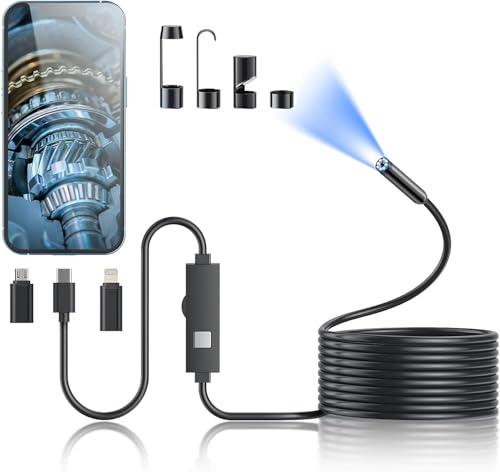
This Kinpthy model provides a reliable single-lens option with the same 1920P HD resolution and 16.4-foot semi-rigid cable. The IP67 waterproof shell supports inspections in damp conditions, making it useful for checking behind walls where moisture is present. Introduction to the APP-based interface remains intuitive for iPhone and Android users, offering real-time image streaming. The compact probe design helps you reach narrow cavities and wall voids, while the bright LEDs keep visibility high in dim areas. This option is ideal for users who prefer a straightforward, single-camera approach without the complexity of dual lenses.
Teslong Two-Way Articulating Borescope

The Teslong two-way articulating borescope focuses on maneuverability in tight spaces. Its 5-foot flexible probe helps you reach corners that standard endoscopes struggle to access. The 4.5-inch IPS LCD color screen provides high-clarity visuals independent of a smartphone, which can be beneficial in bright outdoor or workshop lighting. Its articulated mechanism lets you adjust the viewing direction to capture details from multiple angles, saving time during automotive, wall, or engine inspections. The absence of a smartphone requirement reduces potential connectivity issues, offering a stand-alone inspection experience.
PAPIBLU Dual-Lens Endoscope — Flexible And Durable

The PAPIBLU endoscope emphasizes dual-lens flexibility with a 16.4-foot semi-rigid cable and IP67 waterproof protection. The dual-lens format allows quick switching between viewing modes to inspect pipe joints, HVAC ducts, or wall cavities from multiple angles. The 1920P resolution promises crisp imagery, and the semi-rigid design helps maintain direction while navigating obstacles such as joists and backing materials behind drywall. This model focuses on drawing reliable performance from a rugged tool suitable for professional and home tasks alike.
TGJOR Endoscope With Light — High-Definition On The Go

The TGJOR model pairs a 5-inch LCD display with a dual-lens setup and a 16.4-foot flexible, IP67-rated cable. The larger built-in screen allows inspections without pulling out a smartphone, which can be beneficial in workshops or job sites where phone visibility is compromised. Its wide-angle 170°–179° field of view ensures comprehensive coverage of wall voids, sewer lines, or automotive engine bays. The device supports straightforward operation, with nothing to install, and the dual-lens arrangement helps inspectors capture angles that might be missed with a single view.
Buying Guide: Key Considerations For Choosing A Wall-Inspection Endoscope
- Image quality: Look for 1920P/2.0MP sensors for crisp images and clear video. Dual-lens options provide additional angles that can be crucial when behind drywall.
- Cable design and length: A semi-rigid 16.4-foot cable balances flexibility with control, enabling access to pipes, studs, and cavities without losing shape. Longer cables are useful but may be harder to maneuver in tight spaces.
- Waterproofing and durability: IP67 ratings protect against water, dust, and splashes, especially in plumbing inspections or damp wall cavities.
- Display options: Some models rely on a smartphone app; others feature built-in LCD screens. Built-in displays reduce dependence on external devices and can be easier on job sites with limited space.
- Lighting: Eight to multiple LEDs ensure visibility in dark walls. Adjustable LEDs help balance brightness and avoid glare on shiny pipe surfaces.
- Connectivity: App reliability and ease of pairing with iPhone, Android, or both matter for real-time viewing. Ensure compatibility with your devices and operating systems.
- Lens options: Dual-lens designs let you switch perspectives quickly, which is particularly helpful when inspecting corners or curved pipes.
- Ease of use: Look for straightforward setup, clear instructions, and intuitive interfaces to minimize troubleshooting on site.
- Portability: If you move between sites, consider the overall weight, battery life (for standalone LCD units), and ease of transport.
- Price-to-performance balance: While higher-resolution cameras deliver clearer images, evaluate whether the extra cost is justified by your typical inspection scenarios.
When selecting a camera to see behind drywall, consider the type of inspections you perform most—plumbing, electrical, HVAC, or automotive. A dual-lens model can simplify complex inspections, while a standalone LCD model may be more convenient when smartphones are impractical. Prioritize water resistance, cable manageability, and image clarity to ensure reliable results in challenging spaces.