Choosing a reliable camera mount is essential for crisp astro images. This guide reviews top mounting solutions that balance stability, portability, and features for astrophotography. Each option supports a range of cameras and lenses and offers tracking capabilities to capture the night sky with reduced star trailing. Below is a quick overview of five versatile mounts and related accessories to consider as you build your portable or stationary observatory. The selections emphasize value, ease of use, and compatibility with popular star trackers.
| Product | Brand |
|---|---|
| SkyGuider Pro Full Package | iOptron |
| Star Adventurer 2i Pro Pack | Sky-Watcher |
| SkyTracker Pro Mount | iOptron |
| PMC-Eight Equatorial System | Explore Scientific |
| Starboosa Camera Adapter Mount | starboosa |
SkyGuider Pro Full Package

The iOptron SkyGuider Pro Full Package is a versatile, portable tracking mount designed for astrophotography on location. Its all-metal frame provides solid stability while remaining light enough for field use, supporting long exposures and sharp star fields. The full package bundles essential accessories for quick setup, allowing you to chase the Milky Way, eclipses, and other celestial events with confidence, whether in a dark-sky park or a suburban backyard.
- SUPERIOR STABILITY – All-metal body construction and precise machining ensures minimal vibration, providing a stable platform for astrophotography, resulting in sharper images with reduced blur.
- INCREASED PORTABILITY – Compact and lightweight design at just 2.2 lbs (1.00kg) makes it easy to transport for astrophotography on the go, fitting easily into a camera bag or backpack.
- HIGH WEIGHT CAPACITY – Supports up to 11 lbs (4.99kg) when balanced, making it possible to mount a variety of camera and lens combinations for versatile astrophotography setups.
Star Adventurer 2i Pro Pack
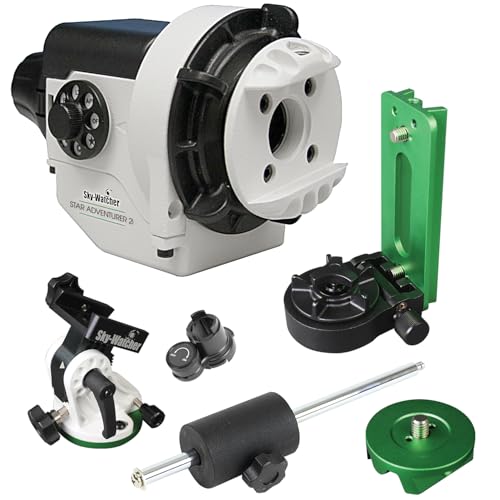
The Sky-Watcher Star Adventurer 2i Pro Pack is a compact, motorized night-sky tracker designed for portable wide-field astrophotography. Its modular design supports time-lapse sequences, panoramas, and basic telescope use, making it suitable for landscapes and night skies. Wi-Fi connectivity enables smartphone control, simplifying operation from challenging viewpoints. The interchangeable design allows integration with existing tripods, broadening its versatility for travel and field work.
- Portable nightscape tracking platform: Motorized portable tracking platform perfect for capturing incredible detail of the Milky Way, eclipses and other astronomical objects.
- Wide-field astrophotography: The unique, modular design allows for integration with existing photographic tripods. Wide-field astrophotography as well as time-lapse video and telescopic use are all possible with the Star Adventurer 2i.
- New features: The new, upgraded Star Adventurer 2i includes Wi-Fi, allowing for smartphone control using Sky-Watcher’s free SAM Console app.
SkyTracker Pro Mount

The iOptron SkyTracker Pro offers dependable tracking with a robust die-cast aluminum body and a 25 mm RA shaft. This combination reduces vibration and supports a mid-weight payload, making it suitable for beginners and enthusiasts who want reliable performance without bulky gear. The included polar scope aids quick alignment, helping you achieve accurate celestial tracking for longer exposures and sharper star fields.
- SUPERIOR STABILITY – Features a die-cast aluminum body with ABS cover and a 25mm diameter steel RA shaft, ensuring minimal vibration for crisp, clear astrophotography sessions.
- HIGH PAYLOAD CAPACITY – Supports up to 6.6 lbs (2.99kg), making it ideal for various camera and lens combinations, offering versatility for different astrophotography setups.
- PRECISION TRACKING – Equipped with R.A. automatic tracking and multiple tracking speeds (1X Cel, 1/2 Cel, solar, lunar, N/S) for capturing celestial objects with accuracy.
PMC-Eight Equatorial System

The iEXOS-100-2 PMC-Eight is a high-performance equatorial tracking system built around a multi-processor PMC-Eight architecture. The system promises fast response, smooth tracking, and efficient operation for astrophotography sessions, including time-lapse and deep-sky imaging. Its advanced control and precision mechanics aim to deliver reliable GoTo capabilities and repeatable tracking across a range of observing conditions.
- Integrated Explore Scientific PMC-Eight system that transcends the industry standard single processor by utilizing eight CPUs that operate independently of one another to focus on defined functions, which results in superior responsiveness, efficiency, reliability and astoundingly fast timing intervals.
- Clutched dual-axis worm gears with quiet precision stepper motor belt drives.
- Intuitive ExploreStars app, which is available for Apple, Android and Windows tablets, that makes it simple to operate the GOTO system. Through it, users can quickly align their telescope, navigate the stars and learn specifics about tens of thousands of celestial objects.
Starboosa Camera Adapter Mount

The Starboosa Telescope Camera Adapter Mount offers a compact way to attach cameras to finders or telescope accessories. Its all-metal aluminum alloy construction and standard dovetail base provide solid compatibility with many cameras and lenses used in sky photography. The combination of a 1/4-inch mounting screw and a lightweight body makes it an accessible accessory for prime focus shots, guiding setups, or finder-based photography.
- Universal Finderscope Dovetail Base Featuring a 1.3in/33mm standard dovetail clamp for effortless attachment of guide scopes or finders to your camera, while the bottom cold shoe fits most camera flash shoes for seamless and stable integration, quickly capturing the targets on the night sky when using a telescope with your camera.
- Dual Lock System Comes with the knurled screw and thumb screw to tight lock your device by hand on the camera. The knurled design adds friction and provides precise torque for ease of use.
- Built to Last The all metal aluminum alloy construction withstands regular use, and the precisely CNC machined and black anodized treatment ensures its long term durability. At just 45g/1.59oz, its robust body supports up to 2.2lb/1kg.
Buying Guide
When selecting a camera mount for astrophotography, balance your goals with practical constraints. Consider how you plan to shoot—traveling across dark-sky parks or building a more permanent setup at a fixed observing site. Evaluate stability against weight, tracking accuracy, and the availability of accessories that simplify alignment and imaging workflows. Below are key factors to weigh and how different approaches compare.
Stability And Vibration Control
Stability minimizes star trailing and image blur. All-metal frames and precision machining reduce micro-vibrations, especially when using longer lens combos. If you frequently shoot from on-the-go locations, prioritize mounts with rigid construction, well-balanced counterweights, and solid RA (right ascension) shafts. Consider whether the mount offers vibration damping or isolation options for delicate sensors or heavy cameras.
Tracking Capabilities And Speed Options
Different astrophotography styles demand different tracking profiles. Some mounts provide basic sidereal tracking, while others offer 1X sidereal, half-sidereal, solar, lunar, or customized speeds for precise framing. If you shoot wide-field Milky Way scenes or time-lapse sequences, a motorized tracker with GoTo or manual control can dramatically reduce setup time and post-processing complexity.
Payload, Balance And Camera Compatibility
Match the mount’s payload rating to your camera and lens combination with headroom for future upgrades. Proper balance reduces strain on drive systems and improves tracking accuracy. Check the base compatibility with your tripod or pillar, as well as the ability to attach a finder scope, autoguider, or a guiding accessory for long-exposure work.
Connectivity, Control And Apps
Wi‑Fi, Bluetooth, or wired control can simplify field operations. An accompanying mobile app or computer interface should offer intuitive alignment, catalog navigation, and easy GoTo. Ensure the control protocol is active and well-supported, especially if you plan to use guiding software or remote shutter control during remote sessions.
Portability, Setup Time And Usability
On-location astrophotography benefits from lightweight, compact systems that are quick to assemble and calibrate. A modular design lets you pack efficiently and deploy rapidly, which is valuable when chasing fleeting weather windows or limited observing time. Weigh how much time you’re willing to invest in polar alignment and field checks relative to the quality of your final images.
Budget Considerations And Long-Term Value
Prices reflect build quality, features, and future-proofing. A higher upfront investment can translate into more stable images, longer service life, and easier upkeep. Compare included accessories and warranty terms to determine overall value. If you expect evolving needs, consider a system with scalable upgrades, such as integrated GoTo, app control, or compatibility with additional guiding equipment.