Best Camera Lenses for Astrophotography: Top Picks
Astrophotography demands gear designed to perform in cold, dew-prone conditions while delivering clear, sharp images of the night sky. The following selections emphasize dew prevention, reliable imaging, and practical compatibility with common telescopes and cameras. Each product is tailored to help maintain lens clarity during long exposures and reduce the impact of humidity, temperature swings, and condensation on your astrophotography workflow.
| Product | Brand | Key Benefit |
|---|---|---|
| Lens Warmer With Cold Flexible Cable | MOVE SHOOT MOVE | Prevents dew and condensation on lenses in cold nights |
| SV105 Telescope Camera | SVBONY | Entry-level imaging for lunar and planetary targets |
| SV305C Astrophotography Camera | SVBONY | Low-noise color imaging for EAA and planetary work |
| NEEWER HW-23B Lens Heater | NEEWER | Long dew protection for lenses up to 600mm |
| JJC USB Lens Warmer | JJC | Compact dew prevention for smaller lenses |
Lens Warmer With Cold Flexible Cable Down To -25C

The MOVE SHOOT MOVE lens warmer uses a flexible neoprene strip that remains pliable down to -25°C, reducing the risk of condensation on critical optics during long night sessions. The material helps minimize heat loss in the atmosphere, promoting efficient power use and consistent warmth. A built-in temperature regulator with three levels allows tailored control, delivering up to approximately 167°F for rapid initial warming and steady maintenance as temperatures fall.
Designed for compatibility with a wide range of lenses and telescopes, this warmer is suitable for both camera bodies and observational equipment. Field performance notes indicate that the neoprene wrap is easy to position without overly constraining the lens barrel, aiding in rapid setup between targets. While it emphasizes dew prevention, users should consider pairing it with stable power sources for extended sessions.
SVBONY SV105 Telescope Camera
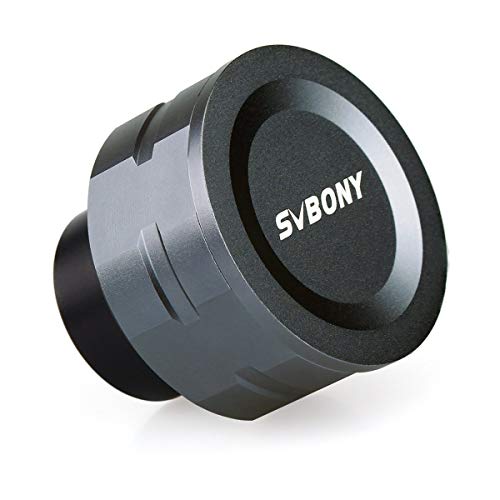
The SV105 is a 1.25″ USB2.0 IMX307 color camera designed as an entry point for astronomical imaging. It suits lunar and planetary photography, offering a straightforward “plug and play” workflow without driver installs on Windows. Real-time viewing can be streamed to a laptop, making it a practical option for beginners exploring astrophotography. Compatibility considerations include Sharpcap Capture for Windows and AstroDMx Capture for Linux, with Android support via USB Camera apps.
For beginners, the SV105 provides immediate access to bright planetary and lunar imagery, helping new users learn exposure and framing. While not a dedicated deep-sky imager, its simplicity supports quick practice sessions, while still fitting into a broader setup that could be expanded with more advanced cameras later.
SVBONY SV305C Astrophotography Camera

The SV305C is a color-entry level telescope camera featuring the IMX662 sensor with a 1/2.8” back-illuminated design and 2.9μm pixels. It offers improved light sensitivity and reduced readout noise, making it suitable for planetary, lunar, and EAA (Electronically Assisted Astronomy) applications. The sensor design helps manage overexposure and provides solid performance in red spectral bands, contributing to better detail in planetary images and brighter lunar captures.
This camera is targeted toward beginners and enthusiasts who want a reliable, straightforward imaging tool that can pair with standard 1.25″ eyepieces and small telescopes. Users should be prepared to manage exposure settings and consider a PC-based processing workflow to maximize the captured data’s potential.
EF/EF-S 420-800mm F8.3 Telephoto Zoom Lens (Manual)

This fully manual telephoto zoom provides a flexible range for distant targets and is designed for precise manual focusing. It offers a large focus ring and internal focusing, with UMC technology to reduce aberrations and flare. The lens automatically adjusts the effective aperture with focal length, balancing performance across the 420–800mm range. It is compatible with EF/EF-S mounts and supports 62mm filters, enabling more control over contrast and color in night-sky photography.
The manual design makes it ideal for photographers who enjoy hands-on control and want to experiment with long-exposure compositions. Because it is fully manual, users should ensure camera bodies are set to M mode and be prepared for a slower workflow while dialing in precise exposure and focus settings for best results.
Altura Photo 8mm Fisheye Lens for Canon
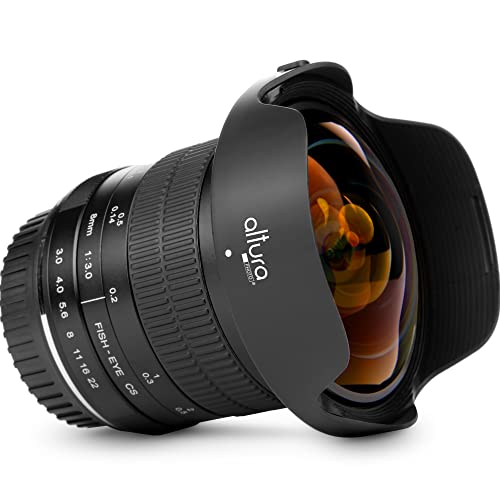
The Altura Photo 8mm f/3.0 fisheye provides an ultra-wide field of view for Canon APS-C cameras, enabling dramatic night-sky panoramas and immersive star field images. It features a robust metal construction, a hybrid aspherical element, and multi-layer coatings designed to minimize aberrations and maximize sharpness. While it is compatible with full-frame Canon bodies, expect a circular vignette on full-frame sensors due to the circular image circle of fisheye optics.
Key considerations include manual focus operation and compatibility with older and current Canon DSLRs. The fisheye’s extreme perspective is well-suited for sky surveys, aurora captures, and creative star-trail imagery, but not ideal for detailed planetary work where higher optical accuracy at longer focal lengths is preferred.
NEEWER 23.6″/600mm USB Lens Heater Warmer

The NEEWER HW-23B offers a 23.6-inch (600mm) heater strip with a built-in temperature regulator and three heat settings. It’s designed to fit lenses, telescopes, and binoculars with large circumferences, providing a steady warmth to prevent dew and condensation during cold or humid sessions. The device is described as lightweight and portable, making it convenient for fieldwork and travel to remote dark-sky locations.
With three temperature settings, users can tailor warmth to weather conditions—from brisk winter nights to damp early mornings. The long length makes it suitable for larger lenses and telescopes, but care should be taken to manage cable routing and power supply to avoid interference with mounting hardware during imaging runs.
NEEWER 12″/300mm USB Lens Heater Warmer
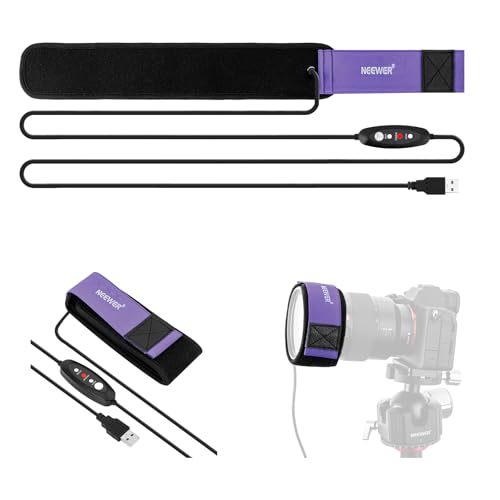
The NEEWER HW-28B offers a compact 12-inch heater strip with a three-level temperature regulator. It’s built to raise a lens’s temperature above the dew point, effectively preventing fogging during cold and humid sessions. The heating element is designed for quick response, minimizing downtime between frames and enabling longer, uninterrupted imaging runs on smaller to mid-sized lenses and optics.
Users should note the device’s suitability for smaller diameter lenses and its portability for field use. Pairing with a compatible power source is recommended to maintain stable temperatures across extended sessions. The 3-temperature settings help adapt to varying conditions and dew formation risks during astrophotography shoots.
JJC USB Lens Warmer, 80mm

The JJC USB lens warmer is a compact 80mm dew prevention band designed for smaller lenses and telescope eyepieces. It features a 1.5m temperature regulator with three heat settings and a low-temperature design that remains functional down to -40°C. This device is particularly useful for travelers and photographers who require a light and unobtrusive dew control solution for compact optical setups.
Practical considerations include ensuring compatibility with your specific lens diameter and mounting setup. The JJC warmer’s slim profile makes it easy to route cables without obstructing the camera or telescope controls, while the three-regulator option provides adaptable performance for night-sky sessions in varying climates.
Buying Guide: Key Purchase Considerations
- Purpose and compatibility: Match dew prevention and heaters to your lens diameter and telescope setup. Larger lenses and longer exposures benefit from longer heaters, while compact rigs may be covered by smaller warmers.
- Temperature control: Seek models with adjustable temperature settings and clear indicators to avoid overheating or under-heating the optics, which can impact image quality.
- Power source and portability: Consider whether your field setup supports USB power, external batteries, or standard mains adapters. Weight and cable management are important for mobile astro setups.
- Material and build quality: Neoprene or other insulating materials reduce heat loss and improve efficiency. A flexible wrap that doesn’t stress the lens barrel is preferable for quick adjustments.
- Ease of use and setup time: Heaters with simple installation, quick connection, and minimal maintenance save valuable imaging time during clear skies.
- Broader imaging workflow: Heaters work best when integrated with a weather plan and dew point monitoring. Combine with proper cooling, camera settings, and post-processing to maximize results.
- Safety: Ensure electrical insulation and temperature limits are clearly defined to avoid damage to optics or electronics in cold environments.
These products collectively address dew prevention, basic astrophotography imaging needs, and portable field use. When building an astrophotography kit, pairing dew heaters with a reliable power setup and a flexible image processing workflow will help maintain image quality across diverse observatory and outdoor conditions.