Best Camera Lens Mount Adapters for Expanding Your Canon and Sony Gear
Many photographers expand their kit by adapting lenses across different camera systems. This guide highlights top camera lens mount adapters that help you use EF, EF-S, or other lenses on Canon EOS R-series bodies, EOS M cameras, Sony bodies, and more. Each option offers varying levels of autofocus, stabilization, and build quality to fit different shooting styles and budgets.
Summary of chosen products
| Product | Brand | Mount Pairing | Key Benefit |
|---|---|---|---|
| Canon Mount Adapter EF-EOS R | Canon | EF/EF-S to EOS R | Dust- and water-resistant; exterior matches EF lenses |
| EF-EOS M Lens Adapter Auto-Focus | EBYPHAN | EF/EF-S to EOS-M | AF speed, built-in IS, direct aperture control |
| Fotodiox Lens Mount Adapter | Fotodiox | Nikon F to Canon EF/EF-S | All-metal design; manual operation |
| Lens Mount Adapter EF-EOS R (Canon EF/EF-S) | YELLBIN | EF/EF-S to EOS R | IS stabilization; gold-plated signal pins |
| VILTROX EF-EOS M Lens Mount | VILTROX | EF/EF-S to EOS M | AF and IS; broad compatibility with EOS M series |
Canon Mount Adapter EF-EOS R: EF/EF-S to EOS R

This standard mount adapter enables EF and EF-S lenses to work on Canon EOS R-series bodies, including EOS RP, EOS R, EOS R6, and EOS R5. The exterior design mirrors EF lenses for a familiar grip, and the unit is dust- and water-resistant for challenging shooting environments. Autofocus performance is generally reliable with compatible lenses, making it a solid first choice for Canon shooters expanding into mirrorless bodies.
EF-EOS M Lens Adapter Auto-Focus (Canon EF/EF-S to EOS-M)
Designed for Canon EF and EF-S lenses used with Canon EOS-M models, this adapter supports auto-focus and aperture control from the camera. It includes an inbuilt image stabilizer to improve sharpness in handheld shots and provides data feedback via the camera’s display. A practical option for those who want to keep using existing lens collections on smaller Canon mirrorless bodies.
Fotodiox Lens Mount Adapter (Nikon F to Canon EF/EF-S)

Fotodiox offers a manual adapter that lets Nikon F-mount lenses fit Canon EF/EF-S bodies. It features high-tolerance craftsmanship with an all-metal, hardened anodized aluminum construction. Since this is a manual adapter, expect no electronic communication or autofocus, but it unlocks wide lens options for Canon shooters seeking a budget-friendly path to vintage Nikon glass.
Lens Mount Adapter EF-EOS R (Canon EF/EF-S)

This adapter is designed for Canon EF/EF-S lenses to work with Canon EOS R, RP, R5, R6, R7, and R10 cameras. It includes built-in image stabilization support and a gold-plated contact pin system for improved data transmission, along with AF and aperture control from the body. It’s a versatile option for shooters deep in the Canon ecosystem seeking reliable performance across multiple RS-series bodies.
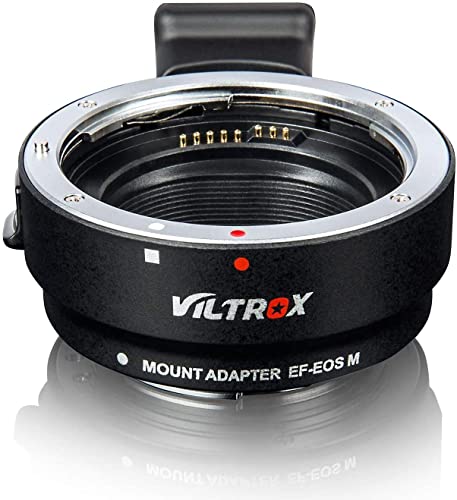
VILTROX EF-EOS M Lens Mount Adapter

This adapter allows you to attach Canon EF/EF-S lenses to Canon EOS M cameras, enabling autofocus and image stabilization across a broad lens lineup. It also features a removable tripod mount and aims to preserve as much optical functionality as possible when shifting from an EF-M perspective to broader Canon lens compatibility. It’s suitable for EOS M users looking to maximize lens flexibility.
Camera C-Mount to CS Extension Tube Adaptor

Designed for CCTV and surveillance-style cameras, this C-to-CS mount adapter is built from aluminum for durability. It provides a simple spacer solution and can be useful for specific studio or industrial setups where C-mount optics need to be repurposed on CS-compatible devices. It is not intended for standard shot-ready photography but expands compatibility in niche applications.
Buying Guide: Key Factors When Choosing a Lens Mount Adapter
Adapting lenses across mounts involves trade-offs. This buying guide outlines practical considerations to help you pick an adapter that aligns with your camera system, shooting style, and budget.
- Mount compatibility: Ensure the adapter matches both your lens mount and camera body. Some adapters are one-way, while others support multiple lens mounts.
- Autofocus and exposure control: Some adapters offer full AF and EXIF data transmission, while others are manual only. Consider whether you rely on reliable AF for your subject matter.
- Image stabilization: Built-in IS can improve handheld shots, especially with longer lenses. Verify whether stabilization works with your camera’s IS system.
- Build quality: All-metal designs tend to be more durable and shield against dust and moisture, but may be pricier. Plastic builds are lighter and cheaper but can wear over time.
- Optical and data transmission: Gold-plated contacts and precise signaling help preserve exposure, shutter, and ISO data in the camera. Poor signals can degrade performance.
- Infinity focus and alignment: A high-tolerance design is crucial for maintaining sharpness at various focusing distances, especially with older glass.
- Ease of use: Some adapters include quick-access controls or a built-in iso or aperture control ring. Consider what features improve your workflow.
- Price and availability: Budget options exist, but very low-cost adapters may compromise AF speed, stabilization, or build.
- Future-proofing: If you plan to switch bodies or lenses, choose adapters with broad compatibility and regular firmware updates.
Overall, the right lens mount adapter depends on whether you prioritize autofocus performance, stabilization, or simply the ability to repurpose existing lenses across camera systems. For Canon users moving between EF/EF-S lenses and EOS R bodies, adapters with reliable AF and IS tend to deliver the best balance of practicality and image quality. For Nikon or vintage glass, manual adapters provide budget-friendly versatility, though at the cost of autofocus.