Best Camera Flashes for Real Estate Photography: Affordable, High-Quality Lighting Solutions
Real estate photography hinges on clean, evenly lit rooms and sharp details. A capable off-camera flash setup helps eliminate harsh shadows, balance windows, and bring out architectural textures. The following selections are compact, versatile, and well-suited for property shoots, offering manual control, multiple flash modes, and reliable performance across popular brands. This guide highlights five options that strike a balance between power, ease of use, and value.
| Product | Brand | Light Output (GN) | Key Strengths |
|---|---|---|---|
| PHOTOOLEX Camera Flash (FK310) | PHOTOOLEX | GN 33 | Balanced 5500K light, three flash modes, solid build |
| NEEWER TT560 Camera Flash Speedlite | NEEWER | GN 38 | Affordable, reliable manual control, optical slave option |
| Godox TT600 Wireless Flash | GODOX | GN 60 | 2.4G wireless, master/slave, wide compatibility |
| PHOTOOLEX LCD Camera Flash (FK310) | PHOTOOLEX | GN 33 | LCD control, multiple modes, solid daylight color |
| Powerextra DF-400 Speedlite | Powerextra | GN 33 | Multiple flash modes, PC port, broad camera compatibility |
PHOTOOLEX FK310 Camera Flash

The FK310 from PHOTOOLEX delivers a compact, high-conductivity flash with a 33 guide-number. It maintains a steady 5500K daylight color and features manual, S1, and S2 modes for flexible lighting scenarios. Its multi-flash mode supports adjustable output across a range from 1/128 to 1/4, with convenient left/right Fn controls for power adjustments. TTL and camera menu control aren’t supported, making it a straightforward option for studio-like real estate lighting.
NEEWER TT560 Flash Speedlite
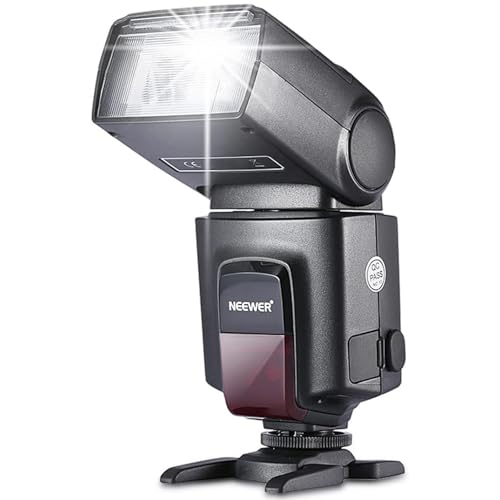
The TT560 is a budget-friendly speedlight with a GN of 38 (ISO 100) and eight manual power levels. It provides a stable daylight color around 5600K and offers S1/S2 optical modes for off-camera use. A PC sync port enables wired triggering, while the head’s vertical and horizontal rotation supports versatile setups for interior real estate shoots. Note that TTL, HSS, and camera-menu controls are not supported, keeping operation simple and predictable.
GODOX TT600 Wireless Flash

The TT600 integrates Godox’s 2.4G X system for wireless control, enabling remote triggering, high-speed synchronization, and coordinated lighting with other Godox devices. It is compatible with Canon, Nikon, Pentax, Olympus, Fujifilm, Panasonic, and other cameras with a standard hot shoe. With built-in wireless transmission and a broad working range, it supports complex lighting setups that real estate photographers often rely on to balance bright windows and dim corners.
Powerextra DF-400 Speedlite

Powerextra’s DF-400 offers a guide number of 33 and supports manual, S1, and S2 modes with a single-contact hot shoe. It includes adjustable vertical (0–90°) and horizontal (0–270°) rotation, making it suitable for interior real estate shots where ceiling and wall lighting angles matter. An 8-level power output indicator helps operators dial in the right exposure, though it requires compatible batteries and may differ in performance from higher-end models.
PHOTOOLEX LCD Model (FK310)

This LCD-equipped PHOTOOLEX model mirrors the FK310’s light characteristics with a 33 GN and 5500K daylight balance. Its LCD interface helps with mode selection and output settings, streamlining workflow during property shoots. Like the FK310, it lacks TTL and menu-based control, which can simplify operation for photographers preferring manual-style lighting control on real estate projects.
Buying Guide: Key Purchase Considerations
Power and light quality matter. For real estate photography, aim for a flash with a reliable GN range and consistent color temperature around 5500K. Manual control provides predictable results across varying room sizes and window lighting conditions. If you often shoot larger properties or rooms with strong daylight contrasts, consider a flash system with wireless triggers or compatibility with multiple accessories for off-camera use.
Ease of use and setup time can save hours on a shoot. Simpler flash models with clear mode labeling and straightforward power adjustments enable rapid lighting decisions. Off-camera flexibility, whether via optical S1/S2 modes or wireless triggers, supports more natural, evenly lit interiors without relying solely on on-camera flash bounce.
Compatibility is another critical factor. Cameras from Canon, Nikon, Sony, Fujifilm, Panasonic, and Olympus share hot shoes with common speeds, but some units require dedicated triggers for advanced features like high-speed sync. If you anticipate expanding to more complex lighting rigs, a system with robust ecosystem options (like 2.4G wireless or a PC port) can future-proof the setup.
Durability and form factor influence transport and field performance. Compact flashes save space in travel kits and on tight shoot schedules. Look for sturdy construction, reliable batteries or power options, and straightforward maintenance to minimize downtime during client projects.
Cost-to-performance is another consideration. Budget options can meet essential needs for smaller spaces or quick property shoots, while higher-output, feature-rich models deliver more consistent results in challenging interiors. Balancing price with required features will ensure you get reliable lighting without overspending.
Additional notes for buyers: assess whether you need TTL, high-speed sync, or advanced wireless integration. For most real estate tasks, manual modes with solid color accuracy and a dependable recycle time are enough to produce professional results. Always test your setup in a couple of rooms to calibrate exposure and grading before an important listing shoot.