Best Camera Brackets for Tripods: Top L-Brackets for Stable Shots
Choosing the right camera bracket for a tripod can dramatically improve stability, framing speed, and workflow in the field or studio. This guide spotlights top L-brackets and mounting accessories designed to switch quickly between portrait and landscape, plus dual-mount options for cameras, lights, and accessories. The selections emphasize durability, broad compatibility, and easy attachment to Arca-Swiss or compatible plates. A concise summary table below helps you compare key specs at a glance, followed by detailed product sections to help you pick the best fit for your setup.
| Product | Brand | Key Benefit |
|---|---|---|
| Vikii Store DSLR L Bracket Vertical/Horizontal | Vikii Store | Portrait/landscape quick switch; CNC aluminum |
| UTEBIT 11 Inch Flash Bracket | UTEBIT | Long extension with dual mounting holes |
| NEEWER 8 Inch Dual Camera Bracket | NEEWER | Two-camera/dual-mount versatility |
| TOSICAM Real Single L Bracket | TOSICAM | Arca-Swiss compatible; simple vertical/horizontal switch |
| Foldable DSLR L Bracket Arca Base | Generic | Foldable, portable Arca-Swiss system |
Vikii Store DSLR L Bracket Vertical/Horizontal

The Vikii Store L bracket supports rapid orientation changes from landscape to portrait without relying on a ball head, preserving camera level and composition during transitions. It is machined from aviation-grade aluminum using CNC techniques, delivering a balance of light weight, high strength, and long life. The design emphasizes precise tolerances to minimize flex when mounted on tripods, monopods, or stabilizers, ensuring stable framing even with longer lenses. Compatibility spans many brands and bodies listed in the promo copy, making it a versatile choice for multi-camera setups or rental kits.
In practice, this L bracket provides a secure vertical mounting option for portrait shots and a seamless swap to landscape without re-framing. The robust build supports extended use with heavy camera bodies and accessories, while the precision machining helps maintain alignment with quick-release plates. Users should verify Arca-Swiss compatibility with their specific base plates and ensure their gimbal or stabilizer quick-release plate accepts an auxiliary bracket without interference.
UTEBIT 11 Inch Flash Bracket
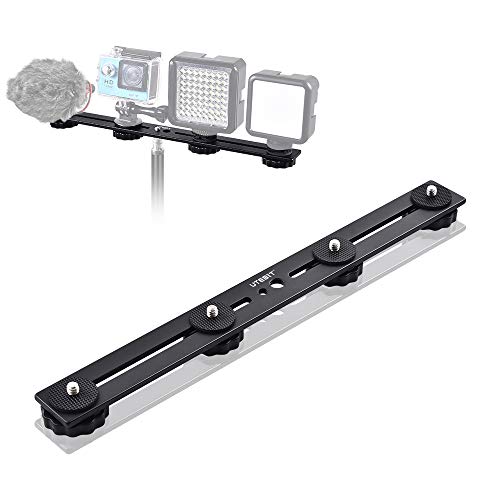
The UTEBIT 11-inch flash bracket extends lighting farther from the camera, enabling broader and more flattering illumination angles. Constructed from aluminum alloy, it offers a strong load capacity and a slim profile that stays travel-friendly. The bracket features standard 1/4-inch and 3/8-inch screw holes in the center, allowing easy attachment of cameras, LED lights, or small microphones. Its length supports better balance when using large external flashes or compact LED panels, reducing red eye and harsh shadows while maintaining a manageable weight on the tripod or light stand.
When using this bracket, photographers can position lights or accessories to create depth and contrast without crowding the camera body. It’s compatible with a wide range of camera bodies and stands, and its robust construction helps sustain field use. For best results, pair it with a stable tripod and verify the balance of two accessories mounted on the bracket to prevent tip or sway in outdoor wind or crowded studio spaces.
NEEWER 8 Inch Dual Camera Bracket

The NEEWER 8-inch dual camera mount makes it possible to mount two cameras or two auxiliary devices on a single tripod head, a practical option for stereo photography, interview setups, or on-location testing. At 8 inches long, the bracket stays compact while offering a solid aluminum construction that supports multiple pieces of gear without excessive sway. The design includes straightforward mounting points and standard screw interfaces, enabling quick setup changes when switching between rigs or light configurations on the fly.
For users, this dual-mount bracket reduces the need to switch plates or swap tripods for different angles. It’s well suited to photographers who routinely shoot from two viewpoints or need to balance two light sources. As with any dual-mount system, balance and center of gravity are important; ensure both cameras or devices share a common, stable base to maintain precision during long shoots or time-lapse sessions.
TOSICAM Real Single L Bracket

The TOSICAM Real Single L Bracket is designed for smooth vertical and horizontal shooting, avoiding the need for a separate ball head for most framing tasks. It emphasizes a simple, stable link to the camera via an Arca-Swiss quick-release plate, with a cautionary note that it is not directly compatible with non-Arca base plates like some Manfrotto systems unless the original plate is used. The bracket is touted as easy to use for vertical shooting and is presented as a reliable partner for stable, precise compositions when paired with a compatible quick-release system.
Users should carefully review compatibility with their base plate and stabilizers. While the bracket excels for portrait-focused framing, those using gimbals or multi-attachment rigs should verify how this bracket integrates with the gimbal’s own quick-release plate. The design prioritizes simplicity and stability, making it suitable for travel and studio setups where quick orientation changes are frequently required.
Foldable DSLR L Bracket Arca Base

The Foldable DSLR L Bracket offers a compact, travel-friendly solution with Arca-Swiss compatibility. Its two milled aluminum plates fold together, enabling a smaller footprint when stored and easily deployed in field work. The folding mechanism locks when extended and can be folded back with a push of a button, helping photographers move quickly between vertical and horizontal shooting without compromising stability. The construction emphasizes lightweight strength, making it suitable for travel shoots, events, and on-location work where space and weight matter.
In use, this bracket shines for photographers who value portability without sacrificing rigidity. It supports both orientations on Arca-Swiss compatible plates, enabling straightforward swapping between portrait-mode captures and wide-angle landscapes. While ideal for many DSLR and mirrorless bodies, users should confirm Arca compatibility with their specific tripod head and verify that any gimbal or stabilizer plates do not conflict with the foldable mechanism during operation.
Buying Guide
When choosing a camera bracket for tripod work, several factors determine the best match for your gear and shooting style. The following considerations cover performance, compatibility, and practical usage to help you compare options more effectively.
Compatibility and Standards
Arca-Swiss compatibility is a common baseline for modern quick-release systems. If your tripod, ball head, or gimbal is not Arca-compatible, ensure you have the appropriate adapter plates. Some brackets are designed to work only with Arca-Swiss plates, while others offer compatibility with multiple standards like Manfrotto. Before purchase, confirm that your camera body, lens size, and any added accessories fit securely on the bracket without interference with the quick-release system.
Load Capacity and Build Material
Most brackets are constructed from aluminum alloys to balance strength and weight. Check the stated load capacity, especially if you use heavier DSLR bodies or long telephotos. A bracket rated for 5 kg or more is generally sufficient for mid- to full-frame cameras with typical lenses, plus external flashes or small lighting panels. Durable CNC machining improves precision and minimizes flex under load, contributing to steadier framing in variable shooting environments.
Orientation and Quick-Release Behavior
Vertical and horizontal switching is a core feature of L brackets. Ensure the design allows fast orientation changes without losing level alignment. Some models offer screw-free linking for simplicity, while others rely on a traditional clamp system. Consider how frequently you switch between portrait and landscape, and whether you need a rigid lock to prevent drift during long exposures or video pans.
Accessory Compatibility and Expansion
Look for additional mounting points, such as built-in 1/4-inch and 3/8-inch holes, to attach lights, microphones, or monitors. Dual-mount brackets enable two devices on a single base, which can streamline setups for interviews, product shoots, or stereo photography. If you use a gimbal or stabilizer, verify that mounting brackets won’t interfere with the stabilizer’s own quick-release system and that the bracket can be used with your existing plates.
Portability and Storage
Foldable or compact designs are beneficial for travel photographers and event shooters. Foldable brackets reduce bulk in a camera bag and can be folded to a small footprint while maintaining rigidity when deployed. Consider weight, size, and ease of packing alongside other gear, especially if you carry multiple bodies or expanders for field assignments.
Practical Scenarios and Use Cases
Portrait photographers often value vertical mounting for optimal subject framing, while landscape shooters benefit from rapid landscape-to-portrait transitions. Studio setups may require dual-mount brackets to balance lighting or attach monitors. If you frequently work with stabilizers or gimbals, ensure compatibility and plan for potential plate adjustments. The right bracket should streamline your workflow, reduce setup time, and improve the consistency of shots across sessions.
Overall, the best choice depends on your camera weight, your typical shooting angle, and whether you prioritize foldability or maximum rigidity. If you routinely need two accessories or two cameras on one bracket, a dual-mount bracket is advantageous. For photographers who travel light, a foldable, Arca-compatible bracket can save space while delivering reliable performance in varied environments.