Best Camera Adapters for Telescopes to Enhance Astrophotography
Combining a camera with a telescope opens up the universe for prime-focus photography and eyepiece projection. This guide highlights versatile camera adapters designed to fit common DSLR, mirrorless, and smartphone setups, helping you capture sharper lunar details, star fields, and distant galaxies. Each choice balances ease of use, build quality, and compatibility, enabling eyepiece projection or prime-focus captures. Explore options from trusted brands to find the adapter that best fits your telescope and camera system.
Summary of selected products:
| Product | Brand | Primary Use | Notes |
|---|---|---|---|
| Starboosa Variable Extension Telescope Camera Adapter (Canon) | starboosa | Canon SLR/DSLR prime focus and eyepiece projection | Variable extension; supports eyepieces in extension tube |
| Celestron Smartphone Adapter for Telescope | Celestron | Phone-based imaging through scope | Universal fit; works with many devices and cases |
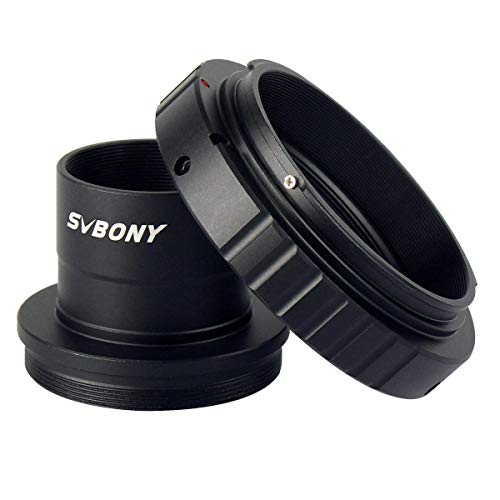
| SVBONY T2 Ring Adapter | SVBONY | Canon EOS prime-focus attachments | 1.25″ metal adapter; simple to use |
| Starboosa Telescope Camera Adapter (Nikon) | starboosa | Nikon DSLR prime focus and eyepiece projection | Includes T2 ring; broad Nikon compatibility |
| Celestron 93633-A T-Adapter | Celestron | DSLR/SLR to Schmidt-Cassegrain prime focus | Direct telescope attachment with T-threads |
Starboosa Variable Extension Adapter for Canon

Overview
This variable extension telescope camera adapter attaches directly to Canon SLR and DSLR bodies via a T2 ring, enabling both prime-focus photography and eyepiece projection. Mirrorless cameras are not suitable for this configuration, according to the product notes. The extendable design allows you to position the camera relative to the telescope, with space inside the extension tube to place eyepieces for enhanced detail and clarity. It’s a practical accessory for enthusiasts pursuing astrophotography with established Canon systems.
Key Features
- Variable extension to tailor focal distance
- Works with Canon SLR/DSLR bodies (not ideal for mirrorless)
- Extension tube accommodates eyepieces for improved image quality
- Suitable for prime-focus and eyepiece-projection photography
Celestron Smartphone Adapter for Telescope

Overview
The Celestron Smartphone Adapter enables image capture through a telescope, binoculars, spotting scopes, or microscopes by mounting a smartphone over the eyepiece. It fits a wide range of modern phones, including those with protective cases. The design is straightforward: place your phone over the eyepiece, align, and secure with knobs. This option is ideal for quick capture and sharing of lunar details, craters, and planetary views, especially for beginners who want an approachable entry into digiscoping.
Key Features
- Universally compatible with many smartphones
- Simple alignment and securing process
- Capable of capturing stills and videos through the eyepiece
- Stout metal build for travel-friendly use
SVBONY T2 Ring Adapter
Overview
This T2 ring adapter is designed to integrate Canon EOS cameras with telescope systems via a standard 1.25″ mount. It is compatible with Canon EOS SLR and DSLR cameras using EF mounts, and notes that EOS-M models are not supported. The adapter makes direct prime-focus photography straightforward and pairs with a T-adapter to connect to the telescope. It’s a compact, reliable option when you want a simple, robust connection without extra length or complexity.
Key Features
- 1.25″ universal T adapter
- Compatible with Canon EOS EF-mount cameras
- Direct prime-focus connection to telescope
- Simple to install and use
Starboosa Nikon Camera Adapter

Overview
Starboosa’s Nikon-oriented camera adapter provides a variable extension solution for Nikon SLR and DSLR bodies, with a T2-Ring included for rapid camera-to-telescope connections. Mirrorless cameras are discouraged for use with this model, per the product guidance. The design emphasizes ease of use and flexible positioning, enabling prime-focus and eyepiece projection techniques to capture detailed lunar textures and planetary features with Nikon gear.
Key Features
- Variable extension for precise focal distance
- Broad Nikon DSLR compatibility with T2-Ring
- Supports both prime focus and eyepiece projection
- Durable, user-friendly construction
Celestron 93633-A T-Adapter

Overview
The Celestron 93633-A T-Adapter is designed to connect DSLR or SLR cameras to Schmidt-Cassegrain telescopes for prime-focus photography. It threads onto the rear cell of the telescope and uses T-threads that accept brand-specific T-rings (sold separately). This straightforward, sturdy option is a staple for those who already own a Celestron SCT and want reliable, modular upgrading to photographic capabilities without additional complexity.
Key Features
- Direct sequence to SCT rear cell
- T-thread compatibility for various camera brands
- Solid metal construction for travel and rugged use
- Essential for prime-focus astrophotography with SCTs
Astrophotography Buying Guide: Camera Adapters For Telescopes
Key compatibility considerations
Identify your camera type (DSLR, mirrorless, or smartphone) and confirm the telescope’s connective options (1.25″ or 2″ focus tubes, rear cell threads, etc.). T-threads and specific brand rings (Canon EF, Nikon F, Sony E, etc.) determine which adapters will fit. For smartphone-based setups, verify your phone’s size and any protective case compatibility with the chosen adapter.
Prime-focus vs. eyepiece projection
Prime-focus photography is generally easier for beginners, delivering brighter images by attaching the camera directly to the telescope. Eyepiece projection can yield higher magnification but requires careful alignment of eyepiece, camera, and optical elements. Consider starting with prime focus to accumulate consistent results before attempting projection techniques.
Build quality and durability
Metal adapters with rigid mounts tend to resist flex and wobble, improving image sharpness. Look for anodized aluminum or steel construction and secure locking mechanisms. Lightweight plastic adapters may be adequate for casual use but may degrade stability during long exposures.
Ease of use and field practicality
Adapters that are easy to mount and align save time during observing sessions. Universal smartphone adapters are appealing for quick captures, while modular T-Adapters and 3rd-party rings excel for long-term setups with multiple cameras.
Future-proofing and expandability
Consider adapters that support multiple camera brands or allow for interchangeable rings. If you anticipate upgrading equipment, choosing adapters with widely supported thread standards (T-threads, 1.25″, 2″) helps maintain compatibility across gear generations.