Best Camcorder Firewire Port Cables and Cards for DV Transfers
If you’re seeking reliable FireWire (IEEE 1394) connectivity for DV camcorders and legacy devices, this guide helps you pick the right cable or card. This selection targets creators, editors, and hobbyists who still rely on 1394 ports for video transfer, capturing, or archiving footage. The top five picks balance compatibility, transfer speed, and ease of use across PC and Mac systems.
Buying quick-reference table:
| Product | |||
|---|---|---|---|
| PASOW FireWire Cable 9 Pin to 4 Pin | FireWire 800/400 Cable | Integrating 1394b devices with 1394a ports | Limited to 6 ft length |
| PASOW Firewire 4 Pin to 6 Pin Cable | FireWire 400 Cable | Direct camcorder to PC connection | Only 6 ft length |
| ELIATER PCIe Firewire Card | PCIe 1394a/1394b Card | Desktop editing with multiple devices | Internal upgrade required |
| Anu Limen FireWire PCIe Card | PCIe 1394a Card | 3-port expansion for DV cameras and externals | Limited to PCIe slot type compatibility |
| Cuifati PCIe Firewire Card | PCIe 1394a/1394b Card | High-performance multi-device setups | Needs PCIe availability in system |
PASOW 9-Pin to 4-Pin FireWire Cable

Type and purpose: This IEEE 1394b FireWire 800/400 cable connects FireWire 800 devices to legacy 1394a ports. It supports plug-and-play and hot-plugging, with twisted-pair construction and triple shielding to reduce cross-talk and maximize data transfer rates up to 800 Mbps. Best for users who need to bridge newer FireWire devices with older computer ports.
Who it’s best for: Editors or archivists with Camcorders or peripherals that use FireWire 400/800 and a modern host with 1394a ports. Ideal for short-range connections where cable length is within 6 feet.
Why selected: It directly addresses compatibility gaps between 1394b devices and 1394a ports, while offering robust shielding for stable transfers.
Caution: The 6-foot length may be limiting for desktop setups requiring longer runs without extenders.
PASOW FireWire 4-Pin to 6-Pin Cable
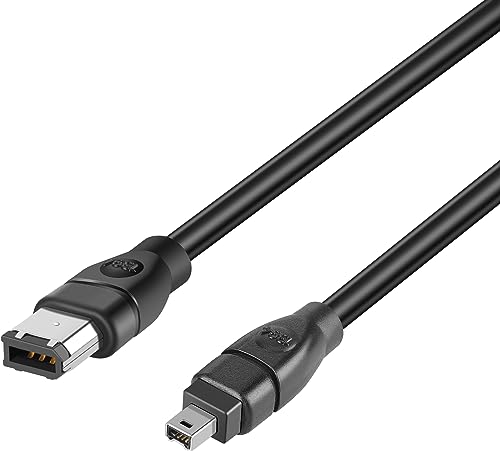
Type and purpose: FireWire 400 (6-pin) to FireWire 400 (4-pin) cable designed to attach a camcorder with a four-pin port to a computer’s six-pin port at up to 400 Mbps. Best for direct camera-to-PC transfers where the host lacks a 4-pin port on modern hardware.
Who it’s best for: Users with older DV camcorders needing a simple, single-cable solution without an internal PCIe upgrade.
Why selected: This cable directly matches common camera outputs to PC inputs, reducing adapter complexity.
Caution: Limited to 400 Mbps; not ideal for higher-bandwidth HD capture needs.
ELIATER PCIe Firewire Card
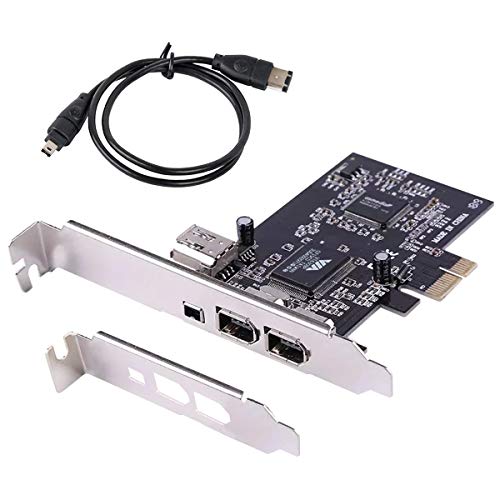
Type and purpose: A PCIe FireWire controller card with four ports (three 6-pin and one 4-pin). It supports 1394a/1394b devices and includes a low-profile bracket and cable. Best for upgrading a desktop to support multiple DV devices and external storage.
Who it’s best for: Desktop editors or archivists needing reliable multi-device FireWire access and easier bus distribution.
Why selected: It provides multiple ports, enabling simultaneous DV capture, transfer, and peripheral connections on a single machine.
Caution: Requires a PCIe slot and internal installation, which may be challenging on compact systems.
Anu Limen FireWire PCIe Card – 3-Port

Type and purpose: PCIe 1394a expansion adds three FireWire ports to a desktop, ideal for connecting multiple DV camcorders and external drives. Supports HD video capture and up to 1440×1080 resolutions via DV/HDV formats.
Who it’s best for: Professionals who need stable, high-bandwidth 1394a connections for simultaneous cameras or external storage in a desktop setup.
Why selected: Three ports increase device versatility without sacrificing transfer stability.
Caution: Performance depends on system bus and other PCIe devices sharing bandwidth.
Kouiyta USB to Firewire 4-Pin Cable for Sony DCR-TRV75E

Type and purpose: USB 2.0 Type-A to 4-pin FireWire connector designed specifically for the Sony DCR-TRV75E DV camcorder. Not a universal 1394 adapter; tailored to Sony devices for video viewing on PCs.
Who it’s best for: Sony DCR-TRV75E users seeking a dedicated, simple connection for playback viewing and basic transfers.
Why selected: Provides a straightforward bridge when a direct FireWire port is unavailable on a computer.
Caution: Not suitable for wide-device transfers or non-Sony camcorders.
Asobilor USB to Firewire Cable

Type and purpose: USB to 4-pin Firewire (iLink) adapter for Sony DCR-TRV75E and other DV camcorders. Enables video capture when USB-equipped hosts are used for data transfer. Replaces older native FireWire setups where USB is the available interface.
Who it’s best for: Users with Sony DV cameras and USB-centric workflows who need a lightweight transfer path.
Why selected: Offers a practical USB-to-FireWire solution when a FireWire port is absent on the computer.
Caution: May introduce latency or limited throughput compared to native FireWire connections.
Eilumduo FireWire Cable Bundle

Type and purpose: Pack of two 6-pin to 4-pin FireWire cables, supporting 400 Mbps transfer rates. Compatible with PC, Apple FireWire, and Sony i.LINK devices. Useful for multi-device setups and back-to-back transfers.
Who it’s best for: Users who need multiple cables for different devices or a spare cable for ongoing DV projects.
Why selected: The bundle simplifies extended shoots or archival work where several connections are needed.
Caution: 400 Mbps limit may be a bottleneck for high-definition HDV workflows compared to 800 Mbps FireWire 800 setups.
Cuifati PCIe Firewire Card

Type and purpose: PCIe FireWire expansion card with four ports (three 6-pin and one 4-pin), supporting 1394a/1394b with a 2.5 Gb/s full-duplex PCIe connection. Best for multi-device setups on a single system with PCI Express.
Who it’s best for: Pros who require simultaneous camera connections, external drives, and other FireWire peripherals on a single PC.
Why selected: Combines compatibility with both 1394a and 1394b devices and a robust data path through PCIe lanes.
Caution: Adequate power and spacing inside the PC are necessary for optimal performance and cooling.
Buying Guide: Key Considerations For FireWire Compatibility
- Device compatibility: Check whether your camcorder uses 4-pin or 6-pin FireWire (IEEE 1394a) and whether your host supports 1394b (FireWire 800). If you have newer devices or a mix of gear, a cable adapting 800/400 and a PCIe card with multiple ports can simplify setups.
- Connection type vs. speed: FireWire 800 offers higher theoretical transfer rates than FireWire 400. For standard DV transfers, 400 Mbps is often sufficient, but HD captures benefit from 800 Mbps when available.
- System compatibility: Desktop PCs may benefit from PCIe FireWire cards for expanded ports. Laptops often rely on external adapters or built-in connectors; verify driver support for your OS.
- Cable length and shielding: Longer cables can introduce signal loss in 1394, so choose the shortest reliable length and look for well-shielded cables to minimize interference.
- Ease of use: Plug-and-play and hot-plug support simplify workflows, especially when connecting multiple devices during shoots or edits.
Frequently Asked Questions
- What is FireWire 1394a vs 1394b? 1394a refers to the original FireWire standard with up to 400 Mbps; 1394b introduces FireWire 800 with up to 800 Mbps. Compatibility varies by device and host port support.
- Do I need a PCIe card for my camcorder? If your computer lacks a FireWire port or needs more ports, a PCIe FireWire card provides stable, dedicated throughput for multiple devices.
- Can USB-to-FireWire adapters work for video capture? USB adapters are often limited for real-time video capture or may not support all FireWire features. Native 1394 connections are more reliable for DV workflows.
- Is FireWire still relevant for modern editing? While USB-C and Thunderbolt are common, many legacy DV cameras and archival workflows still rely on FireWire, making compatible cables and cards valuable for preserving playback and transfer options.
- What should I consider when choosing a cable? Prioritize compatibility (pin type), length, shielding, and whether you need 800 Mbps support or a simple 400 Mbps link for DV transfers.
- Are dual or multi-port cards better for editing setups? Yes, multi-port PCIe cards enable simultaneous transfers from several cameras or devices, improving throughput during editing or archiving sessions.