Best 8mm F3.5 Fisheye Lenses for Creative Wide-Angle Shots
Choosing the right 8mm f/3.5 fisheye lens expands the possibilities for landscape, architecture, interiors, and creative photography. This guide compares practical options for APS-C and Micro Four Thirds systems, highlighting field of view, optical design, build quality, and versatility. Whether you shoot Canon, Nikon, Pentax, or Panasonic, the lenses below offer distinctive circular and diagonal fisheye effects with solid performance for travel and professional work.
| Lens | Camera Compatibility | Angle Of View | Notable Features |
|---|---|---|---|
| Meike 8mm f/3.5 | APS‑C (Canon EF-Mount compatibility noted) | 200° | Manual focus; minimum focus ~0.35 m; rectangular fisheye; easy manual operation |
| Rokinon 8mm f/3.5 HD | APS‑C (Canon EF mount) | 180° | 10 elements in 7 groups; detachable hood; high optical clarity |
| Rokinon FE8M-N | Nikon (APS‑C) | 180° | Built-in hood; compact and lightweight |
| PANASONIC LUMIX 8mm f/3.5 | Micro Four Thirds | 180° diag | ED glass; close focusing; inner focus system |
| Rokinon 8mm f/3.5 HD for Pentax | Pentax APS‑C | 167° diag | Detachable hood; sharp across the frame |
Below you’ll find five well-suited options, each with distinct strengths. The profiles include build notes and how they may suit landscape, architecture, or interior photography. All models in this guide are designed to offer dramatic perspective while maintaining optical reliability in real-world shooting conditions.
Meike 8mm F3.5 APS-C Fisheye Lens Review

The Meike 8mm f/3.5 is a manual focus rectangle fisheye lens designed for Canon EF‑Mount APS‑C cameras (with broader compatibility noted). Its design includes 8 groups and 11 elements, delivering a dramatic 200° field of view. A key practical note is the manual operation: users must enable “M mode” or “Release without lens” in the camera settings when appropriate. The minimum focusing distance is about 0.35 m, making it viable for close-in architectural details and immersive landscapes. The lens is lightweight and travel-friendly, great for shooters who want a distinctive corner-to-corner curvature with a classic fisheye look.
Strengths include a strong, wide perspective that excels for interior spaces and cityscapes, where the distortion emphasizes dramatic lines. Users who enjoy precise manual control will appreciate the tactile focusing and the distinctive barrel distortion that characterizes rectilinear to circular transitions. Consider this option if you value a high degree of control and a robust hardware profile in a budget-friendly package.
Rokinon 8mm f/3.5 HD Fisheye for Canon EF
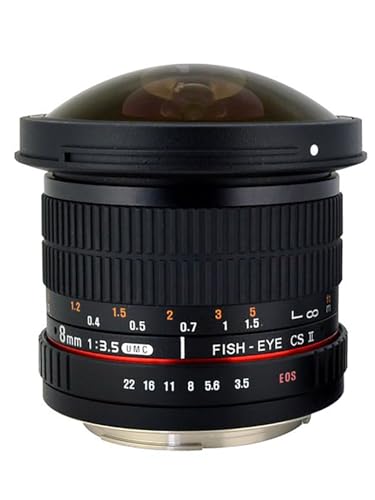
The Rokinon 8mm f/3.5 HD fisheye for Canon EF offers a dramatic 180° field of view on APS‑C bodies. Its optical design includes 10 elements in 7 groups, with one hybrid aspherical element to minimize distortion and aberrations while preserving sharpness across the frame. The lens construction is durable for travel and daily use, making it a solid choice for landscapes, interiors, and architecture where expansive perspective and vivid perspective shifts matter.
Notable features include a removable lens hood that enables greater flexibility in lighting conditions and the potential for circular fisheye effects when detached, depending on the camera body and sensor size. This model is a reliable balance between accessibility and image quality for photographers who want a ready-to-shoot option with strong edge-to-edge performance.
Rokinon FE8M-N 8mm F3.5 For Nikon APS-C

This Rokinon FE8M-N is tailored for Nikon APS‑C bodies and delivers a classic 180° diagonal view. Its straightforward optical design focuses on delivering reliable performance with practical handling, making it an appealing option for photographers who value consistency in architectural and landscape applications. The fixed hood is built in to help curb glare and flare while keeping the footprint compact for travel.
Key considerations include cylindrical distortion patterns that provide a distinctive look without excessive aberrations in most shooting conditions. While manual focus demands attention, experienced shooters often appreciate the tactile control and the lens’s ability to produce immersive, dramatic scenes with minimal setup.
PANASONIC LUMIX G FISHEYE 8MM F3.5

The Panasonic Lumix 8mm f/3.5 is designed for Micro Four Thirds mirrorless bodies, delivering a diagonal 180° field of view for both stills and video. The lens uses ten elements in nine groups, including extra-low dispersion (ED) glass to minimize chromatic aberrations and maintain color accuracy across the frame. The closest focusing distance is around 0.1 m, enabling close-range environmental portraits and tight interior shots with a wide scope of view. The inner focus system helps maintain a comfortable working distance in many situations.
Users render wide, immersive landscapes and architectural scenes with this lens, appreciating the compact design and the ease of integration with Micro Four Thirds bodies. The combination of 180° perspective and modern glass ensures strong edge-to-edge sharpness when stopped down slightly, while the shallow depth of field effects can be creatively explored in crowds or interior spaces.
Rokinon 8mm F3.5 for Pentax APS-C

This Rokinon 8mm f/3.5 for Pentax APS‑C focuses on delivering a 167° diagonal field of view with a dedicated Pentax K mount. The lens features 10 elements in 7 groups and includes a detachable hood to help minimize flare and protect the front element. It is well-suited to interior and architectural photography where creative distortion can accentuate lines and spaces. The compact build supports field work and travel, making it a practical choice for Pentax shooters seeking a dedicated wide-angle fisheye option.
Considerations include ensuring compatibility with your Pentax body’s autofocus settings, since this is a manual lens. The optical performance is designed to be sharp with controlled distortion, offering a useful balance between performance and portability for creative projects.
Rokinon FE8M-C 8mm for Canon EF
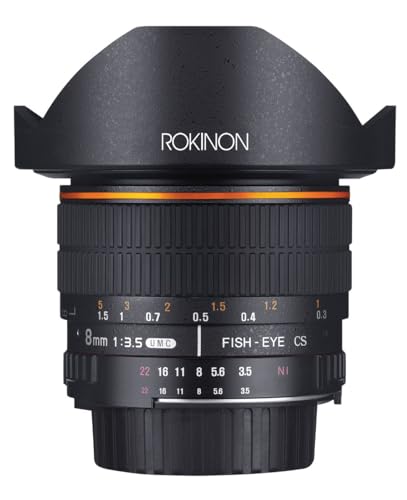
The Rokinon FE8M-C is a Canon‑EF mount fisheye designed for 8mm focal length and f/3.5, offering a 180° angle of view. The design incorporates 10 elements in 7 groups with a built-in petal hood for flare control and a compact, rugged profile suitable for travel and field work. The configuration yields strong perspective for landscapes and interiors, with the flexibility to shoot stark circular fisheye effects when the circumstances call for it.
Users benefit from the simplicity of a fixed focal length and an optical stack that prioritizes a clean, wide-angle field. For photographers exploring creative exaggeration of perspective or bold architectural statements, this lens provides reliable performance with a classic fisheye aesthetic.
Buying Guide: Key Purchase Considerations
- Sensor compatibility: Many 8mm fisheyes are designed for APS-C or Micro Four Thirds. Confirm your camera mount and sensor size to ensure the right field of view and image circle.
- Focusing method: Most 8mm fisheyes are manual focus. If you rely on autofocus, verify whether the lens supports AF on your camera or if manual focus is a necessary trade-off.
- Field of view and distortion: 180° diagonal is common on full-frame, while 200° or 167° corners differ by mount. Consider how you’ll use distortion for landscapes, interiors, or creative portraits.
- Hood design: Removable or built-in hoods affect flare control and circular fisheye effects. A detachable hood offers versatility for different lighting and framing needs.
- Build and weight: Travel photographers benefit from compact, robust builds. Review weight and weather sealing if you shoot in harsh conditions.
- Optical elements: Look for lenses with multiple elements and groups designed to minimize distortion and aberrations. ED glass and aspherical elements are common advantages.
- Closest focusing distance: A shorter distance enables other creative uses like close-up interiors or architectural details in tight spaces.
- Budget vs. performance: Manual fisheyes are often budget-friendly but require time to master. Weigh the cost against the creative potential and handling.
- System ecosystem: If you shoot across multiple brands, ensure the model you choose fits your primary system’s mounting and control style, especially regarding lens compatibility notes.
In comparing options, consider the specific creative goals: dramatic corner-to-corner distortion for landscapes, or cleaner, more precise edges for interior architecture. Each lens listed here provides a different balance of field of view, optical clarity, and handling. For photographers seeking a dependable, widely compatible fisheye with strong performance, these models offer solid choices across Canon, Nikon, Pentax, Panasonic Micro Four Thirds, and more.