Best 80mm Refractor for Astrophotography: Top Picks for American Enthusiasts
This article highlights the best 80mm refractor telescopes suited for astrophotography and deep-sky imaging. Each model below emphasizes optical clarity, color accuracy, and portability, helping you capture sharp Moon, planet, and deep-sky shots. The selections cover ED and triplet designs, with features like field flatteners, dual-speed focusers, and robust mounts to support long-exposure imaging.
| Product | Brand | Key Benefit | Optics |
|---|---|---|---|
| Explore Scientific ED80 Essential Series | Explore Scientific | High-contrast images with chromatic aberration reduction | 80mm ED glass, air-spaced triplet |
| Explore Scientific FCD100 80mm Triplet | Explore Scientific | High-contrast, portable apochromat with strong light gathering | 80mm F/6 air-spaced triplet, FCD100 glass |
| SVBONY SV503 80mm Refractor | SVBONY | Great color accuracy with ED glass and precise focusing | 80mm ED glass, dual-speed focuser |
| Askar 80ED | Askar | Compact, versatile with strong stray light suppression | 80mm ED glass, dual-speed focuser |
| SVBONY SV550 80mm APO Triplet | SVBONY | APO performance with field flattening options | 80mm APO triplet, field flattener option |
Explore Scientific ED80 Essential Series
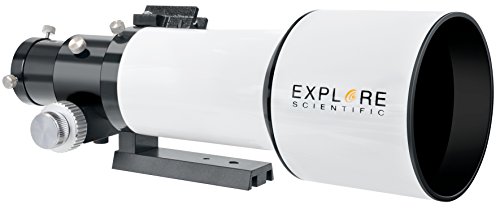
The Explore Scientific ED80 Essential Series uses genuine FCD1 HOYA extra-low dispersion (ED) optical glass with enhanced multi-layer coatings to deliver brilliant, high-contrast views. Its 80mm aperture and f/6 focal ratio, combined with an air-spaced triplet design, virtually eliminates chromatic aberrations, making it well-suited for astrophotography of the Moon, planets, nebulae, and star clusters. The focal length is 480mm, and a retractable dew shield enhances portability for spontaneous sessions and easy collaboration with guiding setups. This model prioritizes portable astrophotography without sacrificing image detail.
Key features include bright, high-contrast imaging and a design that supports imaging sessions by minimizing chromatic errors. While highly capable for planetary and deep-sky capture, it remains a compact option for travel and field use. This makes it a strong choice for enthusiasts who wish to balance ease of transport with imaging performance.
Explore Scientific FCD100 80mm Triplet

The FCD100 Series 80mm air-spaced apochromatic triplet refractor combines high-performance Hoya FCD100 extra-low dispersion glass with advanced multi-layer coatings to deliver crisp, high-contrast observations. Its 80mm aperture and f/6 design minimize chromatic aberration while maximizing light gathering for deep-sky imaging. The unit is compact and portable, suited for field work and quick setup. The optical design supports sharp imaging of the Moon, planets, nebulae, galaxies, and star clusters, making it a versatile choice for astro-imaging enthusiasts who value color fidelity and portability.
With a focal length of 480mm, this telescope balances light gathering with ease of transport. It offers strong performance in a travel-friendly package that pairs well with motorized mounts for long-exposure astrophotography. This model is ideal for photographers seeking a dedicated 80mm refractor that prioritizes entry-level apochromatic quality and field versatility.
SVBONY SV503 Refractor 80mm F7
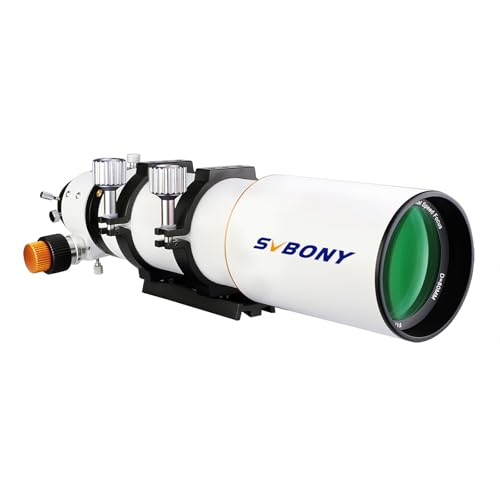
The SVBONY SV503 Refractor offers an 80mm aperture with extra-low dispersion glass to deliver bright, color-true images with high contrast. The dual-speed rack-and-pinion focuser (1:10 gear ratio) enables precise focusing for astrophotography, improving sharpness across frames. The telescope’s CNC-machined construction and premium finishing underscore durability and reliability for fieldwork. This model suits observers who want a balance of optical performance and solid build quality for both visual astronomy and imaging sessions.
Its ED glass design helps minimize chromatic aberration, producing more natural star colors and edges. The dual-speed focuser supports accurate focusing, essential for long-exposure imaging. The SV503’s build quality and optics position it as a practical choice for enthusiasts stepping into astrophotography or expanding to broader use cases, including deep-sky captures.
Askar 80ED
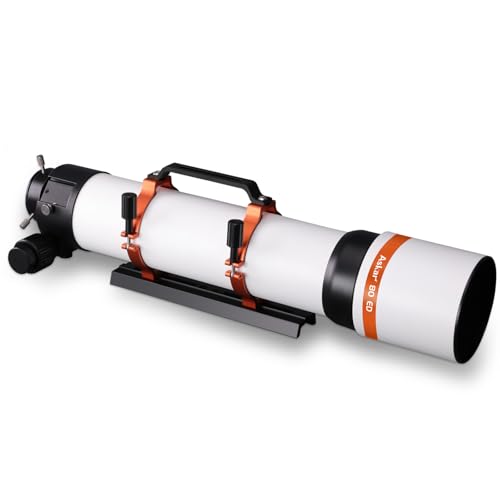
The Askar 80ED refractor emphasizes compact design and strong stray light suppression. Its lens hood is retractable, reducing overall size when not in use, and can be extended to minimize stray light during imaging. The inner tube features dual baffles to enhance image contrast and reduce glare. A 200mm standard Vixen-style dovetail plate ensures broad compatibility with mounts. The dual-speed 2-inch focuser provides precise coarse and fine focusing, with a travel length of 7 cm and a locking screw designed to maintain stability under load. This makes the Askar 80ED a versatile choice for portable astrophotography and general observation.
For imaging, the dual-speed focuser helps achieve accurate focus essential for sharp star fields. The lightweight yet sturdy tube design supports easy transport and field setup, while the electronic focus compatibility expands imaging options for more advanced setups. This model is well-suited for users who prioritize portability without sacrificing optical performance.
SVBONY SV550 80mm APO Triplet

The SVBONY SV550 is an 80mm APO triplet refractor designed for deep-sky astrophotography. It includes a field flattener option (SV209) to correct field curvature, delivering flat, edge-to-edge sharpness for wide-field imaging. The telescope uses a magnesium alloy focusing seat for reduced weight and improved stability, alongside a lightweight 180mm dovetail for easy mounting. The design emphasizes light control, stability, and ease-of-use for long-exposure imaging across a range of targets including nebulae, galaxies, and star clusters. This model is suitable for photographers seeking APO performance with practical field accessories.
Key advantages include improved field flatness with the optional flattener, reduced weight for transport, and a stable optical path ideal for imaging with various cameras and mounts. It provides a strong balance of optical quality and practicality for enthusiasts pursuing high-quality wide-field astrophotography in an 80mm class.
Buying Guide
Key considerations
- Optical design: ED glass vs APO triplet; triplets generally reduce chromatic aberration more effectively, benefiting color accuracy in long exposures.
- Focal length and speed: Shorter focal lengths (f/6–f/7) offer wider fields and easier guiding; longer focal lengths demand precise tracking for deep-sky projects.
- Mount compatibility: Ensure a compatible and stable mount; consider dovetail compatibility and whether tracking, guiding, or remote imaging is planned.
- Field flatteners: If planning wide-field imaging, check for built-in field flatteners or optional flatteners to achieve edge-to-edge sharpness.
- Portability vs. performance: Portable 80mm refractors are ideal for fieldwork or travel; larger, more complex designs may offer better imaging at the cost of weight.
- Focusing precision: Dual-speed focusers (1:10 ratio) help achieve finer control for sharp stars; essential for high-quality wide-field astrophotography.
- Coatings and glass: Coatings affect contrast and glare; premium ED glass coatings improve light transmission and color accuracy.
- Accessories: Consider dew shields, flattener/field correctors, and compatible mounts or adapters for your camera and guiding system.
Comparisons at a glance
- Best overall image sharpness: 80mm APO triplets (SV550) with optional flatteners.
- Best portability: ED80 Essential Series with retractable dew shield (compact and travel-friendly).
- Best value for beginners: SV503 80mm with dual-speed focuser for precise focusing.
- Best field-wide performance: Models offering built-in or optional field flatteners for edge-to-edge sharpness.
- Best for advanced imaging: Askar 80ED with lightweight design and flexible mounting options.