Best 5 Mm Telescope Eyepiece for Planetary Viewing
Choosing a 5 mm eyepiece can sharpen planetary details and deliver high-contrast views through many popular telescopes. This guide profiles five top options, highlighting optical design, field of view, eye relief, and suitability for different setups. Each entry includes a quick summary to help you compare features at a glance and determine which model best fits your observing goals.
Buying Summary
| Product | Brand | Field of View | Key Benefit | URL |
|---|---|---|---|---|
| Celestron 93421 X-Cel LX 1.25″ Eyepiece, 5 mm | Celestron | 60° | Bright, high-contrast planetary views with comfortable eye relief | Link |
| Astromania 5 mm Eyepiece | Astromania | 58° | Economical, solid performance for planetary observing | Link |
| SVBONY SV215 Zoom Eyepiece | SVBONY | Zoom 3–8 mm range | Versatile focal lengths in one piece, parfocal across range | Link |
| Pentax 5 mm 1.25″ 70° XW Eyepiece | Pentax | 70° (conceptual field of view with high apparent FOV) | Excellent edge-to-edge sharpness for bright planetary details | Link |
| Baader Hyperion 5 mm Eyepiece | Baader Planetarium | 68° | High-quality coatings and flexible use with different focusers | Link |
Celestron 93421 X-Cel LX 1.25″ Eyepiece, 5 mm
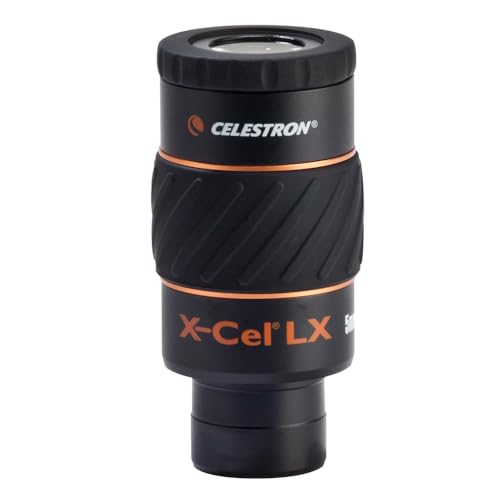
The Celestron X-Cel LX series emphasizes planetary viewing with a six-element fully multi-coated optical system. The 60° apparent field of view delivers a comfortable viewing experience while maintaining sharp edges across the field. A pop-up rubber eyeguard reduces stray light and increases contrast, and a user-friendly twist mechanism lets you raise or lower the eyeguard for different eye relief needs. A textured rubber grip ensures a secure hold, even when wearing gloves. This 5 mm model fits most 1.25″ focuser tubes and complements high-magnification planetary setups.
Optical performance centers on brightness and contrast, with coatings designed to maximize light transmission. The slightly narrow field of view compared to wider-angle eyepieces makes it well-suited for picking out fine planetary features, such as the belts of Jupiter or the polar caps of Mars, under good seeing. The build quality and comfortable eye relief support longer, distraction-free observation sessions.
Astromania Telescope Eyepiece 5mm, 58°

The Astromania 5 mm eyepiece is designed with planetary observing in mind, delivering a 58-degree apparent field of view that balances magnification with a broad enough view to locate and frame planetary discs. The aluminum construction increases durability, while the rotated eyepiece barrel and convertible rubber eyecup help block stray light and provide comfortable viewing, even during long sessions. Blackened lens edges and internal light control minimize glare and halo effects, allowing for clearer planetary details.
Its standard 1.25-inch barrel ensures broad compatibility with most telescopes and focusers. The design emphasizes reliability and value, offering solid performance for enthusiasts who want a cost-effective option without sacrificing essential optical quality. The eye relief is comfortable, and the piece is compatible with accessory filters through the 1.25″ thread, expanding observational possibilities beyond planets.
SVBONY SV215 Zoom Eyepiece, 1.25″ Zoom 3–8 mm

The SV215 zoom eyepiece offers a continuous 3–8 mm focal length range, enabling rapid magnification changes without swapping lenses. This makes it a practical companion for planetary observing, allowing you to refine focus on features such as Jupiter’s cloud bands or Saturn’s rings. It is designed to be parfocal across the zoom range, minimizing refocusing after focal-length adjustments. The eyepiece is described as having good eye relief and being easier to use with glasses compared to some compact fixed focal-length designs.
As a 1.25″ accessory, it should fit most standard telescopes and focusers. The optical construction aims to deliver sharp center and edge performance with multi-coated elements to maximize brightness. For observers who want flexibility in a single eyepiece, the SV215 provides a practical bridge between fixed 5 mm performance and broader viewing options in one piece of kit.
Pentax 5mm 1.25″ 70° XW Eyepiece

The Pentax XW 5 mm eyepiece pairs a 70-degree apparent field of view with high-quality optics designed for bright, edge-to-edge detail. The 1.25″ format ensures compatibility with a wide range of telescopes and spotting scopes, and the XW design is known for consistent performance across the field. This eyepiece is intended to deliver sharp contrast and vivid planetary detail while maintaining comfortable viewing with substantial eye relief. It is often selected for planetary work where small details matter and long observing sessions are common.
Baader Hyperion 5 mm Eyepiece

The Baader Hyperion 5 mm eyepiece offers a 68-degree wide field of view and dual-barrel compatibility, supporting both 1.25″ and 2″ focusers. Baader’s PHANTOM-GROUP multi-coatings are designed to maximize light transmission and reduce stray light, contributing to bright, high-contrast planetary images. The Hyperion design is widely praised for its flexible use with various focusing systems and adapters, making it a versatile choice for different telescope configurations. It is well-suited for observers who want a robust, premium option without sacrificing compatibility.
Buying Guide: Key Considerations For 5 mm Eyepieces
- Magnification and seeing: A 5 mm eyepiece typically yields high magnification. Real-world results depend on telescope aperture and atmospheric conditions. Pair high-quality optics with good seeing for the clearest planetary details.
- Apparent field of view vs edge sharpness: Eyepieces range from around 58° to 70° AFOV. A wider apparent field can be more comfortable and easier to acquire targets, but some designs prioritize edge-to-edge sharpness and contrast over ultra-wide views.
- Eye relief and comfort: For extended sessions, comfortable eye relief and a non-slip grip matter. Eyeguards and rubber grips reduce stray light and fatigue, particularly for eyeglass wearers.
- Coatings and light transmission: Fully multi-coated optics minimize reflections and maximize brightness. This is especially beneficial at higher magnifications where light losses are more noticeable.
- Compatibility and adaptability: Check barrel size (1.25″ vs 2″) and whether the eyepiece supports filters or adapters you already own. Some models offer flexible compatibility with barlow lenses or zoom ranges.
- Cost vs performance: Budget-friendly options can still deliver solid planetary performance, but premium designs may provide more comfortable viewing and more consistent edge quality across the field.
- Maintenance and durability: Aluminum housings and robust construction reduce wear over time. Consider models with reliable grip and durable eye relief components for frequent use in the field.
- Use-case variations: Fixed focal-length 5 mm eyepieces excel at planetary work, while zoom variants (like 3–8 mm or 7–21 mm) offer flexibility for both planetary and lunar observing without swapping eyepieces.
Observing Scenarios and Comparisons
For planetary enthusiasts who value crisp detail in a stable, high-contrast image, fixed focal-length 5 mm eyepieces such as the Celestron X-Cel LX and Pentax XW are strong choices. They often deliver reliable edge sharpness and consistent performance with minimal optical compromises. In contrast, zoom eyepieces like the SV215 and SV135 provide rapid changes in magnification, which can be advantageous when scouting targets or adapting to varying seeing conditions. Baader’s Hyperion series blends broad fields with strong coatings for versatile use across both 1.25″ and 2″ focusers.
When evaluating these options, consider your telescope aperture, typical observing targets, and whether you prioritize comfort, field of view, or peak-edge sharpness. For beginners, a mid-range fixed 5 mm paired with a cost-effective wide-field eyepiece can create a balanced setup. For advanced observers, premium models with high-quality coatings and generous eye relief may justify the higher cost due to improved long-session comfort and image clarity.
In summary, the five products featured here span solid all-around performance (Astromania and Baader), premium build and field quality (Pentax), practical versatility (SV215 zoom), and reliability with strong planetary contrast (Celestron). Each has its own strengths depending on your telescope, observing style, and budget.
More About Buying: Quick Comparisons
- Fixed focal-length 5 mm eyepieces generally deliver the simplest, most reliable optical performance and consistent edge sharpness. They are best when you know your preferred magnification range and want high contrast.
- Zoom eyepieces provide flexibility. They save space and cost, but sometimes require occasional refocusing and can have slightly more complex optical paths.
- Field of view matters for locating planets in the sky. Wider fields help frame the object, but extremely wide fields may show marginally more edge distortion at high magnification.
- Eye relief and comfort influence how long you can observe without discomfort. For eyeglass wearers, prioritize longer eye relief and easier eye positioning.
- Coatings and build quality affect brightness and durability. Look for fully multi-coated optics and robust housing for field use.