Best 35mm Film Negative Scanners for Digitizing Old Photos
Looking to convert 35mm film negatives and slides into digital JPEGs quickly and reliably? This guide highlights five top scanners that are well-suited for different buyers—from casual family archivists to hobbyists who want easy, one‑touch operation. Each pick is evaluated for ease of use, display quality, and compatibility with common film formats.
| Product | ||
|---|---|---|
| KODAK Slide N SCAN Film & Slide Scanner | Vintage collectors who want a built-in LCD and easy direct-to-SD workflow | 5” LCD display with gallery mode |
| Magnasonic All-in-One 24MP Film Scanner | Home users who want a larger display and HDMI output for viewing on a TV | 5″ display; HDMI output |
| DigitPro Film and Slide Scanner | Budget-conscious digitizers who value simple one‑button scanning | 5” LCD, built-in memory, SD card support |
| Kodak SCANZA Digital Film & Slide Scanner | Casual users seeking wide compatibility with multiple film formats | Adapters for multiple formats; 3.5″ LCD |
| BEONEGLOBAL ClearScan MINI Film Scanner | Compact solution for limited space and quick 16MP scans | 2.31″ LCD; handheld-friendly design |
Product Highlights
Below are five carefully chosen 35mm film scanners. Each entry follows a consistent format to help you compare features quickly and decide which model fits your needs best.
KODAK Slide N SCAN Film & Slide Scanner

Best for users who want an integrated viewing experience, this scanner supports 135, 110, and 126 formats, plus 50mm slides. It features a 5” LCD display for instant previewing and options to save to an SD card (not included). Quick-load inserts and adapters support continuous scanning, making it suitable for memory archivists who value speed and convenience. A potential limitation is SD card dependency for saving files, which may require an additional purchase.
Magnasonic All-in-One 24MP Film Scanner

Best for viewers who want a larger built‑in screen and the ability to view on a TV via HDMI. It scans 35mm/110/126 negatives and 135/126/110 slides at up to 24MP, with 128MB internal memory and SD card expansion up to 128GB. This model suits home galleries and quick sharing; the requirement for an HDMI connection means a compatible display is needed for full viewing on larger screens.
DigitPro Film and Slide Scanner

Best for budget-minded buyers who want straightforward operation. This model supports 35mm, 126, 110 negatives, 50mm slides, and Super 8. It saves to a built-in 128MB memory or to an SD card (up to 64GB). It features a 5” LCD and one‑touch scanning. A limitation to note is the modest internal memory; external storage is often necessary for larger scans.
Kodak SCANZA Digital Film & Slide Scanner
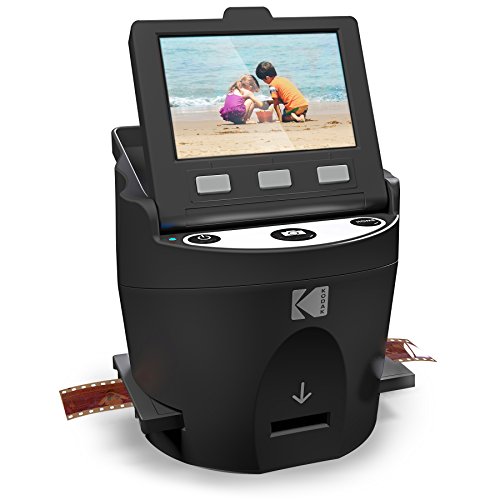
Better for users who want wide format compatibility with quick, one‑step scanning. The Scanza handles 35mm, 126, 110, Super 8, and 8mm negatives and slides, and includes adapters for fast loading. Its 3.5” LCD is smaller than some rivals, which may affect clarity when previewing detailed scans. It’s a solid all‑in‑one option for casual digitization without a computer.
BEONEGLOBAL ClearScan MINI Film Scanner

Best for compact spaces and quick 16MP scans. This model supports 35mm and 135/126 formats with a 2.31″ LCD display. It emphasizes ergonomic design with front‑facing controls and direct SD card saving. The small screen may be less ideal for detailed review, but its portability and simple workflow suit occasional digitizers who prioritize ease of use over feature breadth.
Buying Guide: How to Choose a 35mm Film Scanner
- Format compatibility: Confirm the scanner supports your film types (35mm, 126, 110, slides, Super 8). Some models add multi-format adapters for flexibility.
- Display size and usability: A larger LCD makes previewing easier; some models include HDMI outputs to view scans on a TV or monitor.
- Storage options: Look for built-in memory and SD card support. Consider how many photos you’ll digitize at once and whether you need expandable storage.
- One‑touch scanning: If you want quick results, prioritize scanners with simple “scan and save” workflows and minimal setup.
- Portability and space: Compact units are convenient for small spaces, while larger displays may improve review quality.
- Export formats: JPEG is common; verify if RAW or TIFF is available if you need higher fidelity (not all models offer this).
- Power and connectivity: Check whether the scanner uses USB power or requires an outlet, and whether it supports external displays via HDMI.
Practical tips
- Prepare negatives by cleaning dust to reduce specks in scans.
- Organize a naming convention for easy archival and retrieval.
- Back up digital copies to multiple locations to prevent loss.
FAQ
- Q: Do these scanners require a computer to save scans?
A: Most models offer built-in memory or SD card storage, but some features may be enhanced when connected to a computer or TV via HDMI. - Q: Which scanner is best for 8mm or Super 8 film?
A: Models like Kodak SCANZA and some DigitPro configurations support Super 8, while others focus mainly on 35mm and slides. - Q: What resolution should I expect from these scanners?
A: Scans commonly range from 14MP to 24MP equivalent, depending on the model and light source. Higher MP typically yields finer detail. - Q: Is a larger LCD display worth it?
A: Yes, a larger display makes it easier to inspect color accuracy, brightness, and cropping before saving files. - Q: Are adapters included for different film formats?
A: Several models ship with adapters for 35mm, 126, and 110 formats; verify included inserts before purchase. - Q: Can I share scans directly to social media?
A: You can share JPEG files saved to SD cards or internal memory; connecting to external devices may enable easier sharing.