Best 35 Mm Zoom Lenses for Versatile Wide-Angle Imaging
Looking for a 35 mm to wide-angle zoom setup that covers dramatic landscapes, architecture, and creative travel photography? This guide highlights five top choices across Canon, Tamron, Sony, and Nikon to fit EOS R, Sony E, and Nikon DX ecosystems. Each option targets distinct needs—from ultra-wide capabilities to bright constant apertures and smooth video-friendly zooms. Readers will find clarity on who each lens is best for, plus practical trade-offs to guide your selection.
Product Overview
Below is a quick reference to the featured lenses, focusing on who they suit and the core strengths. Use this as a snapshot before diving into each detailed product section.
- Canon RF14-35mm F4 L IS USM — Best for Canon EOS R users seeking ultra-wide versatility in a single, bright zoom with image stabilization.
- Tamron 35-100mm F/2.8 Di III VXD — Best for Sony E-mount creators needing a portable, fast zoom with a constant f/2.8 across a versatile range.
- Sony FE 16-35mm F2.8 GM — Best for Sony full-frame enthusiasts who require top-tier sharpness and overall optical performance at a wide angle.
- Sony FE PZ 16-35mm f/4 G — Best for videographers and solo shooters needing smooth power zoom and compact design.
- Canon RF15-35mm F2.8 L IS USM — Best for professionals who want a fast, stabilized, bright wide-angle zoom in the Canon RF system.
Canon RF14-35mm F4 L IS USM Lens

Best for Canon EOS R Series shooters seeking dramatic ultra-wide coverage with a single, bright zoom. This lens spans 14mm to 35mm, offering consistent f/4 brightness with L-series optical construction. The built-in image stabilization helps stabilize handheld wide-angle shots, and Canon’s SWC and ASC coatings reduce flare and ghosting in challenging lighting. Limitation: at f/4, some low-light scenarios may benefit from a faster aperture, especially for night photography or shallow depth of field needs.
Tamron 35-100mm F/2.8 Di III VXD Zoom Lens

Best for Sony E-mount creators needing a compact, portable zoom with bright constant f/2.8 across 35-100mm. The lens weighs about 565g and measures 119.2mm, offering a stable center of gravity for handheld shooting and gimbal work. It uses 15 elements in 13 groups, including XLD and LD elements, to suppress aberrations while a BBAR-G2 coating minimizes ghosting. Caution: while lighter and shorter, it remains larger than prime lenses and may feel front-heavy on smaller cameras.
Sony FE 16-35mm F2.8 GM Wide-Angle Zoom

Best for high-end Sony full-frame systems needing extreme edge-to-edge sharpness and wide perspective. The lens uses two XA elements to minimize aberrations and provides a constant f/2.8 aperture with a 0.28 m minimum focus and 0.19x maximum magnification. It supports sharp, cinematic wide-angle imagery with reliable autofocus and robust build. Limitation: higher weight and price compared to f/4 counterparts, which may deter travel-oriented shooters.
Sony FE PZ 16-35mm f/4 G Lens
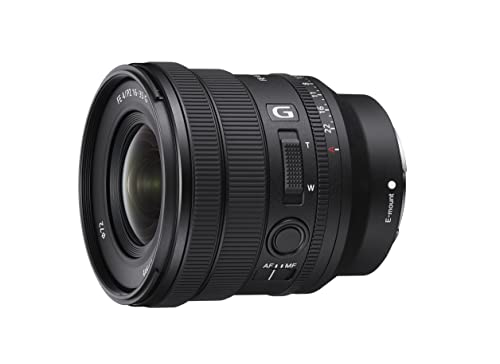
Best for videographers and solo shooters who need a compact, ultralight wide-angle power zoom. This lens uses a four XD Linear Motor system for smooth, silent operation and a continuously variable zoom with a dedicated zoom lever. It minimizes angle-of-view shifts during focusing or zooming, aiding stable video capture. Caution: f/4 brightness may be less favorable in dim lighting, and the smaller maximum aperture reduces depth-of-field control in low light.
Canon RF15-35mm F2.8 L IS USM

Best for Canon EOS R users who require a fast, stabilized wide-angle zoom with bright f/2.8 performance. It delivers high image quality with a wide aperture and built-in stabilization for shake reduction. The lens is designed for professionals who need fast autofocus and reliable performance in varied lighting. Caution: the wider aperture may demand higher care with depth-of-field control and focal length balance in tight interiors.
Buying Guide
Key purchase considerations for 35 mm to wide-angle zoom lenses:
- Camera system compatibility: Choose lenses designed for your camera mount (Canon RF, Sony E, Nikon DX, etc.).
- Maximum aperture: Constant f/2.8 or f/4 vs. variable zooms affects low-light performance and depth of field.
- Weight and balance: Lighter options improve portability but may compromise sturdiness or image stabilization.
- Autofocus and stabilization: Evaluate Nano USM, XD motors, and in-lens IS to suit stills or video work.
- Optical quality considerations: Look for coatings (SWC, ASC, BBAR-G2) and aspherical elements to minimize flare and aberrations.
- Video-specific features: Smooth power zoom, quiet focus, and minimal focus breathing benefit moving images.
- Budget and intended use: Landscapes, architecture, travel, or professional work may justify higher-cost, feature-rich options.
FAQs
- What is the advantage of a constant aperture zoom like f/2.8 or f/4 across the zoom range? It provides consistent exposure and depth of field control regardless of focal length.
- Is a power-zoom lens better for video than a manual zoom? Yes, power-zoom lenses offer smoother, more repeatable zooms ideal for video, especially on gimbals.
- Which lens is best for landscape photography? Ultra-wide to wide zooms with good edge-to-edge sharpness and minimal distortion are preferred; factors include stabilization and coatings.
- Should I choose a lens with in-lens IS or rely on camera stabilization? In-lens IS is beneficial when you shoot handheld in low light or with longer focal lengths; pairing with a stabilized body helps further.
- Do prime lenses outperform zooms in image quality? Primes often deliver sharper corners and better bokeh at specific focal lengths, but zooms provide flexibility for changing composition on the fly.
- Are there compatibility limitations between these lenses and older camera bodies? Yes, some lenses may require newer camera bodies to exploit all features like autofocus speed and stabilization.