Best 35 Mm Slide Converter: Top Film Scanners for Preserving Memories
Find the right 35 mm slide converter to digitize old photos with ease. This guide highlights five dependable options, each suited for different needs—from casual archiving to gallery-ready previews. Best for hobbyists, families preserving family history, and small offices digitizing slide collections, these scanners offer built-in displays, quick-load trays, and simple one-button scanning. Compare features, its best use cases, and potential limitations to help you choose confidently. Below is a quick summary table of the featured products.
| Product | Best For | Key Benefit | Limitations |
|---|---|---|---|
| KODAK Slide N Scan | Casual archiving | 5” LCD for immediate preview | May require adapters for some film formats |
| DigitPro 35mm Film & Slide Scanner | All-in-one convenience | 2.4” LCD, standalone operation | Smaller screen, limited advanced editing |
| DIGITNOW! 135 Film Negative Scanner | Budget-friendly scanning | Fast loading with adjustable feeder | Moderate resolution compared to premium models |
| DigitPro Film and Slide Scanner (All-in-One) | All-in-one flexibility | Supports 35mm, 126, 110 negatives and slides | May require SD card for saving larger batches |
| KODAK SCANZA Digital Film & Slide | Comprehensive scanning | 39 MP-like capability through software improvements | Complex compared to entry-level units |
KODAK Slide N SCAN Film & Slide Scanner

The KODAK Slide N SCAN is designed for older color and black-and-white negatives and slides in 135, 110, and 126 formats. It features a 5” LCD display that provides a live preview, making it easy to check scans before saving. This model supports saving to an SD card (not included) and includes a quick-feeding tray for faster processing. Best for households digitizing mixed-format archives and people who want an all-in-one display and scanner in one device.
Best for: Casual to moderate archive projects where a larger viewing screen and convenient tray loading speed matter. It suits families and hobbyists who want straightforward digitization without a computer.
Caution: Requires SD card (not included) to save files, and some users may need additional adapters for non-standard film formats.
DigitPro 35mm Film & Slide Scanner with 2.4″ LCD

This all-in-one 35mm film scanner converts 135 negatives and slides directly into digital JPEGs without a computer. It includes a 2.4” LCD for instant preview and supports Positive, Negative, and Black & White modes, making it suitable for home archiving and quick sharing. Quick slide loading helps process large collections more rapidly than some entry-level devices.
Best for: Users seeking a compact, computer-free solution with a straightforward interface and direct viewing on a built-in screen.
Caution: The built-in screen is small, which can make precise adjustments less convenient for detailed restoration work.
DIGITNOW! 135 Film Negative Scanner

The DIGITNOW model focuses on 35mm film and slide digitization with an adjustable rapid slide feeder. It saves to an SD card (up to 32GB) or computer via USB, and supports 1800DPI high resolution. It is a practical choice for budget-conscious buyers who want standalone operation with simple transfer options. It also includes a basic TV-out feature for larger viewing without a computer.
Best for: Budget-minded collectors or small projects where quick digitization and easy transfer are valued. It’s a good fit for those who want a simple, efficient workflow.
Caution: Resolution is solid but not top-tier; archival-grade work may require higher-end options for crucial restorations.
DigitPro Film and Slide Scanner (All-in-One)

This all-in-one DigitPro scanner handles 35mm, 126, and 110 negatives, plus 50mm slides. It offers a 5” LCD, built-in memory, and an option to save to an SD card up to 64GB. It emphasizes one-touch scanning with simple navigation and adjustable color and brightness. It is ideal for people digitizing mixed-format collections and who want a single device to manage multiple film types.
Best for: Households with diverse film formats seeking a versatile scanner that minimizes the need for multiple devices.
Caution: The device benefits from a higher-capacity SD card for large batches and longer sessions.
KODAK SCANZA Digital Film & Slide Scanner
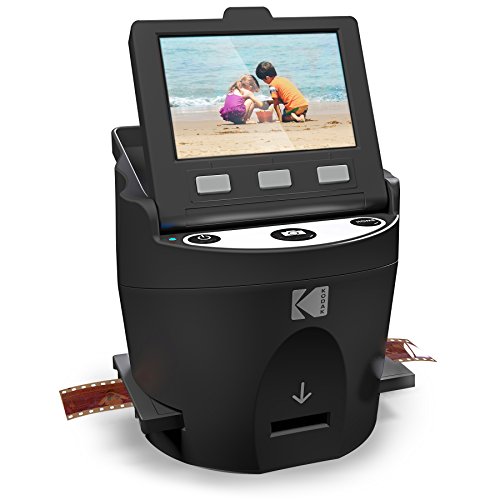
The Kodak SCANZA is a comprehensive film-to-digital scanner supporting 35mm, 126, 110, Super 8, and 8mm formats. It uses a 3.5” LCD for live viewing and includes multiple inserts and adapters for fast operation. Although designed for robust archiving, this model is more feature-rich and may require more setup time than entry-level alternatives. It targets serious archivists and hobbyists who want extensive format compatibility and efficient workflow.
Best for: Serious collectors and small archives needing broad format support and a larger screen for inspection and quick edits.
Caution: It can be more complex to operate for first-time users compared with simpler, entry-level scanners.
Buying Guide: How to Choose the Right 35 Mm Slide Converter
What should you consider when selecting a 35 mm slide converter?
- Format support: Confirm it handles 35mm, 126, 110 negatives, and slides, if you have a mixed collection.
- Display size: A larger built-in LCD simplifies previews and basic edits before saving.
- Storage and transfer: Check if saving to an SD card is supported and the maximum capacity; ensure USB transfer or TV-out if you want to view on a TV.
- One-touch scanning: Look for easy, fast scanning with minimal setup, especially if you have many slides.
- Resolution: For archival quality, higher DPI (or software-assisted enhancement) helps preserve detail in faded images.
- Power and portability: Battery-powered options are handy for travel, but wired units may offer stable performance for long sessions.
Practical Comparison Questions
- Do you need a standalone device or a computer-connected workflow?
- Is a larger built-in display important for your scanning process?
- Will you digitize a large batch of slides or just a few at a time?
- Do you require broad format compatibility beyond 35mm, such as 126 or 110?
FAQ
- Q: Can I use these without a computer? A: Yes, several models provide standalone scanning with built-in displays and internal memory.
- Q: Will these retain color accuracy after scanning? A: Most offer color adjustment options; for archival projects, consider models with manual controls or software enhancements.
- Q: What about file formats? A: JPEG is standard for most scanners; some models save directly to SD cards or external memory.
- Q: Are higher DPI settings better for old slides? A: Generally yes, but very old or faded slides may benefit from post-processing rather than higher native DPI alone.
- Q: Do all models handle Super 8 or 8mm film? A: Not all do; check format support if you have non-35mm film in your collection.
- Q: Is a quick-feed tray essential? A: It speeds up batch scanning, especially for large collections.