Best 35mm Film Scanners for Digitizing Negatives and Slides
Looking to convert old 35mm film and slides into crisp digital files? This guide compares five reliable 35mm film scanners designed for different needs—from casual photo restoration to dedicated archival work. Each option is evaluated for ease of use, display quality, and the kinds of film or slide formats it supports. The best choice depends on your source material, desired resolution, and whether you want built-in viewing or external connectivity. The buyer’s table below highlights who each model is best for.
| Product | Best For |
|---|---|
| KODAK Slide N SCAN Film & Slide Scanner | Best for collectors who want a large LCD preview and Easy Load trays |
| Magnasonic All-in-One 24MP Film Scanner | Best for all-around versatility and built-in memory |
| KODAK SCANZA Digital Film & Slide Scanner | Best for quick conversion across multiple formats |
| Plustek OpticFilm 8300i Ai | Best for serious archival scanning with professional software |
| DigitPro Film And Slide Scanner | Best value with built-in display and straightforward use |
KODAK Slide N SCAN Film & Slide Scanner
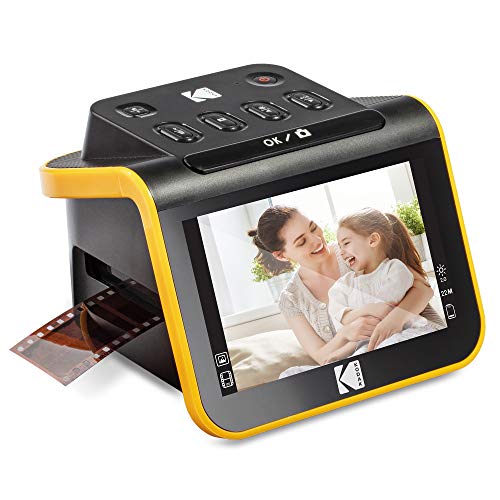
The KODAK Slide N SCAN is a 22MP capable film and slide digitizer designed for 135, 126, and 110 formats. It includes a 5” LCD display for immediate preview and editing, making it easy to share or showcase memories as a digital picture frame. It supports saving to an SD card (not included) and provides a quick-load tray for continuous scanning. Best for film enthusiasts who want a built-in viewing experience without a computer requirement, and for those who prioritize a large screen for on-device editing.
- Best for users who want an LCD gallery view directly on the unit
- Includes 50mm slide holder and film adapters
- Notable limitation: SD card must be added separately
Magnasonic All-in-One 24MP Film Scanner

The Magnasonic model scans 35mm, 110, 126, and Super 8 film into 24MP JPEGs, with a built-in 5″ LCD for direct viewing and optional HDMI connection to a TV or monitor. It also includes 128MB internal memory and supports SD cards up to 128GB. This makes it a solid choice for users who want a simple, all-in-one device with a direct viewing option and expandable storage.
- Best for those who value a built-in display and expandable storage
- HDMI output enables larger viewing on a TV or monitor
- Limitation: Internal memory is modest; large archives may require frequent card transfers
KODAK SCANZA Digital Film & Slide Scanner
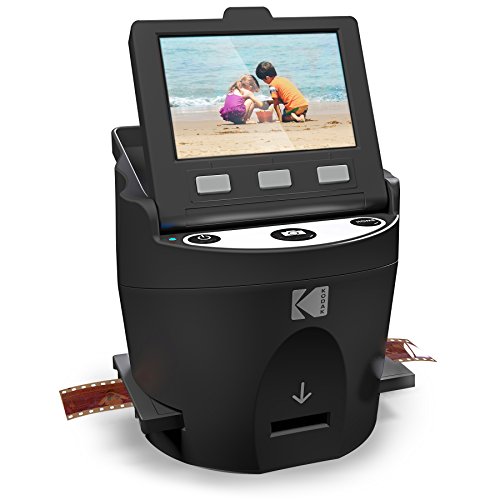
The KODAK SCANZA handles 35mm, 126, 110, Super 8, and 8mm with a resolution range that supports JPEG outputs. A flexible 3.5″ LCD screen ensures easy viewing and editing on the device itself. This model is best for users who need a broad format range and a compact form factor, ideal for casual archiving and quick sharing.
- Best for multi-format conversion in a single unit
- Note: Built-in display is smaller; external viewing may be preferred for detailed edits
DigitConvert 35mm Film Scanner

The DigitConvert model provides a 2.4″ LCD preview and editing on-device, a high-speed batch scanning capability for 35mm, 135, 126, and 110 film, and easy SD card saving (up to 128GB, card not included). It is designed for seniors and casual users who want a simple, stand-alone scan-and-save workflow with minimal setup. Best for minimal-tech users who want a straightforward transfer to JPEG.
- Best for quick, standalone scanning without a computer
- One-touch scan and save to SD card
- Limitation: Smaller screen may reduce on-screen editing precision
Buying Guide
What should I consider when choosing a 35mm film scanner?
Format compatibility matters. Decide whether you need 35mm, 126, 110, or Super 8/8mm support. Resolution and color fidelity are key for archival work, but casual sharing may tolerate lower MP counts. A built-in LCD helps preview and edit on-device, while HDMI output can enable larger viewing on a TV or monitor. Storage options (internal memory, SD cards) determine how large of a batch you can process before transferring files. Ease of use, loading trays, and adapters for different film sizes influence how quickly you can digitize a collection.
What is the best workflow for scanning 35mm slides?
Choose a scanner with a reliable load tray and appropriate adapters. If you have mixed formats, a multi-format scanner like the Kodak Scanza or DigitConvert can simplify your setup. For high-volume archival projects, a model such as Plustek OpticFilm 8300i Ai offers professional software integration, though it may require more learning time.
Should you prioritize built-in display or external viewing?
A built-in display is convenient for quick previews and edits without a computer. External viewing via HDMI provides a larger, more precise assessment, which is beneficial for color-critical work. If you plan to archive large collections, ensure your workflow supports direct-to-SD or direct-to-computer transfers to minimize handling time.
What are common limitations to expect?
Many scanners rely on SD cards for storage, which means you must purchase cards separately. Some units have modest internal memory and smaller screens, which can slow on-device editing. Compatibility with older film formats may vary; verify that your specific negatives or slides are supported before buying.
How to compare the five featured models?
Consider format support first (35mm, 126, 110, Super 8, etc.). Then assess display options (LCD size and quality), followed by software bundles and ease of use. For casual users, a model with an intuitive interface and direct SD saving is ideal. For archivists, a scanner with advanced calibration and professional software offers more precise color and tone reproduction.
FAQ
- What MP is suitable for preserving film quality?
- Do these scanners require a computer?
- Can I scan Super 8 and 8mm film?
- Is a larger LCD better for editing?
- What’s the best option for seniors?
Higher MP scores generally provide more detail; 22MP or 24MP is common among consumer scanners and suitable for preserving most home archives.
Some models work independently with on-device previews, while others can streamline saving to a computer via USB or HDMI.
Not all models support Super 8 or 8mm; check format compatibility for each unit before purchasing.
Yes, a larger LCD helps in evaluating color and detail, but some users prioritize portability over screen size.
Look for a device with a simple, one-touch scanning workflow, front-facing controls, and easy-to-load inserts.