Best 3-Axis Camera Slider for Smooth Cinematic Shots
The rise of motorized sliders and multi-axis rigs has transformed how American videographers approach tracking shots, time-lapses, and dynamic pans. This guide showcases five top picks that blend precision, reliability, and automation to deliver cinematic results with less effort. Whether you’re building a small studio setup or filming on location, these options cover a range of budgets and camera weights while emphasizing multi-axis control, smooth motion, and versatile shooting modes.
| Product | Brand | Multi-Axis Capabilities | Notable Features |
|---|---|---|---|
| YC Onion 100cm Slider | YC Onion | 4 Axes (slider + 2-axis head options; compatible with additional control modules) | Carbon fiber rail, high load, time-lapse and auto round-trip motion |
| FeiyuTech SCORP 2 KIT | FeiyuTech | 3-Axis Gimbal | Built-in AI tracking, vertical shooting quick-release, broad mirrorless compatibility |
| IFOOTAGE Shark Nano II | IFOOTAGE | 5-Axis Coordinated Shooting | Seamless RS adapter integration, memory save, AI subject tracking |
| NEEWER 47.2″/120cm ER1 | NEEWER | Motorized slider with multi-mode control (video, time-lapse) | App and remote control, 4400mAh battery, silent motor |
| NEEWER 39.4″/100cm ER1-100 | NEEWER | Motorized slider with two-way control | App wireless control, time-lapse, compact and portable |
Each product below is described with concise, factual details to help you compare capabilities, mounting options, and shooting modes. All sections use information directly relevant to multi-axis control, motion stability, and automation for professional video and time-lapse work.
YC Onion 100cm Motorized Slider

The YC Onion 100cm slider supports multiple-axis configurations, starting with two axes and expanding to four axes depending on how you combine the slider with the optional motorized panoramic head and control modules. The main carbon fiber rail helps reduce weight while maintaining stiffness, and the system is designed to handle substantial horizontal loads: up to 20 kg when supported by two tripods, up to 7 kg with a single tripod, and 14 kg at a 45-degree tilt with a second support rod in place. Vertical load capacity sits around 5.5 kg. This rugged construction is ideal for heavier mirrorless and DSLR setups when you need stable tracking across long runs. Noise levels from the motor are reported in the 35–45 dB range, which keeps production audio from overpowering the soundtrack during close-ups.
In terms of motion and time-lapse, the slider supports setting A-B points, automatic round-trips, and programmable time-lapse sequences. You can adjust the speed to control the motion curve, creating fluid forward and backward sweeps that blend with real-world lens changes. These features enable complex shot choreography, such as simulating parallax on a moving subject or achieving looping time-lapse sequences that feel organic and cinematic. While the full four-axis setup may require additional control modules, the core platform delivers consistent, repeatable motion for both motion-control timelapse and traditional slider shots.
FeiyuTech SCORP 2 KIT Gimbal Stabilizer

The FeiyuTech Scorp 2 Kit is a compact, three-axis gimbal designed for DSLR and mirrorless cameras. It features an integrated AI tracking system that enables subject following with gesture controls, reducing the need for extra accessories or apps during simple shoots. The quick-release design enables rapid vertical shooting, with an anti-off slider that makes switching between horizontal and vertical framing fast and secure. With a payload of up to 2,500 g, it accommodates a broad range of compact and mid-sized camera bodies. The kit’s vertical shooting mode is particularly appealing for interview-style content or social media formats where vertical composition is essential, while still providing rock-solid stabilization for dynamic, handheld-style motion.
Beyond tracking, the SCORP 2 Kit emphasizes ease of setup and reliability. The upgraded mounting plates and robust construction support a smooth balance across the camera axes, helping reduce post-production stabilization needs. This stability is complemented by intuitive controls and a responsive touch interface, making it suitable for single-operator shoots that demand dependable performance without a steep learning curve. While it isn’t a slider, its three-axis stabilization plays a critical role in achieving multi-axis motion with a smooth, cinematic feel that pairs well with slider-based rigs for hybrid setups.
IFOOTAGE Shark Nano II Motorized Slider

The Shark Nano II is designed for high-precision multi-axis control with seamless integration for DJI gimbals via a dedicated RS Adapter. It supports 360-degree rotary axis and 5-axis coordinated shooting, enabling synchronized motion across pan, tilt, and roll with slider movement. This capability is especially valuable for tracking shots that require both linear and rotational elements—such as moving a camera along a track while maintaining a steady horizon or rotating around a subject for a dramatic reveal. The Nano II also includes a memory function to restore settings after power interruptions, reducing setup time on location and ensuring consistency across takes.
Programmatic control comes from its integration with the Moco ecosystem and RS adapters, allowing you to map motion paths with multiple points and fine-tune each segment for precise results. The device supports objective tracking by highlighting subjects via AI-like recognition through the app, helping keep a moving subject centered during complex sequences. Filmmakers who need synchronized, multi-axis actions—such as product reveals with rotating angles or dynamic parallax shots—will find the Shark Nano II’s 5-axis coordination especially compelling for on-location use with compatible stabilizers.
NEEWER 47.2″/120cm ER1 Motorized Slider

The NEEWER ER1 120cm motorized slider is designed for versatility in professional video work. It supports multiple modes, including video shooting with a constant speed and time-lapse operation, and it provides smart two-way control via a dedicated smartphone app and an optional remote. The long 120 cm rail supports substantial side-to-side motion, with a maximum horizontal load of roughly 11 lb (5 kg) and a tilting capacity of about 5.5 lb (2.5 kg) when the unit is positioned at a 45-degree angle. The system ships with a 4,400 mAh NP-F750 battery for portable runtime and can be charged via a USB-C power source for extended shoots. The motor is designed for quiet operation to minimize noise in post-production audio, making it well-suited for on-camera dialogue or ambient sound capture during movement.
For time-lapse creators, the ER1 offers programmable intervals, frame counts, and exposure controls through the app. Its two-way control makes it feasible to set up complex paths that transition smoothly from one pose to another, while keeping the camera locked into stable, repeatable motion. The combination of extended rail length, silent motor, and flexible control options makes this model a strong choice for filmmakers who need a reliable, longer slider with straightforward operation and reliable battery-powered performance in field settings.
GVM 48″/120CM Carbon Fiber Slider
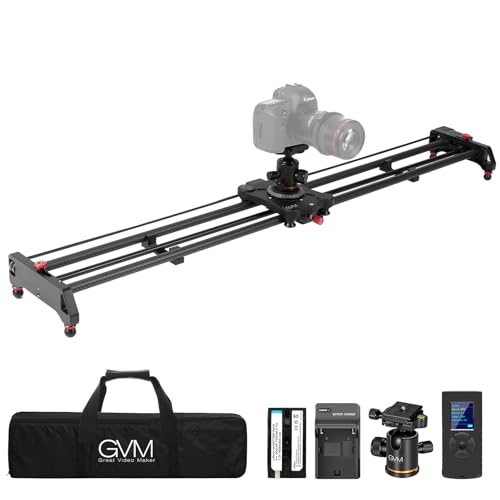
The GVM 48″/120 cm carbon fiber motorized slider is engineered for tracking shots, time-lapse sequences, and 120-degree panoramic shooting. It features three shooting modes—tracking, time-lapse, and standard video—so users can switch between continuous motion and structured motion paths. The slider’s 120-degree panorama capability is particularly useful for environmental or architectural shots where a wide field of view enhances depth. A remote control is included to adjust motion parameters remotely, enabling precise control over speed, dwell time, and start/end points without touching the camera. The compact form factor and carbon fiber construction provide a strong balance of portability and rigidity for dynamic shoots.
Users can operate with both manual and electric modes, adjusting red knobs to influence motion. The remote control supports setting up multiple parameters such as pace, interval, and the number of shots. The slide also offers a loop option, allowing automated repetition of a set path for extended sequences. For crews needing reliable motion control with adjustable tracking capabilities, this model delivers robust performance in a familiar slider format, while expanding creative possibilities through panoramic and multi-axis shooting options.
NEEWER 4 Axis Macro Focusing Rail GM-MP3

The NEEWER GM-MP3 macro rail focuses on precision with 4-axis movement and 360-degree rotation, tailored for macro photography and close-up work. It provides quad-axis movement for framing flexibility, with two sliders using lead screws to deliver smooth and consistent positioning under load. Each axis offers a 100 mm effective travel, and combined movement across axes enables 200 mm of travel in the same direction. The top slider’s 90-degree rotation capability unlocks new angles for ultra-closeups, product shots, and time-lapse sequences that require intricate camera positioning. A quick-release clamp and Acra-type plate simplify mounting on compatible rigs, making this a practical choice for macro shooters seeking precise focusing control and repeatable framing.
While the macro focus rig is specialized, its 4-axis design complements broader slider setups by enabling fine-tuned adjustments at micro scales. This can be especially valuable for product photography, studio macro work, or creative close-ups where microscopic depth of field control matters. The build emphasizes stability and smooth motion to ensure that minute focusing shifts remain consistent across multiple frames, reducing the risk of drift in time-lapse or stacked focus sequences.
Buying Guide
Key purchase considerations
- Axis count and motion complexity: Higher-axis systems (2, 3, 4, or 5 axes) offer more creative options, including integrated pan, tilt, roll, and track movement. Decide whether you need pure sliding motion, or multi-axis coordination for complex shots.
- Load capacity and camera compatibility: Check horizontal and vertical load ratings to ensure your camera and lens won’t exceed the device’s capabilities. heavier rigs require sturdier rails and broader support.
- Power and runtime: Consider built-in batteries, battery life, and the availability of external power options for extended field shoots. Quiet operation is important for on-location audio capture.
- Control methods: Apps, remote controls, and programmable motion points determine how easily you can set up, adjust, and repeat shots. Memory functions and auto-round-trip features save time.
- Compatibility and ecosystem: Some products pair with other stabilizers or gimbals (e.g., DJI RS adapters). Ensure the device fits your existing gear and future upgrade plans.
- Mounting options and portability: Rail length, tripod compatibility, and overall weight affect transport and setup time. Shorter, lighter rigs suit run-and-gun shoots; longer rails suit studio environments.
- Noise and vibration: Quiet motors minimize audio interference during video capture, which is critical when recording dialogue or ambient sound.
- Software support and updates: Apps for motion control can influence ease of use and reliability. Look for active development and intuitive interfaces.
What to compare across models
- Axis capabilities vs. intended use: Gimbals excel for stabilization and tracking, while motorized sliders provide controlled linear motion; multi-axis systems blend both capabilities.
- Programmed motion vs. manual control: Decide if you prefer fully programmable paths (for time-lapse or dynamic reveals) or simpler, repeatable moves.
- Portability vs. stability: Larger rails deliver longer travel and heavier payloads, but require more setup time. Smaller rigs are quicker to deploy on-location.
- Accessory ecosystem: Availability of extra heads, mounts, and compatible heads can extend the life of your rig and adapt to different cameras.
Overall, the right choice depends on your camera weight, the types of shot you routinely shoot, and how much automation you want in your workflow. For multi-axis capabilities and long-duration time-lapses, multi-axial rigs like the YC Onion and IFOOTAGE Shark Nano II offer strong flexibility. If compact stabilization with intelligent tracking is your priority, FeiyuTech Scorp 2 Kit is a solid option. For traditional motorized slides, NEWEER ER1 models provide versatile control with App-based workflows and reliable power for on-location shoots. By weighing axis count, payload, and control methods, you can align a slider system with your creative goals and budget.