Best 220-Degree Fisheye Lens Guide for Creative Photography and Videography
Exploring 220-degree fisheye lenses opens up dramatic perspectives, immersive panoramas, and unique circular frames that transform ordinary scenes into bold visuals. This guide highlights five standout options, outlining what each lens brings to the table for enthusiasts and professionals alike. Whether you shoot on action cameras, mirrorless bodies, or dedicated cinema devices, these lenses offer expansive fields of view and distinctive distortion that can elevate your storytelling. Below, find quick product snapshots and an in-depth look at features, performance, and use cases.
Quick product overview table
- 1.13mm M12 Interface 220 Degree Fisheye Lens — WxjnsIfcF
- Meike 3.5mm f/2.8 220 Degree Ultra Wide Circular Fisheye — Meike
- Fisheye Camera Lens 1.21mm 220 Degree — Generic
- WQRETFYP 5MP 1/3″ 220 Degree Fisheye Lens — WQRETFYP
- AstrHori 6mm F2.8 220° Circular Fisheye — AstrHori
1.13mm M12 Interface 220 Degree Fisheye Lens

The 1.13mm M12 interface fisheye lens targets compact industrial and machine-vision applications, delivering a wide 220-degree field of view in a small footprint. This lens is designed for cameras with an M12 mount and a 1/2.7-inch sensor format, enabling wrap-around scenes with sharp edge-to-edge imagery. The lens is pitched for reliable industrial use, boasting an 8-megapixel imaging capability that supports moderate resolution applications while preserving extreme perspective distortion. It is a practical choice for compact surveillance or process-monitoring setups where space is at a premium.
Key considerations: M12 compatibility makes it versatile for slim-profile cameras, and the 220-degree field offers dramatic anamorphic-like effects. The 8 MP capability provides enough detail for inspection tasks or creative shots, though users should match lighting and exposure carefully to avoid extreme vignetting. In controlled environments, this lens helps capture entire scenes in single frames and can simplify installation on devices with tight form factors.
Meike 3.5mm f/2.8 220 Degree Ultra Wide Circular Fisheye

Meike’s circular fisheye lens for Micro Four Thirds mounts offers a compact 220-degree field of view with manual focus control. Weighing about 190 grams, it is light enough for handheld runs or drone usage when paired with compatible camera bodies. The lens renders expansive, circular frames and pronounced perspective distortion that can produce surreal portraits, cityscapes, and dramatic macro shots when paired with close focusing. It’s particularly suited for users seeking a dramatic, spherical look without electronic autofocus dependencies.
Key considerations: The manual focus regime encourages deliberate framing and composition. The 9.5 cm minimum focusing distance supports near-field circular shots with a shallow maximum magnification, enabling creative close-ups and exaggerated depth. Its compatibility with M4/3 bodies makes it a flexible option for Olympus, Panasonic, and similar cameras, but lighter setups may benefit from extra stabilization in windy or high-motion scenarios.
Fisheye Camera Lens 1.21mm 220 Degree 16MP M12 Mount

This 1.21mm fisheye lens uses an M12 mount and targets 16-megapixel sensors to deliver a full 220-degree field of view. It emphasizes immersive imaging for GoPro-compatible setups or other compact cameras that support M12 optics. The combination of ultra-wide coverage and 4K-ready capability makes it appealing for spherical video shooters and panoramic enthusiasts who want to capture expansive vistas or innovative motion sequences. While the exact optical quality depends on the host camera, the lens provides a strong option for budget-conscious users seeking dramatic perspective in a compact kit.
Key considerations: Ensure sensor compatibility and mounting access with your camera. The 4K compatibility note suggests suitability for high-resolution video workflows, though performance will vary with frame rate, exposure, and stabilization. Users should anticipate pronounced barrel distortion and experiment with subject distance to create the most engaging spherical or curved panoramas.
WQRETFYP 5Megapixel 220 Degree Fisheye Lens

The WQRETFYP 5MP fisheye lens targets 1/3-inch sensor cameras with a 220-degree field of view, designed for IP CCTV and surveillance-like applications. The listing emphasizes broad coverage suitable for expansive scene capture and security-oriented monitoring where a wider capture area is beneficial. The lens design focuses on delivering a practical balance between resolution and field coverage, enabling surveillance systems to cover more area with fewer cameras or to create dramatic, all-encompassing views for monitoring large spaces.
Key considerations: This option leans toward security or industrial monitoring rather than hobbyist video. Users should verify compatibility with their DVR/NVR frameworks and sensor sizes. Distortion will be substantial, so calibration and testing are advised to ensure the desired framing for scenes such as storefront interiors or outdoor venues.
AstrHori 6mm F2.8 220° Circular Fisheye Lens
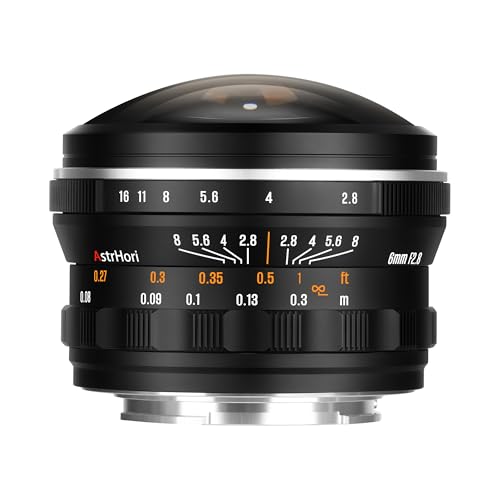
AstrHori’s 6mm fisheye lens provides a fast F2.8 aperture and a 220-degree circular diagonal field of view. This combination supports bright exposure in low-light settings while delivering pronounced circular framing and distortion ideal for artistic projects, concert photography, or astrophotography where a dome-like perspective enhances storytelling. The manual focus design enables precise control over close-ups and mid-range subjects, making it versatile for both stills and video.
Key considerations: The relatively wide focal length in a circular fisheye with manual focus makes it a strong creative tool for action and performance venues, as well as scenic cityscapes. Calibration is important to control edge sharpness and distortion toward the frame’s corners. The bright aperture aids in a variety of lighting scenarios, yet users should plan for post-processing to manage the signature distortion in final outputs.
S Erounder 37mm 0.25X Fisheye Lens Add-on

This 37mm add-on lens extends the kit with an additional wide fisheye capability. The 0.25X magnification broadens the field of view when attached to existing 37mm camera lenses, enabling a dramatic distortion and a wider perspective while keeping a detachable form factor. The two-part design includes a macro-capable element for close-up opportunities, enhancing versatility for macro photography as part of a single lens system. Its portability makes it a convenient accessory for travel-oriented shoots and quick-look experimentation.
Key considerations: It fits standard 37mm lenses, offering compatibility with many compact cameras and accessories. The dual-function design provides macro potential in addition to a wide fisheye effect, though image quality will vary with the attached lens and camera body. It is best used as a creative add-on rather than a primary lens for critical framing tasks.
Buying Guide: Key Purchase Considerations
- Camera compatibility: Verify mount type (M12, Micro Four Thirds, Sony E, etc.) and sensor size to ensure proper fit and image circle coverage.
- Field of view versus distortion: A 220-degree lens yields dramatic distortion and a near-panoramic effect. Consider the intended subject matter and whether you want circular frames or full-surround panoramas.
- Focusing and aperture: Lenses with manual focus or fixed focus behaviors require deliberate focusing decisions. Aperture values influence light gathering and depth of field, especially in low light or night scenes.
- Image quality and sensor support: Higher megapixel compatibility supports crisper details, but the lens’ optical design ultimately drives sharpness at the frame edges and corners.
- Portability and weight: Lighter lenses are ideal for drones or handheld use, whereas heavier options may require stabilization to prevent camera shake.
- Use case alignment: Choose based on creative aims—artistic vlogs, dramatic landscape panoramas, or immersive surveillance and industrial monitoring.
- Post-processing considerations: Expect distortion correction or stylized workflows. Some projects benefit from maintaining the distortion for stylistic reasons, while others need rectification for architectural accuracy.
Overall, 220-degree fisheye lenses enable bold, immersive visuals across genres. The right choice depends on your camera system, desired aesthetic, and whether you prioritize manual control, color rendition, or image resolution. Use cases range from experimental videography and concert photography to surveillance-style wide-area capture and industrial inspection, each benefiting from the expansive field of view these lenses provide.