Best 200x Zoom Lenses for Mobile Photography
Mobile macro work has never been more capable. A 200x zoom lens clip attaches to most smartphones, turning your device into a portable microscope for science, jewelry inspection, hobbying, and education. The best options combine glass optics, built‑in lighting, and a clip precision that stays secure during use. Below are five top picks that balance image quality, ease of use, and compatibility. Each option is designed to be app‑free, pocketable, and ready to deploy in the field or classroom.
| Product | Brand | Magnification | Notable Feature |
|---|---|---|---|
| APEXEL 200X Phone Microscope Lens | APEXEL | 200X | LEDs, CPL Filter, Universal Clip |
| DALYANGDA Nano Zoom 200x Phone Microscope | DALYANGDA | 200X | 12 Lighting Modes, CPL, Quick Alignment |
| MIAO LAB Nano Zoom 200X Kit | MIAO LAB | 200X | 3‑in‑1 Kit (100X/150X/200X), CPL, USB Rechargeable |
| Spider Farmer 200X Phone Microscope | Spider Farmer | 200X | LED + UV Lights, CPL, 15‑Second Setup |
| EZGHAR Nanozoom 200X | EZGHAR | 200X | App‑Free, CPL, Wide Compatibility |
APEXEL 200X Phone Microscope Lens

The APEXEL 200X phone microscope attaches in three simple steps and requires no app. It uses four-layer premium glass lenses to deliver true 200X magnification with a short working distance of about 6mm, ideal for close inspection of jewelry, coins, plant textures, and insect specimens. Built‑in six high‑intensity LED lights provide two brightness modes, while a CPL filter minimizes reflections and glare to reveal accurate color and detail. The clip design is universal, ensuring compatibility with most iPhone and Android models, making it a versatile pocket microscope for enthusiasts, students, and professionals alike.
Beyond imaging, the device is described as a mini pocket digital microscope suitable for hands‑on learning and fieldwork. Its rugged clip reduces wobble, and the glass quality helps minimize distortion at high zoom. Users should note that lighting needs vary with subject, and a stable hand or a small stand can improve focus at high magnifications. Overall, this option emphasizes portability and straightforward use without software dependencies, which is valuable for quick observations and demonstrations.
DALYANGDA Nano Zoom 200x Phone Microscope
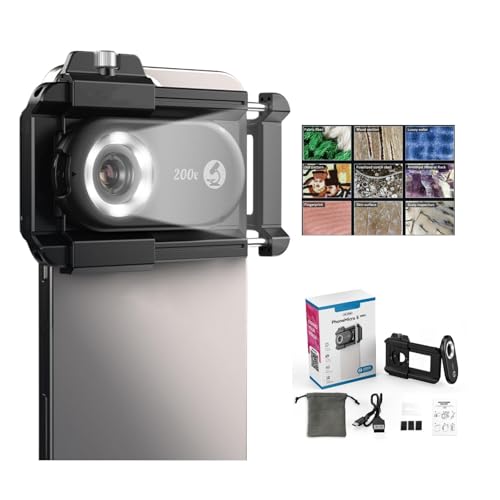
DALYANGDA’s Nano Zoom 200x emphasizes versatile lighting with a CPL lens to suppress reflections and deepen color saturation. It offers 12 distinct light modes, derived from three brightness levels, two color temperatures (warm and cool), and two lighting ranges (half‑circle and full‑circle). This combination enables clearer images in varied environments, from jewelry cases to mineral surfaces. The clip aligns quickly—about one second—providing a stable, non‑slip connection to most smartphones without requiring an app. The result is a practical micro‑world viewer that fits in a pocket and supports spontaneous explorations of texture, striations, and tiny details.
With broad compatibility and straightforward operation, this lens is well suited for students, hobbyists, and professionals who need reliable macro capability on the go. The product is designed to snap onto most phones easily, with a focus on minimal setup. Battery life is supported through the clip’s inherent USB connectivity, ensuring a quick recharge when needed. While it offers strong performance in bright or controlled lighting, users may want to pair it with a small stand for long observation sessions or detailed documentation.
MIAO LAB Nano Zoom 200X Kit

The MIAO LAB kit blends 100X, 150X, and 200X magnification into a single portable package, making it a flexible choice for learners who want staged zoom levels. The CPL lens reduces glare and ghosting during close‑up captures, while the microscope’s universal clamp attaches easily to most smartphones. A USB rechargeable battery supports more than five hours of continuous use, making it suitable for classrooms, field trips, or extended explorations. The kit emphasizes practical, app‑free operation and quick sharing of macro images, helping users document micro‑world observations with clarity.
Practical benefits include its compact footprint and rechargeable power, which reduces the need for frequent battery swaps. The 3‑in‑1 approach is especially appealing for parents and educators who want a single device covering multiple magnifications for diverse subjects—from leaf surfaces to mineral textures. However, higher magnifications can reduce depth of field, so stable handling or macro stands help in obtaining crisp images. Overall, the MIAO LAB kit provides a well‑rounded entry into 200X macro photography with flexible zoom options.
Spider Farmer 200X Phone Microscope

Spider Farmer’s model emphasizes a comprehensive lighting setup with LED and UV lights, plus a CPL polarizing filter that minimizes glare for trichomes, leaf surfaces, and jewelry textures. The 200X magnification reveals fine cellular features and surface details with high fidelity. Its portability — weighing about 1.7 ounces — enables quick field checks and in‑hand inspections, while the three brightness levels and warm/cool tone options help optimize illumination for varied subjects. The CPL reduces reflections, producing truer color and reduced ghosting in complex specimens.
Setup is designed for speed, with a claimed 15‑second assembly that suits on‑the‑spot analysis. The lightweight design makes it easy to clip onto most smartphones, though users should ensure the clip remains stable on larger devices. This option is particularly compelling for gardeners, coin and jewelry hobbyists, and educators who require reliable lighting tools in a compact form factor. Its UV capability adds versatility for certain materials and inspection tasks beyond standard macro photography.
EZGHAR Nanozoom 200x

EZGHAR’s Nanozoom focuses on simplicity and broad compatibility. It delivers true 200X magnification with a CPL lens and LED illumination, all in a compact, clip‑on design. The product emphasizes app‑free use, allowing immediate photo capture and sharing without downloading software. Its universal clip aims to fit a wide range of smartphones, including recent iPhone models, making it a pragmatic option for students and casual researchers who want a straightforward, device‑agnostic macro tool. The build lightens the load for travelers who need a dependable micro‑viewing accessory without extra steps.
While the emphasis is on ease of use and compatibility, users should consider depth of field at higher magnifications and the quality of the glass lamination. A good practice is to support the subject with a stable surface or small stand to maximize sharpness at 200X. Overall, EZGHAR provides a no‑frills, wide‑compatibility macro attachment that suits learning environments and quick observations in the field.
Buying Guide
Key purchase considerations
When selecting a 200x clip‑on lens, prioritize true 200X magnification with high‑quality optics. Glass lenses with multi‑coating tend to deliver crisper details and less distortion than resin alternatives. Lighting matters: models with built‑in LEDs plus a CPL filter reduce glare and improve color fidelity. Some lenses add UV light for specific materials like coins and plant surfaces. Clip design should be universal, stable, and easy to attach to most phones without obstructing cameras or flash. Battery life matters if the device is USB rechargeable, enabling longer sessions on the go.
Lighting and optics
Effective illumination is critical at high magnifications. LED brightness, color temperature options, and CPL filtering affect image clarity and color accuracy. UV lighting can reveal features invisible under visible light for certain materials. A lens with several lighting modes offers flexibility across subjects, from glossy jewelry to textured leaves. For best results, practice controlling distance and focus, as depth of field narrows at 200X and even small movements affect sharpness.
Clip design and device compatibility
Look for a universal clip that provides firm grip without scratching devices. Some clips include adjustable tension or padding to protect phones with slim edges. Compatibility across iPhone and Android devices varies; ensure the clip aligns with your camera position so you don’t block sensors or the flash. A low‑profile design helps with portability, while a quick‑release mechanism can aid in rapid transitions between shots or subjects.
Power and portability
Many 200x lenses rely on built‑in rechargeable batteries or USB power. Consider how long the unit can operate between charges and the type of charger required. Pocket‑sized designs are convenient for travel and fieldwork, but extra features like UV LEDs or CPL filters may add weight. If you frequently observe outdoors or in classrooms, prioritize a model with solid build quality and a reliable clip that stays in place on varied phone sizes.
Use cases and value
Applications range from education and hobbyist exploration to professional inspection of jewelry, coins, stamps, and plant textures. A flexible kit with multiple magnifications provides greater value for families and schools, while single‑purpose lenses may suffice for quick checks. Consider whether you prefer a standalone 200X lens or a 3‑in‑1 kit offering 100X, 150X, and 200X. Budget, durability, and warranty are practical factors that influence long‑term satisfaction.
Quick feature comparison of top picks
| Brand | Magnification | Lighting | Special Filters | |
|---|---|---|---|---|
| APEXEL | 200X | LED, 2 modes | CPL | App‑free |
| DALYANGDA | 200X | 12 modes (LED) | CPL | App‑free |
| MIAO LAB | 200X | LED | CPL | App‑free |
| Spider Farmer | 200X | LED + UV | CPL | App‑free |
| EZGHAR | 200X | LED | CPL | App‑free |
In selecting among these lenses, consider your primary subject matter (jewelry, plant surfaces, electronics, or minerals), how much you value quick setup versus adjustable lighting, and whether you need a single magnification or a flexible kit. All five options provide app‑free operation, which is advantageous for straightforward capture and sharing. If you anticipate frequent field use, prioritize models with robust clip design and longer battery life. For classroom or lab settings, a kit offering multiple magnifications and reliable LED/CPL performance may provide the best overall value.