Best 2-Inch Moon Filters for Lunar Observing and Astrophotography
Finding the right 2-inch moon filter can improve contrast, reduce glare, and reveal crater details on the Moon and nearby planets. This guide focuses on high-quality 2″ filters that help observers at home, in clubs, or in field settings achieve crisper lunar images without sacrificing color fidelity. Each selection below is evaluated for light transmission, glare reduction, and ease of use with standard 2″ eyepieces and telescope setups.
| Product | Brand | Type | Key Benefit |
|---|---|---|---|
| SVBONY SV128 2″ Moon Filter | SVBONY | Variable Polarizing Moon Filter | Adjustable brightness and enhanced contrast |
| SVBONY 2″ Telescope Moon Filter | SVBONY | Neutral Moon Filter | Broad transmission with reduced glare |
| Alstar 2″ Moon Filter ND Kit | A ALSTAR | ND Filter Set (0.3, 0.6, 0.9) | Multiple density options for bright objects |
| Astromania 2″ ND96-0.9 | Astromania | Neutral Density Filter | 13% light transmission for improved crater detail |
| Astromania 2″ ND96-0.6 | Astromania | Neutral Density Filter | 25% light transmission with natural color |
SVBONY SV128 2″ Moon Filter

The SV128 combines two polarizing filters in an aluminum housing, enabling a rotating element to adjust image brightness. This variable polarizing approach helps prevent overexposure of bright lunar features and reduces glare while sharpening contrast and saturation of observed objects. Its brightness control is useful during moments of high sky brightness or when observing near the terminator, where detail is most apparent. The two-filter design supports fine-tuning light transmission from roughly 1% to 40%, allowing precise, image-wide brightness adjustments without shifting color balance.
SVBONY 2″ Telescope Moon Filter

This moon filter is a versatile all-rounder designed for lunar and planetary observations. It delivers a broad spectrum of light transmission, avoiding excessive darkening while still reducing background sky glow. By filtering out selective wavelengths associated with street lighting and other artificial sources, it helps bring out lunar surface details with improved definition. The result is a balanced view that preserves natural color while increasing crater visibility against the Moon’s terrain and nearby planetary features.
Alstar 2″ Moon Filter ND Kit
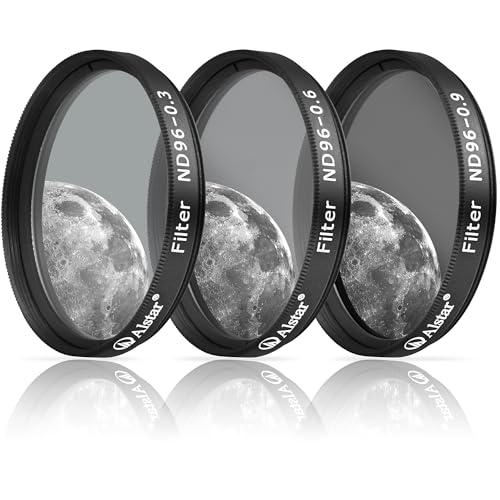
The Alstar ND filter kit provides a 3-filter set (ND0.3, ND0.6, ND0.9), which reduces overall brightness and glare while preserving color balance. These neutral density filters are compatible with standard 2″ eyepieces, making them suitable for observing the Moon, binary star systems, and other bright solar system objects. The ND filters maintain uniform transmission across the visible spectrum, which helps ensure natural looking lunar surface tones and consistent contrast across different filter densities.
Astromania 2″ ND96-0.9

The Astromania ND96-0.9 filter transmits about 13% of visible light, reducing moon glare and enhancing crater detail. It threads directly into the 2″ barrel of the eyepiece, making installation straightforward for most standard telescopes. The neutral density design ensures minimal color shift, preserving natural lunar tones while enabling observers to reveal surface textures and features that can fade under brighter conditions or in light-polluted skies.
Astromania 2″ ND96-0.6
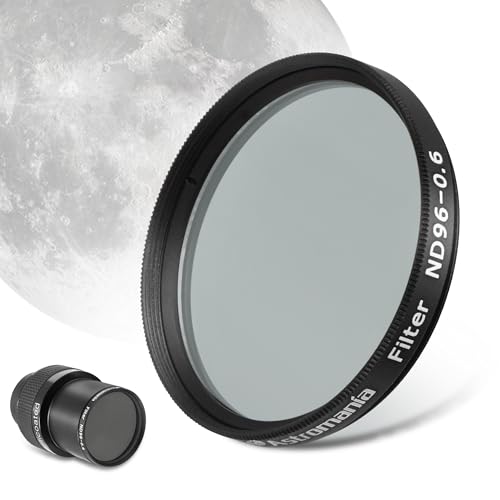
This 2″ ND96-0.6 filter offers 25% light transmission, providing a balance between brightness reduction and detail preservation. It is designed to keep natural lunar colors intact while enhancing the visibility of craters and maria against the Moon’s illuminated surface. The filter’s neutral transmission makes it a reliable option for observers in moderately bright environments who want to maintain a natural look without sacrificing contrast or resolution.
Astromania 2″ Moon Skyglow Filter

The Astromania Moon Skyglow filter is designed to transmit a broad band of the visual spectrum while absorbing more light at longer wavelengths. This enhances contrast by reducing skyglow, making it useful in light-polluted areas. It helps observers maintain a bright lunar view with better definition of craters and surface features, especially when observing from urban rooftops or suburban skies. The filter is mounted in a sturdy housing and is compatible with 2″ eyepieces.
Buying Guide: Key Purchase Considerations
- Filter type: ND filters reduce brightness uniformly, preserving color; polarizing filters allow brightness adjustment but may complicate setup; consider your observing goals when choosing ND, UV/skyglow, or variable options.
- Light transmission: For the Moon, lower transmissions (e.g., 13% to 25%) often yield better crater detail and contrast; higher values are useful in very dark skies or for wider field viewing.
- Color fidelity: Neutral density filters should preserve natural Moon colors; avoid filters that introduce color shifts unless a specific color balance is desired for scientific or astrophotography purposes.
- Mounting compatibility: Ensure the filter is 2″ (50.8 mm) and threads or fits standard eyepieces without adapters. Aluminum or metal housings with robust construction extend filter life in field use.
- Density range and pairing: A kit offering multiple ND densities (e.g., 0.3, 0.6, 0.9) provides flexibility for varying sky conditions, telescope apertures, and observing targets beyond the Moon, including brighter planets and double stars.
- Durability and coatings: Multi-coated optics reduce reflections and ensure smooth light transmission. Look for durable frames and scratch-resistant coatings for frequent handling.
- Budget and scope: If you observe mainly the Moon from light-polluted locations, a single high-quality moon filter with adjustable brightness could be sufficient. For astrophotography or varied targets, a set with multiple densities adds versatility.
When assembling a collection of 2″ moon filters, consider prioritizing a reliable baseline option (neutral density in a single fixed density or a small ND kit) plus an additional variable or specialized filter if your observing site often presents challenging lighting. This approach supports consistent lunar detail while remaining adaptable for planetary views or brighter deep-sky objects under clear sky conditions.