Best 180 Degree Fisheye Lens for Wide Angle Views
180 degree fisheye lenses unlock dramatic, all-encompassing perspectives in security, streaming, and DIY imaging projects. This guide highlights five top Amazon options that balance field of view, image clarity, and versatility across cameras, webcams, and Raspberry Pi setups. Whether you’re securing a home or building a panoramic sensor, the right fisheye solution can simplify coverage and reduce blind spots. Read on to compare lenses and bundled cameras designed for different systems, from analog CCTV to USB webcams and Pi integrations.
| Product | Brand | Key Use | Notable Feature |
|---|---|---|---|
| DCSEC 180 Degree Surveillance Camera | DCSEC | Security Surveillance | Analog 4 in 1 output; 1.7mm fisheye; IR night vision up to 30 ft |
| Dahszhi 180 Degree Fisheye Lens | Dahszhi | CCTV And IP Cameras | HD 5MP; rugged metal and glass; IR block lens |
| Arducam 180 Degree Fisheye M12 Lens Bundle | Arducam | Raspberry Pi HQ Camera | 180° HFOV; M12 mount; tripod and cable included |
| IFWATER HDMI 4K Webcam With 180 Degree Fisheye | IFWATER | Live streaming And Teaching | 4K HDMI/USB output; dual-lens compatibility; plug-and-play |
| Hotpet 5MP USB Camera With 180 Degree Fisheye | Hotpet | Machine Vision / Webcams | 5MP resolution; aluminum case; USB 2.0; 180° view |
DCSEC 180 Degree Surveillance Camera

The DCSEC 180 Degree Surveillance Camera pairs a 1/2.7 inch color CMOS sensor with 2.0 megapixel resolution that delivers clear 1080P HD imagery. It supports four video outputs—TVI, AHD, CVI, and 960H CVBS—allowing flexible integration with different DVRs and existing security systems. Its 1.7mm fisheye lens covers a full 180 degrees, making it well suited for room-scale monitoring, entrances, and perimeters. Night visibility comes from 15 IR LEDs capable of reaching about 30 feet in low light. A note for installers: the default output is Analog CVBS (not HD). To achieve 1080P HD on compatible DVRs, switch to the matching video mode via the joystick according to your DVR type. The camera lacks PTZ functionality, keeping a fixed, wide field of view throughout operation.
In terms of durability and installation, this model is designed for both indoor and outdoor contexts, with weather considerations typical of simple dome cameras. The all-in-one cabling and remote-accessible video modes reduce setup complexity for security teams. If you need a cost-efficient, wide-angle entry into 180-degree surveillance that supports common analog-to-digital pathways, this DCSEC option provides a solid baseline performance with straightforward night monitoring capabilities.
Dahszhi 180 Degree Fisheye Lens

The Dahszhi fisheye lens concentrates on a truly broad panorama with an 180-degree field of view. The lens promises a single, unified capture of wide scenes, potentially reducing the need for multiple cameras or repositioning. It’s paired with a 5-megapixel resolution for sharper detail and color accuracy, supporting clearer identification and scene analysis. The design emphasizes ruggedness, using hard glass and tough metal to withstand daily handling in CCTV and IP camera setups. The lens is described as an “IR block” model, which helps minimize IR reflections and glare in mixed-light environments. This lens is ideal for installations where a wide, continuous view is essential and physical durability is a priority.
Users should consider lens compatibility with their existing housings and mounts, as well as the sensor pairing in their cameras. While the Dahszhi lens delivers a broad field of view and sturdy construction, some distortion is typical with ultra-wide fisheyes. For best results, pair it with cameras that offer appropriate processing for de-warping or with software capable of real-time panorama correction. This option suits surveillance roles, storefronts, and outdoor monitoring where a single 180-degree capture helps reduce blind spots without needing to stitch multiple feeds.
Arducam 180 Degree Fisheye M12 Lens Bundle

The Arducam bundle targets Raspberry Pi users and other embedded platforms seeking a compact, high-coverage lens solution. It includes a 180-degree fisheye M12 lens designed for compatibility with the Raspberry Pi HQ Camera module, offering a wide horizontal field of view (HFOV) ideal for panoramic capture. The kit includes a portable tripod stand and a short camera cable, facilitating quick prototyping and deployment in tabletop, desk, or small-enclosure scenarios. The M12 mount is a common, cost-effective choice for hobbyists and education markets, enabling easy experimentation with ultra-wide viewpoints while keeping the footprint small and integrating smoothly with Pi-based imaging projects.
When evaluating this bundle, consider the Pi camera ecosystem and any additional optics you might want to pair with the HQ camera board. The 180-degree FOV can introduce significant edge distortion, so plan for post-processing or de-warping methods if you need undistorted, usable imagery for measurements or detailed analysis. The optional tripod and short cable add convenience for demonstrations or dynamic testing environments without committing to a permanent install.
IFWATER HDMI 4K Webcam With 180 Degree Fisheye
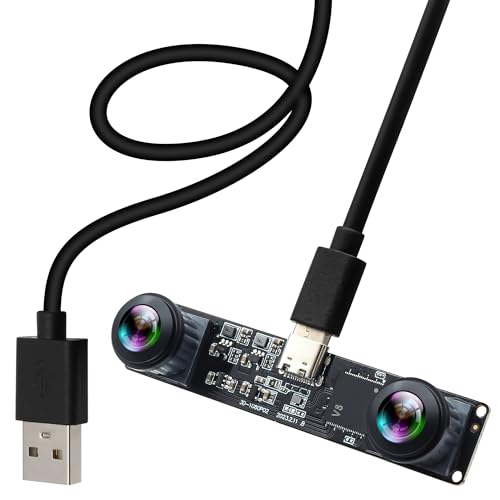
The IFWATER HDMI 4K webcam is designed for high-resolution streaming and teaching scenarios, offering simultaneous HDMI and USB outputs for flexible display and recording options. Its 180-degree fisheye lens (1.56mm) provides a broad field of view, supported by a 4K capture pipeline up to 3840×2160 at 30fps via MJPEG or H.264 encoding. The device supports a dual-lens approach with synchronized imaging, enabling precise depth capture and fast motion representation. USB 2.0 plug-and-play ensures quick setup on Windows, macOS, Linux, and Android, making it suitable for classroom demonstrations, live streams, and remote collaboration, all without extensive driver installation.
Key considerations include bandwidth requirements and your system’s HDMI capture capabilities. While the 4K output delivers sharp images, ensure your host hardware and network can handle high bitrates. The 180-degree field of view is beneficial for room-wide demonstrations or boardroom presentations, but expect some distortion toward the edges, which may require software correction. This option is well suited for educators, content creators, and live event hosts who need a capable, plug-and-play webcam with broad compatibility.
Hotpet 5MP USB Camera With 180 Degree Fisheye

The Hotpet USB camera offers a 5MP sensor with a resolution up to 2592×1944 at 15 frames per second, delivering crisp stills and reasonable video quality for surveillance and robotics applications. The 180-degree fisheye lens expands the scene, enabling broad coverage of work cells or conference rooms. The camera is described as plug-and-play with USB 2.0 compatibility and comes in a robust aluminum enclosure, which helps with heat dissipation and durability in industrial environments. A 3-meter cable supports flexible installation in lab benches or machine-vision setups where USB connectivity is convenient and easy to route.
When selecting this camera, balance the 15fps limit at 5MP with your real-time needs. For static or slow-moving scenes, the resolution payoff is strong, while fast motion may necessitate frame- rate considerations or post-processing to reduce motion blur. This model is suitable for educational demonstrations, prototyping, and small-scale industrial sensing where a straightforward USB webcam can play a pivotal role in panoramic imaging pipelines.
Buying Guide
Choosing a 180-degree fisheye solution requires aligning the lens or camera with your system, environment, and data workflow. Here are key purchase considerations and practical comparisons to help you decide:
- Field of View vs Distortion: A true 180-degree lens covers a broad area, but distortion at the edges is common. Some options include de-warping features or allow easy post-processing to produce usable panoramic images. Consider whether your use case requires real-time correction or post-production processing.
- Sensor And Resolution: Higher megapixel counts (5MP or more) improve detail, but demand more bandwidth and processing power. For security footage, 1080P or higher is beneficial; for Pi-based projects, lens performance and compatibility may trump ultra-high resolution.
- Video Interfaces: Analog (TVI/AHD/CVI) cameras work with older DVRs, while USB and HDMI cameras fit modern PCs and streaming setups. If you plan to broadcast or live-stream, USB/HDMI options with plug-and-play setup simplify deployment.
- Low Light And IR Performance: Models with infrared LEDs or IR-block coatings handle night scenes and glare differently. If outdoor surveillance or low-light interiors are a core requirement, verify IR range and lens coatings to minimize flare.
- Mounting And Form Factor: Lenses designed for CCTV housings, M12 mounts, or Pi camera boards require compatible mounts. Consider whether you need a tripod, a fixed mount, or a compact, modular setup for prototyping and testing.
- System Compatibility: Ensure the chosen lens or camera integrates with your DVR, NVR, Pi board, or computer. Analog cameras may require DVRs with matching input formats, while USB/HDMI devices depend on computer drivers and software support.
- Post-Processing and Dewarping: If undistorted panoramas are essential, plan for software that can apply dewarping in real time or offline. This is particularly important for mapping, measurements, or analytical reviews.
- Durability And Exposure: Outdoor deployments benefit from rugged housings and weather resistance. For indoor installations, a compact, metal or aluminum body can still provide a robust service life.
In summary, the best 180-degree fisheye solution balances field of view with image quality, compatibility with your existing hardware, and the workflow you plan to support. For security-centric projects, prioritize cameras with reliable low-light performance and flexible video outputs. For DIY and Pi-based projects, prioritize mount compatibility, lenses with standard M12 or camera board compatibility, and straightforward software support. Consider the total cost of ownership, including potential dewarping software, mounting hardware, and power or data cabling, to determine which option offers the best overall value for your application.