Best 100-400mm Lenses for Wildlife and Sports Photography
The 100-400mm zoom range offers a versatile reach for outdoor subjects without adding excessive weight. This guide highlights top 100-400mm options from Canon, Nikon, and compatible third-party accessories to help you compare performance, stabilization, and autofocus. Each entry profiles key strengths and what to expect in real-world shooting scenarios, from fast action to distant wildlife. Use the buying guide at the end to compare body integration, stabilization, and handling in varying conditions.
| Product | Brand | Type | Key Benefit | Typical Use |
|---|---|---|---|---|
| Canon RF100-400mm F5.6-8 IS USM | Canon | RF-mount telephoto zoom | Compact, lightweight with up to 5.5 stops stabilization | Wildlife, sports, travel |
| Canon RF 100-400mm f/5.6-8 is USM (Kit) | Canon | RF-mount telephoto zoom | Includes UV filter and lens cap keeper; solid feature set | Wildlife, travel, beginner-to-intermediate shooters |
| Nikon NIKKOR Z 100-400mm VR S | Nikon | Z-mount telephoto zoom | 5-axis stabilization on full-frame Z bodies; fast AF | Wildlife, sports on Z mirrorless |
| Canon RF 100-400mm f/5.6-8 IS USM (Lightweight Bundle) | Canon | RF-mount telephoto zoom | Travel-friendly kit with extra accessories | Wildlife, outdoor sports |
| Canon EF 100-400mm f/4.5-5.6L II USM | Canon | EF-mount L-series telephoto zoom | High image quality with chromatic correction and strong stabilization | Sports and wildlife on EF bodies |
Canon RF100-400mm F5.6-8 IS USM

Canon’s RF100-400mm F5.6-8 IS USM is a compact telephoto zoom designed for EOS R system bodies. It delivers a versatile reach from 100mm to 400mm, balancing reach with manageable weight for handheld shooting. The Optical Image Stabilizer provides up to 5.5 stops of shake correction, and up to 6 stops when paired with IBIS-enabled EOS R bodies. The Nano USM autofocus system combines speed and quiet operation, making it suitable for wildlife, sports, and travel photography. This lens is ideal when you need long reach without carrying heavy gear.
Canon RF 100-400mm f/5.6-8 IS USM Lens Kit

This kit bundles the RF 100-400mm with a 67mm UV filter and a Lens Cap Keeper, offering protection and ease of use on the go. The RF mount supports full-frame EOS R bodies, with features like a customizable control ring and a rounded 9-blade diaphragm. Its optical design includes one UD element and one aspherical element, along with Canon’s Super Spectra Coating to reduce ghosting and flare. It’s a practical option for travelers who want a complete, ready-to-shoot package.
Nikon NIKKOR Z 100-400mm VR S

The Nikon Z 100-400mm VR S is designed for Nikon Z mirrorless cameras, offering a strong 100-400mm range with robust stabilization. It provides up to 5.5 stops of VR on FX-format Z cameras and efficient 2-axis VR on certain DX-format bodies. Two high-speed STM motors enable smooth, near-silent autofocus with edge-to-edge sharpness and minimal color fringing. This lens excels for wildlife and sports on Nikon’s Z system, especially when paired with teleconverters for added reach.
Canon RF 100-400mm f/5.6-8 IS USM Lens Bundle

Canon’s bundle combines the RF 100-400mm f/5.6-8 IS USM with a 64GB memory card and a camera bag. The lens balances reach with portability and includes an ultra-low dispersion element to reduce chromatic aberration along the full zoom range. It also employs Canon’s Nano USM for precise, quiet AF performance in dynamic outdoor scenes. This package is well-suited to photographers who want a complete travel-ready setup for wildlife, sports, and travel photography.
Canon EF 100-400mm f/4.5-5.6L II USM (Renewed)
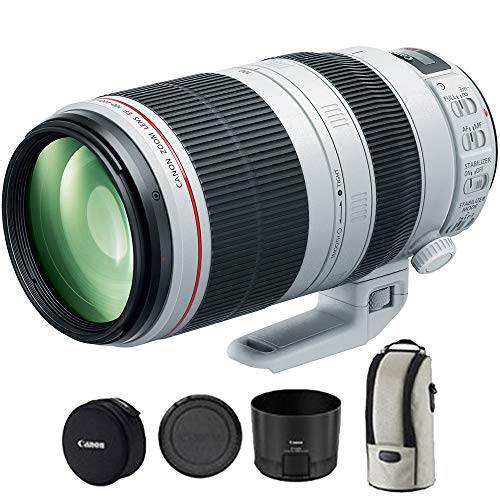
The EF 100-400mm f/4.5-5.6L II USM is a legacy L-series telephoto zoom with strong image quality, great for Canon DSLR users needing reliable reach. It features a fluorite and a super UD lens element to minimize chromatic aberration, and it offers up to four shutter speed stops of stabilization per CIPA standards when paired with compatible bodies. While designed for older EOS systems, it remains a benchmark for optical performance in the 100-400mm class.
Canon EF 100-400mm f/4.5-5.6L is II USM Lens (Lens Only)
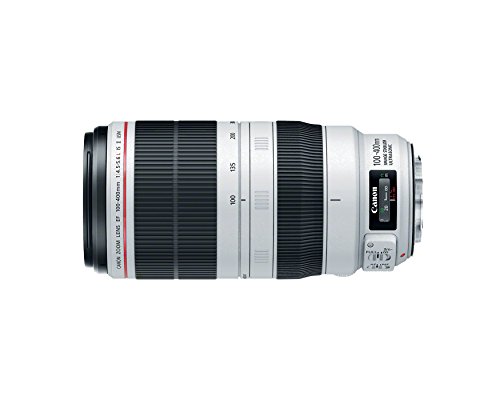
Another staple option in Canon’s EF lineup, the EF 100-400mm II f/4.5-5.6L USM emphasizes a robust build with a rotation-type zoom ring for precise composition and a balanced handhold. Its 100-400mm range is well-suited for fieldwork, offering sharp results across the zoom span and a design focused on durability in wildlife and sports contexts. It remains a go-to choice for Canon DSLR shooters needing reliable reach.
Buying Guide: Key Considerations For 100-400mm Lenses
- Camera compatibility: RF-mount and EF-mount options behave differently with bodies and stabilization. For mirrorless systems (Canon RF, Nikon Z), leveraging in-body or lens stabilization can maximize performance.
- Image stabilization: Look for lens stabilization beats (2-6 stops) and how it pairs with your camera’s IBIS or VR/IBIS combination to achieve sharp handheld shots at longer focal lengths.
- Autofocus speed and tracking: Fast, reliable AF is essential for moving subjects. Nano USM, Dual Pixel, and STM technologies influence speed, noise, and accuracy in action shooting.
- Weight and balance: Lighter lenses improve handheld shooting comfort, especially during long sessions. Consider the total system weight including camera body and accessories.
- Optical quality: Elements like UD and aspherical designs reduce chromatic aberration and distortion. Coatings further minimize flare in bright outdoor scenes.
- Weather sealing and durability: Outdoor photography benefits from rugged builds and weather sealing, especially for wildlife and aviation subjects.
- Mount compatibility: If switching between Canon, Nikon, or Sony ecosystems, ensure the lens you choose aligns with your camera’s mount and available teleconverters.
- Value and accessories: Bundles with filters, caps, and bags offer convenience and protection. Reconditioned options may save money but assess warranty terms and condition.
- End-use scenarios: For wildlife, prioritize reach, stabilization, and AF performance. For sports, focus on speed and tracking across rapid motion.